Share
Rethinking Uganda’s Political Reality
Uganda’s constitutional history is often presented as a story of principle, reform, and institutional maturity. Yet, beneath that narrative lies a more pragmatic—and less comfortable—truth: constitutions are not static moral documents; they are instruments shaped, and reshaped, by power.
When President Yoweri Museveni and his contemporaries introduced presidential term limits and age limits, the justification was clear. These provisions were designed, in part, to prevent the possible return of former President Milton Obote, who, despite his controversial legacy, still commanded significant support. At the time, the fear of his political resurgence was real.
However, history has since taken a different course. Once the perceived threat had faded, the same constitutional safeguards were systematically removed. The country witnessed the scrapping of term limits in 2005, followed by the removal of the presidential age limit in 2017. What was once presented as a protective measure for democracy became, in time, an obstacle to political continuity—and was accordingly dismantled.
This evolution invites a sobering reflection: laws are often not neutral. They are crafted, interpreted, and amended within the context of prevailing political interests.
The Sovereignty Bill
Recent political developments reinforce this pattern. Opposition figures, notably Robert Kyagulanyi (Bobi Wine), have increasingly mobilised support beyond Uganda’s borders, particularly within the diaspora. This external engagement is not incidental. Modern politics, especially in competitive environments, is resource-intensive. Financial backing, networks, and influence are indispensable to both winning elections and sustaining political relevance.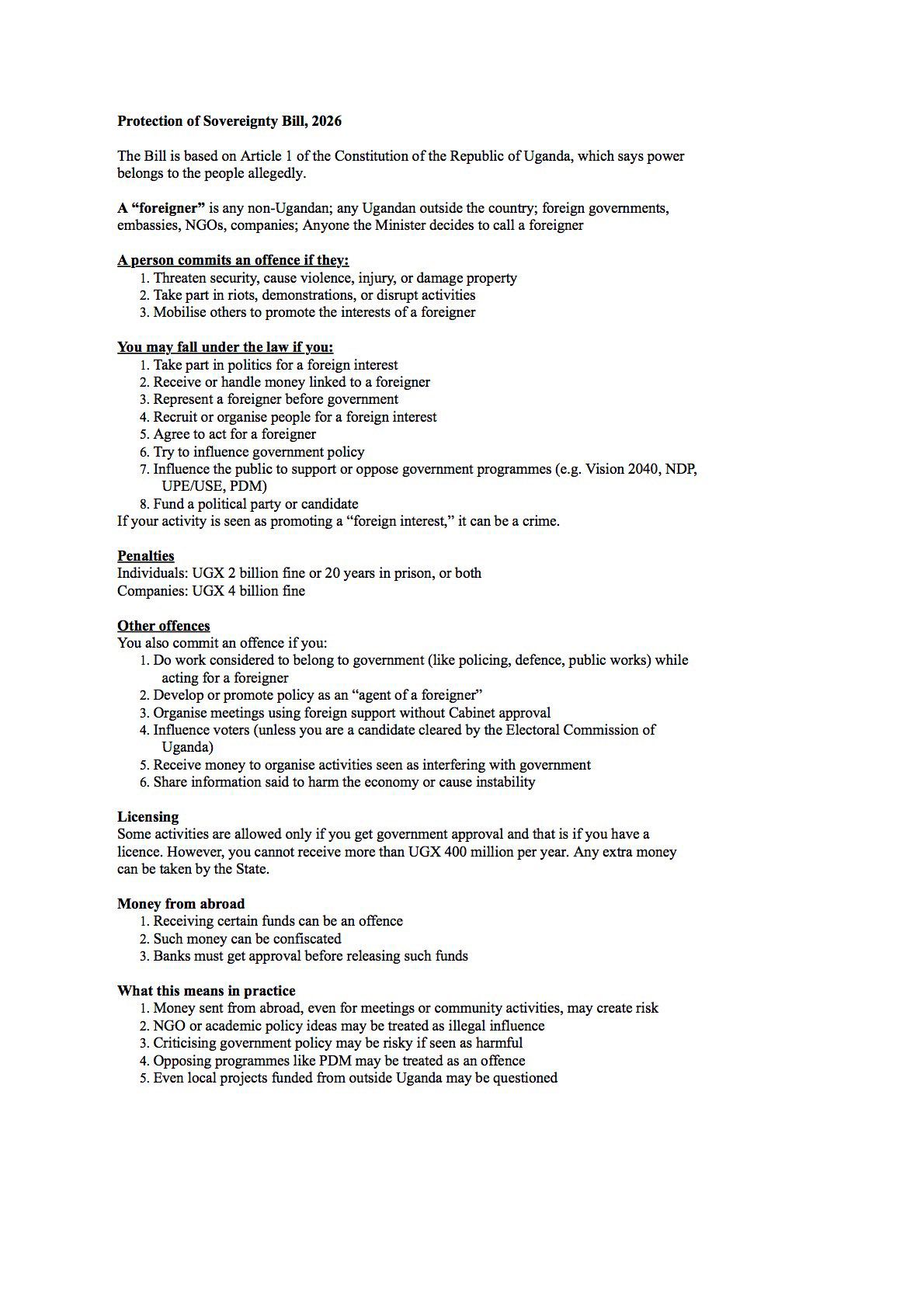
In this context, legislative initiatives such as the proposed Sovereignty Bill should not be viewed in isolation. Rather, they can be interpreted as part of a broader political calculus—one that seeks to manage influence, control political space, and safeguard incumbency.
Consider a seemingly unrelated but revealing example: the ability of diaspora communities to mobilise significant financial contributions within a short time. Reports of tens of millions of shillings raised in days for community causes (Like the recent Mufumbiro's wife buriral) illustrate the growing economic and social influence of Ugandans abroad. In political terms, such capacity cannot be ignored.
The broader lesson is clear. Political systems are not driven solely by ideals; they are shaped by interests—particularly those of individuals and groups with access to power and resources. Laws, in many cases, function as mechanisms through which these interests are protected and sustained.
This helps explain the longevity of Uganda’s current political order. President Museveni’s extended tenure is not merely a product of chance or circumstance. It reflects a calculated approach to governance—one that anticipates threats, adapts to changing realities, and does not underestimate emerging actors.
Yet, public discourse often fails to engage with this complexity. Moments such as the “Togikwatako” debates, which strongly opposed constitutional amendments, were driven by a belief in the sanctity of the Constitution as an untouchable document. While this perspective is understandable, it risks overlooking a fundamental reality: constitutions, like all human institutions, are subject to change when those with the authority to do so deem it necessary.
This brings us to a deeper philosophical distinction—between what might be termed “objective realities” and “constructed realities.”
Objective realities are universal and immutable. Human beings require oxygen to survive. They require food and water. These truths transcend culture, politics, and belief systems.
Constructed realities, on the other hand, are products of human agreement and social organisation. Laws, governments, and constitutions fall into this category. They exist because societies create and sustain them—and they can be altered when circumstances or interests demand.
Recognising this distinction does not diminish the importance of laws or institutions. Rather, it encourages a more grounded understanding of how they function in practice. It shifts the conversation from idealism to realism, from what should be to what is.
For Uganda, this perspective is particularly important. It challenges citizens to move beyond surface-level interpretations of political events and to critically examine the underlying dynamics of power, interest, and influence.
Ultimately, the question is not whether laws should change—they inevitably will. The more pressing question is: in whose interest are these changes made, and at what cost to the broader society?
Until this question is confronted with honesty and clarity, the cycle of amendment, adaptation, and contestation will continue—largely misunderstood, and often unchallenged.
Torch Media Africa



