Share
When Elon Musk, the world’s richest man, remarked that “Whoever said money can’t bring happiness really knew what they were talking about,” the statement struck many as paradoxical. Coming from a man whose wealth exceeds the GDP of some nations, it sounded less like irony and more like a confession. Yet beneath the simplicity of the remark lies a deeper, uncomfortable truth about the human condition—one that money exposes rather than resolves.
Modern society clings stubbornly to the pursuit of happiness, as though it were a permanent state waiting to be unlocked by the right income, relationship, or achievement. But what if happiness, as we commonly understand it, does not exist at all?
What we experience, at best, are fleeting moments of joy—brief emotional peaks comparable to laughter sparked by a well-told joke, the warmth of companionship, or the satisfaction of a small victory. These moments are real, meaningful, and often beautiful. But they are temporary. They arrive, linger briefly, and then dissolve, leaving us once again in our default state.
That default state is not happiness—it is unease.
Human existence is defined by insecurity. From birth, we are subject to forces we cannot control: illness, loss, ageing, failure, and death. This underlying uncertainty creates a constant, low-grade discomfort. Some experience it more intensely than others; some are shielded from its sharpest edges by privilege or fortune. But no one escapes it entirely.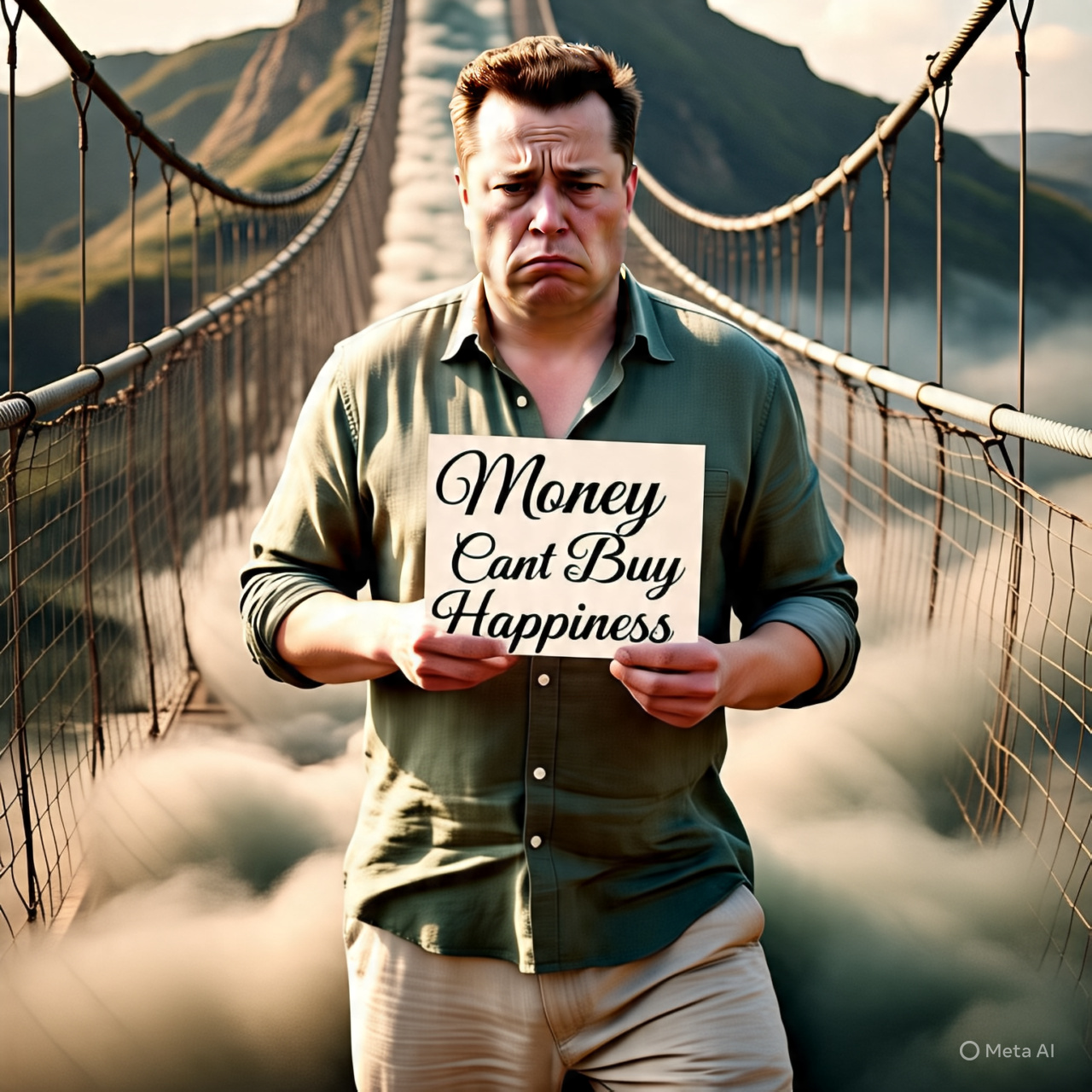
In this sense, misery—or perhaps restlessness—is our natural condition. Wealth does not abolish it; it merely changes its texture. Poverty brings anxiety over survival, while wealth introduces a different unease: fear of loss, meaninglessness, isolation, and the pressure to justify one’s excess. To be rich and miserable is not an anomaly; it is often the logical outcome of discovering that the ultimate prize does not deliver the promised fulfillment.
This is where money’s great illusion lies. Money can purchase comfort, convenience, security buffers, and even pleasure. It can reduce certain forms of suffering, and this should not be understated. But it cannot deliver lasting satisfaction. Satisfaction implies finality—a sense of arrival. Human desire, however, is endless. The moment one goal is achieved, another emerges. What we seek is not wealth itself, but security and contentment—states that remain perpetually out of reach.
Musk’s statement resonates because it strips away the lie we are taught from childhood: that happiness is an attainable destination. It is not. What is attainable are moments—moments of joy, peace, connection, and purpose. The tragedy occurs when we mistake these moments for permanent states and structure our lives around chasing an illusion.
Perhaps the more honest question is not how to be happy, but how to live well despite our inherent dissatisfaction. That may involve cultivating meaning, accepting uncertainty, building relationships, serving causes larger than ourselves, and learning to sit with discomfort rather than fleeing it.
In that light, Musk’s words are not cynical—they are sobering. Money does not buy happiness because happiness, as we imagine it, was never for sale. What remains is the task of living consciously, knowing that insecurity is inevitable, joy is temporary, and meaning—unlike happiness—is something we must actively construct. And maybe that, uncomfortable as it sounds, is the closest we come to peace.
Torch Media Africa



