Written By | Staff Writer
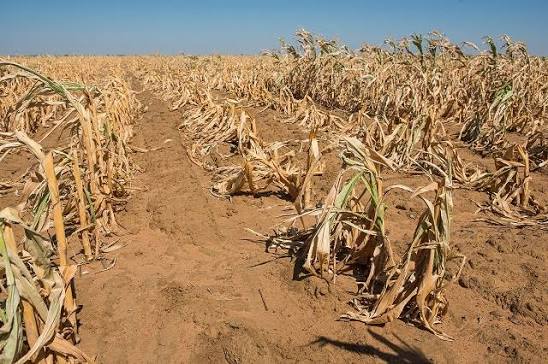
A nationwide dry spell has wiped out a planting season across Uganda
Feature
Sulaiman Minani spent years building his one-and-a-half acres of coffee at Bisanje Ward in Masaka City into something that could pay school fees. This month he is walking through it counting dead trees. The prolonged dry spell that has gripped much of Uganda since the middle of the year has, in his words, destroyed the plantation and with it a major source of household income.
His is one voice in a nationwide tally that has been building for weeks and that finally landed in print on 12 September, when a survey of farming districts published by The Independent found farmers in Greater Masaka, Greater Luwero, Isingiro, Nakasongola, Buliisa and Kumi all counting the same losses: crops that dried before harvest, water sources that disappeared, livestock losing condition, and milk yields falling by half or more.
What makes this dry spell different from ordinary seasonal variability is not only its geographic reach. It is that it has arrived after three years in which the state actively pushed smallholders to borrow, plant more, and treat farming as a business. The crops have failed. The loans have not.
A failure that crossed the agro-ecological zones
Uganda's droughts usually have a geography. Karamoja and the north-east dry out; the Lake Victoria crescent and the western highlands stay wet enough to carry the national food basket. That pattern did not hold this year.
In Greater Masaka — the heart of central Uganda's robusta belt — coffee and food crops have been badly hit. Salim Bukenya, a coffee farmer from Kannabukuliro Cell in Masaka City, says losses from dried coffee have left several households unable to pay school fees or meet basic needs. State Minister for Local Government Justine Nameere visited affected gardens at Kiziba in Masaka City this week, an indication of how far up the political ladder the distress has travelled.
In Greater Luwero, the damage followed a cruel sequence. Light showers fell in August, farmers read them as the onset of the second season and planted maize and beans, and then the rains stopped. Luwero District Agriculture Officer Wilberforce Ssemigga says Kamira, Kikyusa, Butuntumula and Zirobwe sub-counties — all in or near the cattle corridor — were severely affected. Coffee there suffered a second-order loss: the quality of kiboko, the dried cherry that most smallholders sell, deteriorated, and prices fell with it.
In Isingiro, farmers inside the Nakivale Refugee Settlement are among the worst hit. Austin Rugamba, refugee welfare chairperson in Rubondo Village, says he has lost more than ten acres of beans and maize. Yustine Katarugamba, the LCI chairman of Kisura Village, put about Shs1.5 million into renting land and planting 15 acres of sorghum, finger millet, beans and maize; almost all of it is gone, leaving him without the capital to prepare for the next season. That last detail matters most: a failed season in a cash-poor household does not end when the rains return. It removes the ability to plant the following one.
In Nakasongola, district chairman Rogers Kulaba Ssemanda reports cassava and watermelon gardens destroyed and livestock weakening, with some animals at risk of dying if the rains hold off. In Buliisa, cattle farmer Charles Rukundo says valley dams have dried to the point that herders are considering moving animals to districts nearer permanent water. In Kumi, Francis Okitoi of Tisai Island says his daily milk output has fallen from more than 45 litres to 21, while treatment costs have risen because the animals are suffering from extreme heat.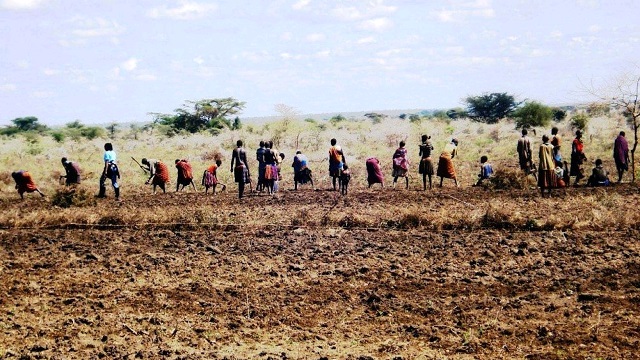
The crops that were supposed to hold
The most technically alarming finding in the survey is that sorghum, millet and cassava failed alongside maize and beans. These are the crops Ugandan extension services have spent two decades promoting as the drought-tolerant fallback, particularly in Teso and the north-east. They are what households eat when the maize is gone.
Their failure fits a pattern accumulating in the evidence all year. A study published in late August by Aaron Davis and colleagues at the Royal Botanic Gardens, Kew, argued that robusta coffee's reputation for climate resilience is largely an artefact of models that mistook irrigated farms for climatically suitable ones: robusta tolerates heat, but not drought. The same distinction applies to Uganda's staples. Sorghum and cassava tolerate poor soils and high temperatures; neither is immune to the complete absence of soil moisture across a full growing window.
Moses Attan Okia, the Member of Parliament for Soroti City East, framed the conclusion plainly: the season is a reminder of how exposed Uganda is through its near-total dependence on rain-fed agriculture. Formal irrigation still covers well under two percent of Uganda's farmland — roughly 23,000 hectares against a National Irrigation Policy target of 1.5 million hectares by 2040.
The part that is new: a credit problem
The detail that separates this drought from its predecessors surfaced in a single quote from Masaka City. Hawa Nalumansi, treasurer of the Ssenya Parish Development Committee SACCO, says many beneficiaries of the Parish Development Model invested their loans in coffee growing. With the crop dead, they cannot repay.
That is a structural warning, not an anecdote. The PDM's Parish Revolving Fund was designed as exactly that — revolving — with repayments recycled into new lending. Its recovery performance was already poor before the drought. At a Public Accounts Committee (Local Government) hearing on 2 September, Nakaseke District was found to have disbursed about Shs25 billion while recovering Shs28.2 million. Katakwi had disbursed Shs33.8 billion to 109 SACCOs and recovered about Shs6 million. Those figures were compiled from seasons in which crops largely grew.
Layer a total crop failure onto that base and two things follow. First, the arrears figures for FY2026/27 will be worse, and the political pressure for a blanket moratorium will grow — Karamoja Affairs Minister John Baptist Lokii already requested one on 9 September. Second, and more damaging in the long run, a generation of first-time borrowers will have learned that agricultural credit is a trap rather than a tool. Repairing that perception is considerably harder than replanting a coffee garden.
Uganda does have an instrument designed for this risk. The Uganda Agriculture Insurance Scheme, run through the Agriculture Insurance Consortium on an annual government subsidy of about Shs5 billion, crossed one million insured farmers this year and has paid roughly Shs54 billion in claims since 2016. But its penetration among PDM borrowers is thin, and very few of the farmers quoted this week are likely to receive anything. The obvious fix — making index cover a default, subsidised attachment to every Parish Revolving Fund disbursement rather than an optional extra — has been discussed for years without being executed.
What the forecast actually says
Relief is coming, but not in a form that undoes the damage. The Uganda National Meteorological Authority has flagged north-eastern Karamoja, parts of northern Uganda, Masaka and several south-western districts as areas of significant water stress and elevated temperatures with rising risks to food and nutrition security. The seasonal outlook presented by Dr Alfred Okot Okidi, Permanent Secretary in the Ministry of Water and Environment, projects near-normal to above-normal rainfall for the September–November season, with El Niño conditions setting in from around mid-September.
For farmers, an above-normal season arriving late is a mixed blessing. It shortens the growing window, raises the odds that harvest coincides with heavy rain, and — as Rwampara and the Lake Kyoga basin showed this year — turns drought-hardened soils into flood and runoff risk. The whiplash that destroyed robusta flower buds in the 2025/26 rains and then wilted the crop in the May dry spell is the template, not the exception.
The gap between that forecast and the farmer is the other unresolved problem. Dr Isaac Mugume of the Department of Meteorological Services has described the last-mile failure candidly: a national meteorology budget of about Shs20 billion, no funding to translate advisories into Uganda's 35 or so major languages, and no district meteorologist post in local government. Farmers in Luwero who planted on August's false start were not reckless. They acted on the only information they had — the sky.
What would actually change the arithmetic
Farmers across the affected districts asked for four things: drought-tolerant seed, irrigation, water for livestock, and affordable inputs. Each has a programme attached, and each programme is running behind the weather.
Agriculture Minister Frank Tumwebaze described the year's conditions as unprecedented on 9 September and confirmed he is in discussions with Finance Ministry officials over a large national irrigation programme. The existing micro-scale irrigation matching grant is capped at 2.5 acres — useful for a horticulture plot, largely irrelevant to a 15-acre cereal field in Isingiro. The US$200 million Africa Rural Climate Adaptation Finance Mechanism launched on 8 September by IFAD and Equity Group lists irrigation and water harvesting among eligible uses, but its first disbursements will not reach a Ugandan smallholder this season.
The cheapest intervention is also the least capital-intensive: getting a usable, local-language forecast into a farmer's hands before he decides whether August's shower is the season or a tease. The second cheapest is attaching index insurance to public agricultural credit by default. Neither requires a dam. Both would have changed what this season cost.



