Livestock and animal disease
Farmers in the cattle-corridor district say government FMD vaccine has made animals sick and killed calves. The ministry promises an investigation. Whatever it finds, the dispute shows that a vaccination drive is only as strong as the trust of the people asked to join it.
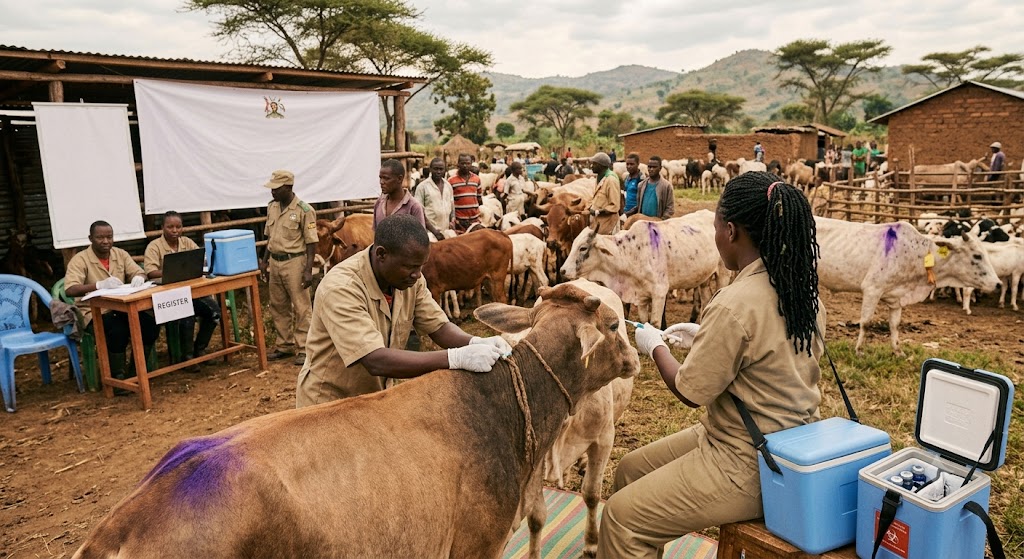
Uganda's campaign against foot-and-mouth disease (FMD) has so far been framed around supply and enforcement: buy the doses, equip the districts, arrest anyone who sells the state's vaccine. On 29 October, a different problem surfaced in Nakasongola District. Livestock farmers there told Nile Post that the government-supplied vaccine is making some cattle severely ill, that some animals have died, and that they want the Ministry of Agriculture, Animal Industry and Fisheries (MAAIF) to explain. The district chairperson says suspicion is already slowing mobilisation.
This is a follow-up to earlier coverage of vaccine enforcement. What is new is not the outbreak, which has been running since early September, but the confidence gap that has opened inside the campaign meant to end it. The deaths have not been independently linked to the vaccine, and the ministry says the cause is still to be established. That uncertainty is exactly what makes the moment delicate.
An outbreak that never fully left
Nakasongola sits on the cattle corridor and on a major transit route for animals moving north, south and east. On 15 September the district announced an indefinite ban on livestock movement across all sub-counties, according to the Daily Monitor. FMD had been confirmed in Wabinyonyi, Kakooge, Nakitoma, Nabiswera and Lwampanga, and was reported to have killed 55 cows and affected about 1,300 animals. A narrower restriction covering Wabinyonyi had been issued on 2 September.
Residents have been here before. A year-long quarantine imposed after an outbreak in January 2024 was only lifted on 27 January 2025. At the time, Agriculture Minister Frank Tumwebaze told Parliament that about Shs671 billion would be needed to vaccinate an estimated 44 million animals twice a year, while Cabinet had approved Shs10 billion for vaccines in high-risk areas. The distance between those two numbers explains much of why outbreaks keep returning.
District Veterinary Officer Dr Samuel Eswaggu says quarantine measures began on 15 September in the five affected sub-counties, suspending meat sales, animal transport and livestock markets. The disease has declined in most of the district but persists in Nakitoma, Nabiswera and Wabinyonyi.
The numbers behind the stand-off
The district figures reveal a vaccination effort that has barely started relative to the stock on hand. More than 470,000 doses have been supplied to Nakasongola, yet only about 96,000 cattle have been vaccinated, and over 370,000 doses remain in storage. In rough terms, about one in five doses supplied has been used, while nearly four in five sit in cold stores. Since FMD vaccination must reach a large majority of a herd population to stop transmission, that leaves a lot of animals exposed.
The policy design adds to the pressure on uptake. Under a compulsory programme introduced in July on a cost-recovery basis, farmers contribute Shs8,000 per dose for cattle and pigs and Shs4,000 for sheep and goats, while government covers officer facilitation, transport and cold-chain equipment. Animals are meant to be vaccinated every six months, and cattle may not move without a letter from the District Veterinary Officer confirming vaccination. By way of illustration, vaccinating 96,000 cattle at the cattle rate implies roughly Shs768 million in farmer contributions, money paid up front by households whose main asset is the herd. When the injection is followed by sick animals, the cost-benefit calculation changes quickly.

What farmers and officials are saying
Farmers questioned the safety and effectiveness of the vaccine, particularly a product they said was manufactured in Iran. District Chairperson Rogers Kulaba said farmers in Nabiswera lost more than 24 vaccinated calves. He told the paper that mobilisation has been scaled back because farmers are suspicious, and that farmers "need assurance that the medicine being administered to their animals is safe." He also claimed that the District Veterinary Officer advised staff to avoid the Iranian-made vaccine and use a Russian-made alternative. That claim is the chairperson's account; the article does not report a response from the veterinary officer on it, and it should be treated as unverified.
Resident District Commissioner Festus Bandeeba praised the government for supplying vaccines but asked MAAIF to investigate the complications and identify their cause. That position, supportive of the programme yet demanding answers, is probably where most farmers stand.
The ministry's response came from James Kakungulu, Commissioner for Animal Health and Production. He said some cattle may show severe symptoms because they were already infected when vaccinated, and that incomplete herd vaccination allows disease to spread to unvaccinated animals. "Sometimes, we vaccinate animals that are already sick, and this can cause them to develop more severe symptoms," he said, adding that an investigation into the illnesses and deaths would be carried out.
That explanation is scientifically plausible, since vaccinating animals during an active outbreak can coincide with disease progression and with stress reactions, and the vaccines used in field campaigns are not designed to cure an animal already infected. But from a farmer's point of view, the sequence is simple: the animal was vaccinated, then it fell ill. Without a transparent investigation, plausibility will not be enough.
Why trust is part of the cold chain
The Nakasongola dispute lands at a sensitive time. In early October, Minister of State for Animal Industry Bright Rwamirama warned that veterinary workers found selling government vaccines would be arrested, after the government procured 44 million doses. His message was about discipline at the supply end. The Nakasongola complaints are about confidence at the receiving end. A programme needs both.
Three things follow. First, the quality question needs an answer that farmers can see. That means documented batch information, cold-chain checks, post-vaccination follow-up and, ideally, laboratory findings shared publicly, rather than a statement that investigations will happen. Second, the vaccination protocol matters. If animals are being vaccinated while visibly sick, then sorting and recording clinical status before injection becomes as important as the injection itself, and extension staff need to be able to explain this at the kraal. Third, consistency across districts matters. A farmer who hears one vaccine is favoured by the district veterinary office and another is distrusted will conclude that officials themselves are unsure.
The economics of getting this wrong
The stakes extend beyond Nakasongola. Uganda's dairy sector produces about 5.3 billion litres of milk a year and earns roughly US$380 million in exports, supporting an estimated 2.7 million people along the value chain, according to figures cited by the minister earlier this month. FMD does not usually kill adult animals in large numbers, but it cuts milk output, weakens draught and breeding stock, and, through movement bans, shuts farmers out of the markets where they raise school fees and pay for veterinary care. In a district where quarantine has already suspended meat sales and livestock markets for six weeks, every additional week of disruption compounds household losses.
There is also a trade logic. Regional buyers, particularly for milk products and live animals, pay attention to disease status. A credible, widely taken-up vaccination programme is the route back to freer movement and, eventually, to markets that currently stay closed to animals from affected zones. A programme that farmers avoid delivers neither.
What happens next
The immediate test is the ministry's investigation. Farmers will look for a cause established with evidence, a clear statement on whether the Iranian-made and alternative products are equivalent in quality, and a decision on which vaccine continues in the district while questions remain. Compensation is a separate matter that neither the district nor the ministry has addressed publicly.
Meanwhile, the unused stock of more than 370,000 doses is both a resource and a risk. If trust is restored, Nakasongola could vaccinate quickly and help close a gap that has kept outbreaks recurring. If it is not, those doses risk expiring unused while the disease circulates. The lesson for the national programme, and for the other districts now ramping up their own campaigns, is that supply, enforcement and trust must move together. Doses in a fridge cannot protect a herd, and neither can doses a farmer refuses to accept.
Published By | Features Editor