Kampala
For years, the story Ugandan farmers and agro-processors told about bank credit was a familiar one of frustration: commercial lending rates hovering near 20 percent, collateral demands that shut out smallholders, and loan tenors too short to match the multi-year gestation of a coffee estate, a grain silo or a fruit-processing line. This week, the government moved to widen a channel that has increasingly become the default route around that problem — Uganda Development Bank (UDB) — by approving a dramatic expansion of the state lender's capital base and pressing it to convert that capital into cheaper credit for the productive sectors that employ most Ugandans.
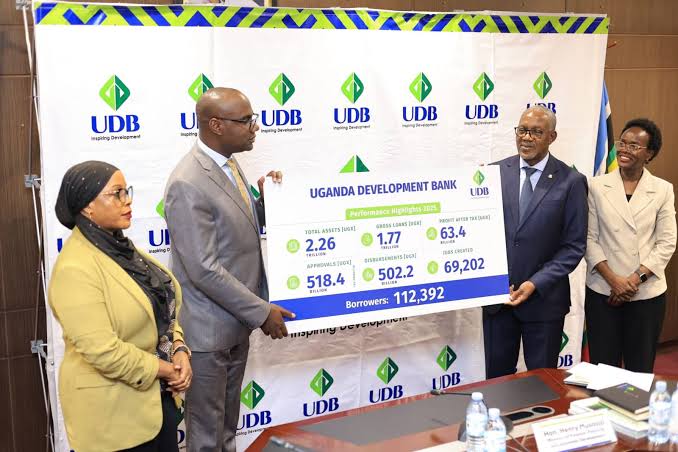
Finance Minister Henry Musasizi announced on August 14 that Cabinet has approved lifting UDB's authorised share capital from Shs2 trillion to Shs5 trillion, unlocking an additional Shs3 trillion in headroom for future recapitalisation. In the nearer term, government has also authorised the bank to retain roughly Shs63 billion of its 2025 after-tax profit as fresh capital, rather than remitting it as a dividend. Musasizi delivered the announcement alongside Minister of State for Investment Aminah Mukalazi as UDB's board, led by chairman Geoffrey T. Kihuguru, and management presented the bank's 2025 performance.

Minister Musasizi
The numbers behind that performance explain why the Treasury is doubling down. UDB reported a profit after tax of Shs63.4 billion for 2025, total assets of Shs2.26 trillion — up 27 percent from Shs1.78 trillion in 2024 — and gross loans of Shs1.77 trillion, with net loans and advances rising 6.6 percent to Shs1.63 trillion. During the year the bank disbursed Shs502.2 billion to 112,392 direct borrowers across 105 districts, spread over 120 projects, a 29 percent increase in disbursement volume on 2024. Non-performing loans stood at about 6.7 percent, a level UDB executives describe as within acceptable risk tolerance for a development finance institution operating in sectors — agriculture chief among them — that commercial banks routinely treat as too risky to touch.
Where the money is actually going
The detail most relevant to farmers sits in the sectoral breakdown. UDB managing director Patricia Ojangole told the same forum that agriculture, commercial agriculture, agro-industrialisation and manufacturing together account for 60 to 70 percent of the bank's annual loan growth, with agro-industrialisation alone representing roughly 65 percent of the total loan book. That is a striking concentration for an institution with a Shs1.77 trillion gross loan portfolio, and it reflects a deliberate strategic choice rather than an accident of demand: Musasizi explicitly instructed UDB to keep its lending aligned with the priority sectors named in Uganda's National Development Plan IV, which places agro-industrialisation, agriculture and agro-processing alongside minerals development, manufacturing, science and technology, and tourism at the centre of the country's growth strategy.
For a country where agriculture still employs roughly two-thirds of the workforce and generates a large share of export earnings, but where commercial bank lending to the sector has been tightening — the Bank of Uganda's own Q1 2026 credit conditions survey recorded 13.5 percent net tightening in agricultural lending standards and an average agricultural lending rate of 20.7 percent — a development bank willing to lend patiently at around 12 percent, with an explicit government target of bringing that down to 10 percent in the medium term and eventually into single digits, represents a materially different proposition. Musasizi was blunt about the ambition: "We want to see more of our people borrowing from UDB at affordable rates," he said, adding that government wants the bank's growing balance sheet "to translate into stronger enterprises, more employment, increased production and greater participation of Ugandan businesses in domestic and export markets."
The jobs argument
The employment figures UDB presented are central to the political case for recapitalisation. The bank said its 2025 interventions contributed to the creation or sustenance of 69,202 jobs, up from 55,553 in 2024 — a 25 percent increase attributed directly to enterprises that received UDB financing, many of them agro-processors, grain millers, dairies, and commercial farms. Musasizi used the figure to set expectations for the additional capital rather than simply celebrate past performance: "Every shilling deployed must translate into jobs, stronger businesses, increased production, exports and Uganda's economic transformation," he said, warning that the ultimate measure of the bank's success would be development impact rather than balance-sheet growth alone.
That framing matters because Uganda's agro-processing sector has a well-documented financing gap that shows up repeatedly in independent assessments — most recently in the Economic Policy Research Centre's work highlighted alongside financiers such as Equity Bank Uganda's Shs60 billion-a-year Master Grain Milling relationship in Jinja, and in the EU's €100 million EIB-Centenary Bank credit line targeted partly at agriculture-linked micro-enterprises. UDB's recapitalisation adds a third, larger channel: unlike commercial banks financing individual transactions or EU-backed credit lines targeting specific portfolios, UDB is a wholly state-owned development finance institution whose mandate is explicitly to absorb risk that private lenders will not.

What bigger capital actually buys
Recapitalisation matters mechanically as well as politically. Development banks are typically capital-constrained rather than deposit-constrained — unlike commercial banks, UDB cannot simply take in more customer deposits to fund a bigger loan book, because its business model relies on longer-tenor, lower-margin lending that depositors are unwilling to fund directly. Its lending capacity is instead bounded by its capital base and its ability to borrow from shareholders (the Ugandan government) and external development partners. Ojangole made this point explicitly, noting that when UDB approaches international lenders to mobilise additional funding, "they want to see our pipeline. They want to know what our strategy is, where we are going to deploy the money, which sectors we are targeting and how much we have deployed in previous years." A stronger capital base, in other words, is also a credibility signal that should make it easier for UDB to raise cheaper external financing to blend with government capital — precisely the mechanism through which a Shs3 trillion authorised-capital increase can eventually translate into multiples of that amount in actual lending capacity.
Kihuguru described the bank's evolving approach as "proactive" development financing — helping businesses build bankable projects, de-risking investments so private capital will follow, and mobilising co-financing rather than simply writing cheques. For agricultural entrepreneurs who have struggled for years to present bankable business plans to risk-averse commercial lenders, that technical-assistance layer may prove as valuable as the cheaper credit itself.
The caveats
None of this guarantees smallholder farmers will feel the difference quickly. UDB's average loan size and its emphasis on "commercial agriculture" suggest its primary clients remain medium and large agribusinesses — processors, exporters, aggregators — rather than the millions of subsistence and semi-commercial farmers who make up the bulk of Uganda's agricultural workforce and who typically access credit, if at all, through SACCOs, microfinance institutions or informal channels. Musasizi acknowledged the reach problem directly, instructing UDB to expand its presence outside Kampala "so that people in different parts of the country can benefit from its financing" without having to travel long distances, and to speed up loan processing so viable projects do not languish in the pipeline. Whether a bank built to underwrite large, bankable agribusiness projects can meaningfully extend its reach down the value chain to smaller producers — without diluting the loan quality that keeps its non-performing loan ratio near 7 percent — will be the real test of whether this capital injection changes farmers' lived experience of credit, or simply strengthens the balance sheets of the processors and exporters who buy from them.
For now, the direction of travel is clear: Uganda's largest state development lender is being handed a substantially bigger balance sheet with an explicit, government-mandated instruction to keep the majority of it flowing into agriculture and agro-processing — a bet that patient, state-backed capital can do for Uganda's farm economy what expensive commercial credit has consistently failed to.
Published By | Features Editor