Written By | Staff Writer
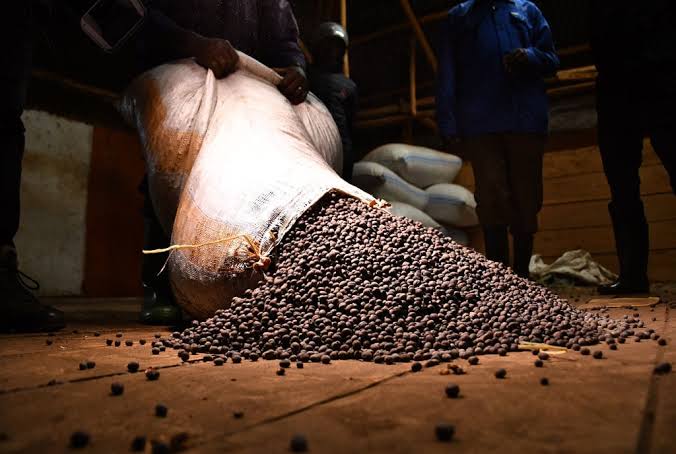
Bank of Uganda figures show gold and coffee now account for roughly 70 per cent of merchandise exports.
Feature
Uganda's export story this year has been told in record numbers. Government figures put export earnings at $10.2 billion for July 2024 to May of the 2025/26 financial year, up from $6.5 billion in the same period a year earlier, according to remarks by President Yoweri Museveni reported in June. This week, a fuller picture emerged. Bank of Uganda data cited by the Daily Monitor on 28 September show that in the 2025/26 financial year gold exports reached $8.91 billion and coffee $2.19 billion. Together, that is about $11.1 billion, or roughly 70 per cent of all merchandise exports.
The arithmetic is striking on its own. Two commodities, one mined and one grown, now carry the bulk of the country's foreign-exchange earnings. But for readers in the agricultural sector, the more useful reading is the split between the two. Gold is now worth roughly four times as much as coffee on the export ledger. Coffee, long the emblem of Uganda's farm economy, is the smaller partner, and it is the only one of the pair on which millions of rural households directly depend.
How gold overtook the farm
The rise of gold has been fast. Ecofin Agency reported that Uganda's gold exports jumped 75.8 per cent to $5.8 billion over a 12-month period in 2025, making gold the country's leading export. International gold prices climbed by more than 60 per cent during 2025, and a Bank of Uganda official told the agency that attractive prices had drawn new entrants into the business, producing a large volume of exports. Uganda also inaugurated its first industrial gold mine in 2024, a $250 million Chinese-backed project with an integrated refinery able to produce 1.2 tonnes of refined gold a year, and authorities introduced licensing for traders and export permits for imported gold amid concern about material sourced from neighbouring Democratic Republic of Congo.
Ecofin's account suggests much of that growth is price-driven, with regulators also watching the origin of some gold, rather than the product of new farm output. That matters for how the numbers should be read. A strong gold price lifts national export totals and can steady the shilling, but it does little for the household growing coffee in Masaka or Ntungamo. The gains from gold flow through refiners, traders and the state, not through village markets.
Coffee: record volumes, thinner margins for the grower
Coffee has not been standing still. Ecofin reported that coffee exports hit a record $2.4 billion in the first ten months of 2025, on 8.4 million 60-kilogramme bags, putting Uganda in position to challenge Ethiopia as Africa's top coffee exporter. The $2.19 billion figure for the 2025/26 financial year cited by the Monitor is measured over a different period, so the two numbers should not be compared directly. What both confirm is that coffee remains a multi-billion-dollar earner and the country's dominant agricultural export.
The problem is what sits underneath. An industry participant quoted in the June coverage put it plainly: there is a huge market for green coffee beans, but value-added coffee still faces barriers in accessing some international markets. Uganda largely ships beans, which means the farmer and the exporter capture the least valuable slice of the chain. Stakeholders quoted in the same report called for stronger trade agreements, better branding and targeted support for local processors, arguing that value addition could raise export revenue, create jobs and speed up industrialisation.
The weather problem behind the price
Coffee's share of the export basket also depends on rain, and this season has been unkind. Nile Post reported this month that coffee farmers in Nyakyera, Ruhaama East, in Ntungamo District, had lived through a dry spell from April to mid-September, leaving plantations that once had lush canopies looking scorched. Farmers there said recovery could take years. The district production officer, Dr Yake Basulira, said the district was working on dam desilting and micro-scale irrigation, but no farmers benefited from the irrigation programme in 2025/26 despite a target of 12, because funding was limited. A farmer, George Bamwesigye, said the 25 per cent co-funding requirement was too high and should be cut to about 10 per cent.
Columnist Michael J Ssali, writing in the Monitor on 22 August, described a season of contradictions: prolonged rains from late 2025 to April 2026 that rotted coffee buds before flowering, followed by an abrupt stop in May that wilted young plants. He also pointed to AGRA's July Food Security Monitor, which warns of a strong El Niño between October 2026 and April 2027 that could bring droughts, floods and agricultural losses across East Africa.
A new study adds a caution for anyone planning to grow robusta's way out of trouble. Aaron Davis of the Royal Botanic Gardens, Kew, told the Monitor that the popular belief that robusta is climate-resilient is an 'internet myth': robusta is more heat-tolerant than arabica, he said, but it is drought-intolerant, and much of the world's robusta output leans on irrigation that has masked that weakness. For Uganda, where coffee is overwhelmingly rain-fed, the message is that volumes are more exposed to weather than the export headlines suggest.
What government is doing about concentration
Officials are aware of the imbalance and have started to move money toward export readiness. According to the Monitor's report, funding to the Uganda National Bureau of Standards rose from Shs55.9 billion in June 2025 to Shs133 billion in the current financial year, with a further Shs130 billion approved for 2026/27. The agro-industrial development budget has been raised to Shs2.26 trillion for the coming financial year from Shs1.86 trillion. Both moves fit the government's goal of a $500 billion economy by 2040, in which exports are meant to play a major part.
Standards spending is not glamorous, but it addresses a real bottleneck. A separate Monitor report has quoted government saying all agricultural products for export must meet international certification. Rejected consignments, weak traceability and slow laboratory testing are the kind of friction that keeps value-added products such as roasted coffee, processed fruit and packaged foods out of premium markets. Money for standards and for agro-processing is, in effect, the state's bet that Uganda can broaden the farm side of its export base rather than leave the field to gold.
Implications for farmers, markets and the wider economy
For farmers, the first implication is that national export success and household income are not the same thing. A record trade year built largely on gold does not put money into a smallholder's pocket, and coffee volumes recorded at the border can mask a poor season in the garden. The most reliable ways to raise farm income remain unglamorous: better yields per tree, lower post-harvest losses, access to processing and a fairer share of the export price.
For markets, the concentration is a risk in both directions. A fall in the gold price, or a tightening of the rules on traceability that cuts re-export volumes, would drain foreign-exchange earnings quickly and could weaken the shilling, raising the cost of imported inputs such as fertiliser and agrochemicals. Coffee, meanwhile, is exposed to global price cycles and to weather. Dependence on two products means a shock to either one is felt across the economy.
For policy, the test is whether the extra budget for standards and agro-industry translates into products that are actually exported. The direction is right, but the numbers to watch are not budget lines. They are the share of coffee shipped roasted or ground rather than green, the number of new agricultural products clearing certification for export, and the extent to which irrigation and drought-tolerant varieties reach farmers in places such as Ntungamo, where a district could not fund a single farmer into its irrigation scheme last year.
The 70 per cent figure is therefore best read as a warning as much as a milestone. Uganda has found two commodities that sell well. Whether the farm economy can build a wider, more resilient export base beneath them will decide whether the boom lasts.



