FEATURE
On the lower slopes of the Rwenzori in Kasese, and in the shaded plots of Mukono and Kayunga where vines climb their host trees, a clock is running down. Uganda’s Ministry of Agriculture, Animal Industry and Fisheries (MAAIF) opened the official Season A vanilla harvest on 29 June and set it to close on 29 September. Fewer than four weeks remain.
Very few crops anywhere are harvested on a date set by a ministry. Vanilla in Uganda is one of them, and the reason says a great deal about what has gone wrong — and what is slowly going right — in one of the country’s highest-value export commodities.
A calendar enforced by police
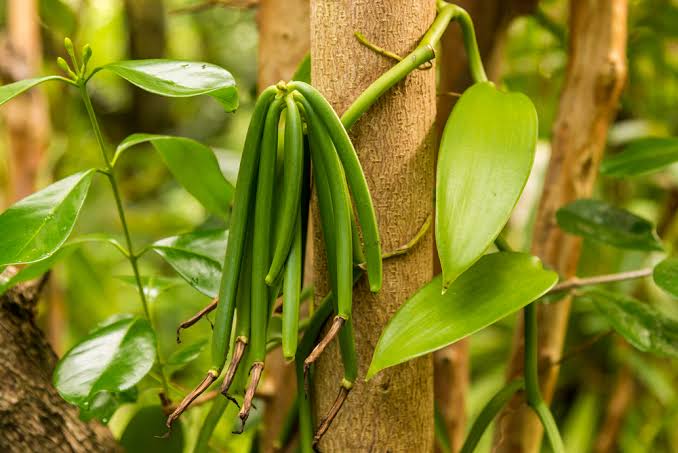
Vanilla is only worth its price if the bean is mature when picked. Vanillin, the compound buyers pay for, accumulates in the final weeks on the vine. Harvest a bean too early and it will never develop the aroma; it will cure poorly, split, and drag down the reputation of every consignment it is blended into. Uganda’s answer has been to declare a national harvest window, license buyers and traders, and put district officials and the Agricultural Police behind enforcement.
Franco Kiiza, the Kasese District Crop Quality Officer, told New Vision in late June that before the dates were gazetted his office had been impounding sacks of vanilla from farmers and traders who picked early. “We did this to avoid compromising the quality of the crop, as well as avoiding black markets,” he said, urging farmers to use the window “since the prices are averagely good.”
Julius Rukara, Kasese’s principal agricultural officer, aimed his warning at the middlemen rather than the growers. “Keep it in mind that once we fake the quality of our vanilla at the international market, the effect is largely felt by you, the farmers,” he said.
That is the crux of it. The person who loses most from a premature bean is not the trader who bought it cheaply, but the grower whose next crop meets a lower offer.

Why farmers pick early anyway
The enforcement framing — farmers as culprits — obscures the economics driving the behaviour. Vanilla is among the most stealable crops in Uganda. A sack of green beans is light, high-value and easy to move at night, and the trade attracts both opportunistic thieves and organised groups. A farmer who watches a neighbour’s garden get stripped faces a stark calculation: a premature bean sold at a discount is worth more than a mature bean stolen.
So theft and premature harvesting are not two separate problems. They are the same problem, and a harvest window alone does not solve it. Where farmers organise night patrols, where districts issue and enforce ordinances, and where licensed buyers show up reliably at the start of the window, early picking falls. Where they do not, the calendar is a piece of paper.
Price adds pressure. Farm-gate prices for mature green vanilla in Kasese this season have been averaging roughly Shs14,000 to Shs20,000 a kilogramme, according to district officials — better than the Shs8,000 to Shs10,000 range that MAAIF cited when it opened the previous season, but still far below the boom years that first drew tens of thousands of Ugandan households into the crop. At those depressed levels, some growers have been weighing a switch into cocoa or coffee, both of which have had stronger recent price runs.
The numbers behind the crop
The scale is easy to underestimate because vanilla moves in tonnes, not shiploads. Uganda exported a record 604 metric tonnes of natural vanilla in 2024, worth about US$16.6 million, up from 266 tonnes the previous year, according to Bank of Uganda figures cited by the agriculture ministry. That confirmed Uganda as the world’s second-largest producer for a second consecutive year, behind Madagascar, which ships between 1,200 and 2,000 tonnes in a single season.
The ministry has since guided expectations downward, projecting around 380 tonnes for a season, reflecting the depletion of carry-over stocks accumulated in 2023 and 2024. Volume, in other words, is normalising after an unusual bulge — which makes quality, not quantity, the variable that will determine earnings.
Uganda’s structural advantages are real. The crop is harvested twice a year, giving buyers a supply calendar that Madagascar cannot match, and Ugandan beans routinely test above 4 per cent vanillin, among the highest globally. Those two facts have translated into market share: the United States takes about 42 per cent of Uganda’s vanilla exports, France 18.8 per cent and Germany 11.8 per cent, and Uganda’s share of the US market has grown from roughly 3 per cent to 12 per cent over five years, and from about 1 per cent to 10 per cent in the European Union.
Cultivation now spans 38 districts — Mukono, Kayunga, Buikwe, Jinja, Mayuge, Sironko, Wakiso, Masaka, Mpigi, Mubende and Kabarole among the established ones — with Kamwenge, Kitagwenda, Rukungiri and Kanungu identified as expansion frontiers.
The institutional scaffolding
Around the harvest window MAAIF has assembled a fuller apparatus than most Ugandan value chains enjoy: a dedicated Vanilla Desk for policy coordination, support for 15 district ordinances governing quality and post-harvest practice, a licensing and registration regime for every actor in the chain, and a digital traceability system. Maturity is assessed using five methods — physical observation, pollination records, vanillin and moisture analysis, thermal time and stakeholder validation — rather than a farmer’s eye alone.
The Association of Vanilla Exporters of Uganda (VANEX) has led branding and market development; Catholic Relief Services, through its Vines project, and Makerere University have worked on traceability and governance. Licensed buyers include Esco Uganda, UVAN, Tambisa Uganda, Tuoton Uganda, Natural Extracts Industries, Modern Agro Spices and Kilembe Vanilla Exporters, among others. Farmers who sell outside that list forfeit both price and recourse.

What it means beyond the vanilla belt
For farmers, vanilla remains one of the few crops where a smallholder can earn serious money from a small plot. At Shs8,000 a kilogramme, the ministry has calculated, an acre yielding 1,800 kilogrammes can return around Shs25 million a year after production costs — a figure no maize or bean grower on comparable land will approach. That is also why the volatility hurts so much: the same acre in a bad price year can leave a family that abandoned food crops badly exposed.
For the wider economy, vanilla is a test of whether Uganda can hold a premium position rather than compete on price. The country still trades at a discount to comparable Madagascar grades. Closing that discount is not a matter of growing more; it is a matter of every bean in every consignment being mature, traceable and consistently cured. Uganda has spent three years building the systems to prove that. The next three weeks are when the proof is either delivered or lost in the gardens.
After 29 September comes curing, then the Season B harvest around December and January, and an international buying community increasingly insistent on documented origin. The window closing this month is small. What passes through it is not.
Published By | Features Editor