Written By | Staff Writer
Eight arrests in Butuntumula put a number on something Uganda rarely prices: what it costs when a land dispute is settled with a chainsaw instead of a court.
Luweero District
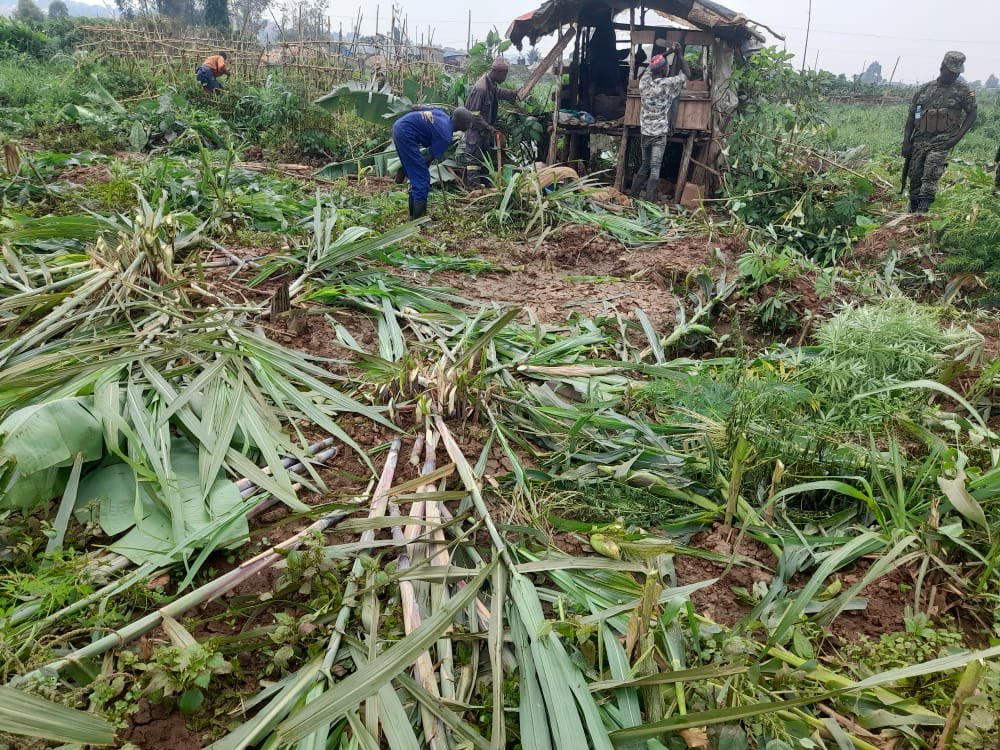
At about eight o’clock on the morning of Wednesday, 9 September, a group of people walked into a garden in Bamugolodde Village, Butuntumula Sub-county, Luweero District, and began cutting. By the time they left, roughly three acres of coffee, cocoa, banana plants and assorted trees had been felled. The owner, 57-year-old Ssengoba David, reported the matter to police the following day. On Friday, Savannah Regional Police confirmed that eight people were in custody, and that three of them were suspected of having mobilised the group that entered the garden.
The details police released are, in their way, the most instructive part of the story. Among the exhibits recovered were a power saw, an oil engine and a jerrycan of petrol. Officers also impounded a Toyota Hiace minivan — the model Ugandans call a “drone.” “A case of suspected malicious damage to crops was registered, relevant witness statements were recorded, and exhibits were recovered,” Savannah Regional Police spokesperson ASP Sam Twiineamazima said, appealing for anyone with information to contact Luweero District Police. The suspects remain in custody as investigations continue.
This does not read like a quarrel that got out of hand. It reads like an operation: transport arranged, fuel bought, a mechanised saw carried into a coffee garden at the start of a working day. Three acres of mature perennials do not fall to pangas in a morning.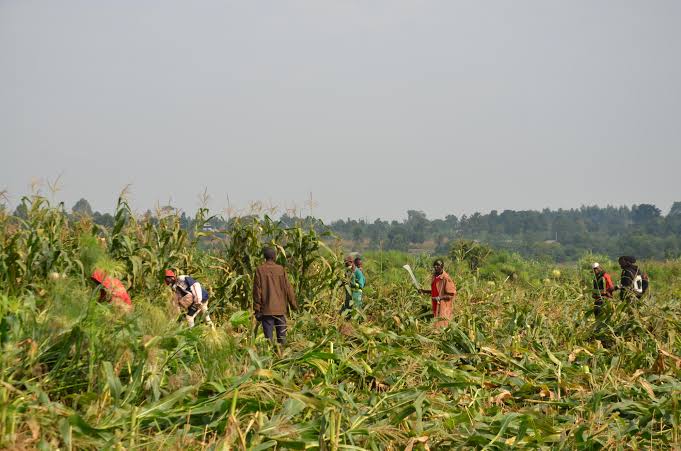
What three acres actually cost
Uganda’s agricultural coverage spends a great deal of energy on export tonnages and farm-gate prices, and comparatively little on the arithmetic of what it takes to get a perennial crop to the point where those prices apply. That arithmetic is what was destroyed in Bamugolodde.
Robusta coffee, which dominates central Uganda, takes roughly three years from planting to a first meaningful harvest and four to five to reach full bearing. Cocoa is slower still — typically three to five years to first pods, and longer to a commercial canopy. Bananas are the quickest of the three, at twelve to eighteen months to first bunch, but a mature matooke plantation represents years of accumulated mat management, mulch and manure that cannot be reconstituted in a single season.
At the prices the Ministry of Agriculture quoted this month — robusta trading between Shs12,500 and Shs13,000 a kilogramme depending on location, arabica averaging around Shs17,250 — a bearing acre of coffee is among the most valuable assets a smallholder household in Luweero is ever likely to own. Cocoa, meanwhile, has become Uganda’s second-leading agricultural export on the national ledger, with export value climbing from US$70.6 million to US$620.4 million as volumes rose from 30,204 tonnes in 2015/16 to 72,545 tonnes in 2024/25 — placing it behind only gold and coffee among the country’s foreign-exchange earners in FY2024/25.
Destroying three acres of that mix is not vandalism in the ordinary sense. It is the deliberate write-off of somewhere between five and fifteen years of household capital formation, and of the export earnings that would have flowed from it. Nobody in the national accounts will record the loss, because standing crops are not on anyone’s balance sheet until they are sold.
Why the saw goes for the coffee first
Police have not stated a motive in the Luweero case, and the suspects are entitled to the presumption of innocence. But the pattern the incident fits is well established, and it runs directly through Uganda’s land tenure system.
Under the 1995 Constitution and the Land Act, a kibanja holder — a tenant occupying registered mailo land without a title of their own — is recognised as a lawful or bona fide occupant with security of tenure. Eviction is permitted only on narrow grounds: failure to pay busuulu, sale of the kibanja without the landlord’s consent, or a lawful court order. In practice, that protection is strong on paper and slow in operation, and the strongest evidence a kibanja holder can produce of long occupation is precisely what grows on the land. Coffee trees, cocoa, a mature banana mat and standing timber are the visible, dateable proof that somebody has been there for years and invested accordingly.
Remove the crops and you remove the evidence. You also remove the reason and the means to stay. A household that has lost its coffee income has lost the money to litigate, to pay busuulu, and often to eat. The crop is simultaneously the asset, the proof of tenure and the war chest — which is why, in dispute after dispute, it is the first thing to go.
The Luweero case is not isolated. In February this year, police in Ibanda District opened investigations after a banana plantation belonging to Olive Namara was cut down by unknown people in what was suspected to be a land-related conflict; Namara accused a relative of orchestrating the destruction to force her off the land, and no arrests had been made at the time of reporting. In July, Lands Minister Judith Nabakooba ordered the arrest of people accused of intimidating and forcibly evicting bibanja holders in Lugazi Municipality, Buikwe District. In Buvuma, residents drove surveyors off land being mapped for oil palm development, saying they had lawfully occupied it for more than seven decades.
The law exists; the deterrence does not
Uganda’s Penal Code Act, Cap 128, criminalises damage to crops, with specific offences covering the setting of fire to crops and growing plants. Charges are available. What is scarce is a credible expectation that a charge will end in conviction and restitution.
Crop-destruction cases are evidentially awkward. The complainant must establish ownership or lawful occupancy of land that is, by definition, disputed; must value a standing crop that no longer exists; and must connect the people holding the saw to the people who paid for the fuel. The Luweero investigation is unusually well placed on that last point — a vehicle, a power saw and a fuel container are the sort of exhibits that support a conspiracy case rather than a bare trespass case — but it is the exception that illustrates the rule.
Civil remedies are worse. Damages for destroyed perennials require expert valuation and years of litigation, which is time a household without coffee income does not have. The practical outcome, repeated across the mailo belt, is that the party willing to destroy first wins on the facts before the law is ever consulted.
The policy contradiction
The uncomfortable part is how directly all of this cuts against everything else the state is currently doing in agriculture.
In the past fortnight alone, government flagged off the distribution of 173,913 bags of fertiliser aimed squarely at coffee, tea and cocoa growers; the Agriculture Minister told the country that drought had made a national irrigation programme urgent; and the coffee sector continued to trade on the back of a record export year of roughly 8.6 million bags worth about US$2.3 billion. Every one of those interventions asks smallholders to sink more capital into land — and specifically into crops that take years to pay back.
That is a rational ask only where tenure is secure. A farmer who believes a power saw could arrive at eight o’clock one Wednesday morning will plant maize and beans — annuals he can harvest before anyone can take them — rather than cocoa. Uganda’s entire agro-industrialisation strategy, from the coffee roadmap to the cocoa expansion now being promoted in Lango, Bunyoro and Bukedi, rests on hundreds of thousands of households making the opposite choice, season after season, for a decade.
What would change the calculus
Three things, none of them novel.
First, speed. Crop destruction needs to be handled as a time-sensitive economic crime rather than a neighbourhood dispute. Exhibits disappear, witnesses reconsider, and the evidentiary value of a felled crop degrades within weeks as the stumps are cleared and the land is reoccupied.
Second, valuation. Uganda already operates a compensation-valuation apparatus: the Ministry of Agriculture and the Lands Ministry used it to pay out UGX 24 billion to people affected by the National Oil Palm Project in December 2025, and to re-verify claimants in Buvuma and Sango Bay-Kyotera this year. The same district compensation rates that value a coffee tree for a hydropower right-of-way could give a magistrate a defensible figure for a destroyed acre within weeks instead of years.
Third, registration. Systematic recording of bibanja interests — long promised, patchily delivered — would mean that a household’s tenure no longer depends on whether its trees are still standing.
Until then, the coffee garden will keep doing double duty as a land title. And the cheapest way to win a land dispute in Uganda will remain a hired van, a jerrycan of petrol and a morning’s work with a saw.



