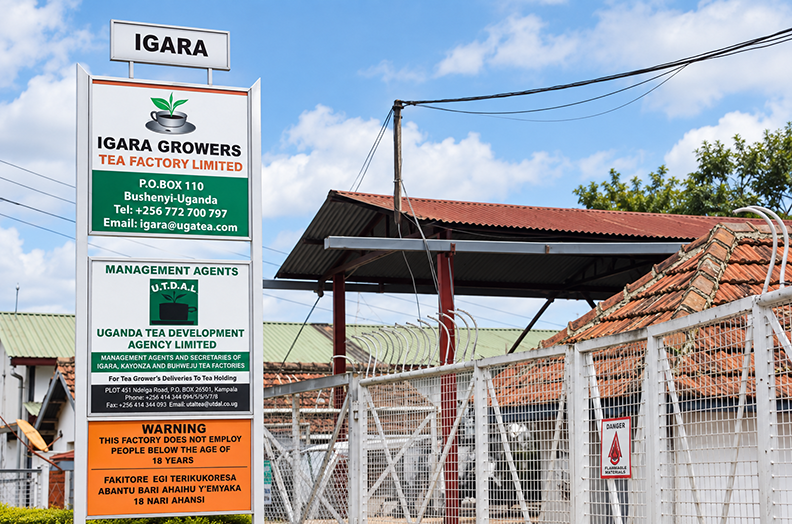
A mortgagee's public notice, issued on 7 October, has turned a long-running boardroom feud at Bushenyi's Igara Growers Tea Factory into a countdown. What happens next will say a great deal about whether Uganda's tea rescue package can reach farmers at all.
Agribusiness and industry
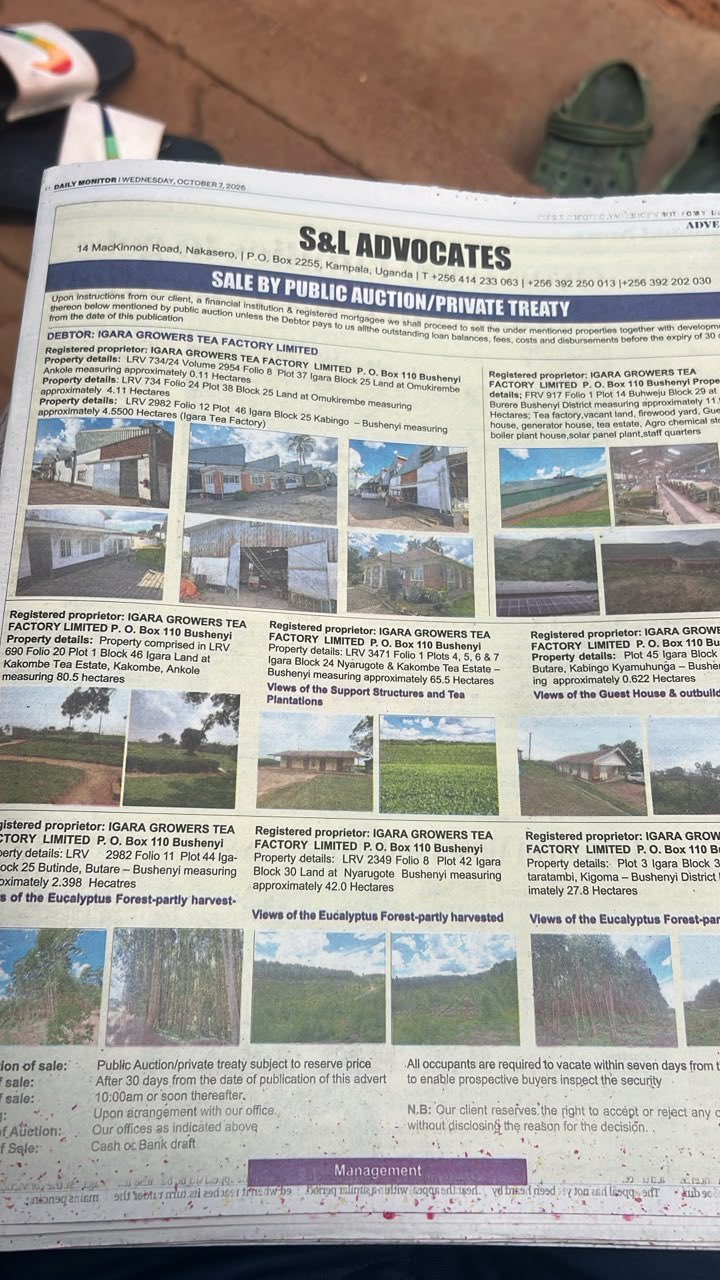
For nearly two years, the story of Igara Growers Tea Factory Limited in Bushenyi has been told as a governance dispute: two sets of directors, conflicting court orders, and shareholders who could not agree on who was in charge. This week it became something harder to argue with. On 7 October, S&L Advocates published a public auction notice on behalf of a financial institution that holds a mortgage over the company's assets. Unless every outstanding loan balance, interest charge, fee and cost is cleared within 30 days, the properties will be sold. Occupants have seven days to vacate so that prospective buyers can inspect them.
That notice, reported on 9 October by The Cooperator News, is the new development in a saga that Ugandan readers have followed in pieces. It is also the first time the possibility of losing the plant has been put in writing, with a clock attached. For the more than 7,000 smallholder shareholders in Bushenyi, Buhweju and Sheema districts who own the company, the question is no longer who should sit on the board. It is whether there will be a factory to govern.
What is on the block
The auction list reads like an inventory of a farmer-owned industry. It includes the main processing plant at Plot 46, Igara Block 25, Kabingo in Bushenyi; an 11.9-hectare parcel at Plot 14, Buhweju Block 29, Burere; the 80.5-hectare Kakombe Tea Estate; and the 65.5-hectare Nyarugote Estate. Further properties are listed at Butare, Rwantaratambi and Kigoma. The assets named include processing facilities, vacant land, firewood yards, a guesthouse, generator facilities, boiler plants and staff housing. In other words, not just the estates that supply some of the green leaf but the machinery that turns that leaf into black tea for the Mombasa auction.
Igara was established in 1969 under government poverty-alleviation initiatives and was privatised to smallholder farmers between 1995 and 2000. It is widely described as one of the largest smallholder-owned tea companies in the country. An earlier industry report put its share at roughly a tenth of national tea output, though that figure is undated and should be treated with caution. Either way, the factory is the economic anchor of a region where tea is often the household's only cash crop.
How the debt got here
The size of the hole depends on who is counting. Reported liabilities now exceed Shs25 billion. A shareholders' petition to the Uganda Registration Services Bureau (URSB), summarised by New Vision in July, put the figure at about Shs21.1 billion. That included roughly Shs6 billion owed to tea out-growers, Shs1.4 billion in unpaid salaries, and about Shs1.7 billion in unremitted National Social Security Fund (NSSF) contributions, plus debts to suppliers, financial institutions and the Uganda Revenue Authority. Workers quoted in the latest coverage put the unremitted NSSF figure at more than Shs1.6 billion, accumulated since 2022. The numbers differ slightly, but the pattern does not: farmers, workers and the pension fund are all creditors of a company that, according to the petitioners, kept selling tea through Mombasa while failing to meet its obligations.
The company has denied the petitioners' allegations. Through its lawyers it has argued that, under its Articles of Association, directors remain in office until lawfully replaced, that an October 2025 annual general meeting could not be completed because the High Court issued interim orders, and that meetings on 24 June 2026 lawfully confirmed the directors-elect. These claims have not been tested to a conclusion, and the debt figures cited by the petitioners are allegations rather than audited findings.
A board that cannot act
The legal picture helps explain why nobody could stop the slide. Justice Amos Kwizera of the High Court in Bushenyi ruled that decisions made by the board after August 2025 were null and void because its mandate had expired, and ordered an Extraordinary General Meeting to establish new leadership. Separately, Justice Simon Peter Kinobe issued an interim injunction in Company Cause No. 36 of 2025. Conflicting orders frustrated the board elections that were supposed to resolve the matter.
In July, an Assistant Registrar of Companies, Daniel Nasasira, barred anyone claiming to be an Igara director from filing resolutions or statutory returns with URSB until the court rules on the board's legality. He declined to decide who the lawful board was, calling that a matter for the High Court under Section 138 of the Companies Act, and deferred the appointment of inspectors to investigate the alleged Shs21.1 billion in liabilities because inspectors need a recognised board to act on their findings. In late August, security forces took control of the premises, with police saying the deployment was meant to prevent violence and protect property. Shareholders had already been barred from the site.
The result is a classic trap. The investigation that might trace the money cannot start until there is a lawful board; there cannot be a lawful board until the courts or an election settle the matter; and meanwhile a secured lender has run out of patience. According to The Cooperator News, URSB has agreed a roadmap with management running to 6 January 2027, which means the factory is likely to have no substantive board during the entire 30-day auction window.
Farmers and workers at the sharp end
For the people who actually grow and pick the leaf, the sums are personal. Willis Bashasha, who heads an Interim Farmers' Committee, said farmers resumed supplying leaf after being urged to do so but were never paid. "The auction is a result of what we were fighting," he said, adding that the debt obligations were never disclosed to shareholders. An employee, Joseph Barugahare, said: "Landlords have chased us out and banks are taking our property," and questioned why tea was still being loaded for sale while management said there was no money to pay workers.
The rescue package meets a governance wall
The timing matters because the government has just announced a sector-wide lifeline. As reported in September, it plans to write off more than Shs35 billion in tax arrears owed by tea processors and has announced a Shs212 billion investment package, along with a Shs152 billion presidential bailout subject to verification by the Auditor General. The Cooperator reports that access to this support is tied to verified governance structures and operational stability. Igara, by definition, has neither right now.
That is the uncomfortable irony at the centre of the story. The money exists on paper, the conditions are reasonable, and the one factory most in need of help may be the least able to qualify. Paddy Twesigaomwe, the Trade Secretary for the tea sector, said workers were losing hope and that management and the board had been given a 14-day ultimatum to meet and provide a clear roadmap for payment. A roadmap from a board whose own legitimacy is in doubt is a thin reed, and a 14-day ultimatum will expire well before a 30-day auction does.
The wider market gives no relief. Black tea prices at the Mombasa auction remain depressed, while fertiliser and energy costs are high. A buyer for Igara's assets would be purchasing into a weak price cycle, which may depress what the estates and plant fetch and leave a shortfall even if the sale proceeds.
What to watch
Several outcomes are possible, and each has different consequences for farmers. If the lender is repaid or agrees to stand down, perhaps through a negotiated restructuring backed by the tea package, the factory survives but the governance questions remain. If the auction goes ahead, the plant and estates could pass to a private buyer, which might keep the processing line alive but would end farmer ownership of the assets that farmers spent decades building. A third path, a court-supervised process that fast-tracks an Extraordinary General Meeting and unlocks the stalled URSB inspection, is the one that would deal with the cause rather than the symptom, but it needs judges, regulators and factions to move faster than they have so far.
For farmers elsewhere, the lesson is about structure as much as about tea. Producer-owned processors can give smallholders a share of value-added income that raw-leaf sellers never see. But they rely on boards that report accurately, audits that are published, and regulators who can act before a debt becomes a foreclosure. Igara shows what happens when those safeguards are suspended for two years.
In the coming weeks, the signals to follow are straightforward: whether the 14-day ultimatum produces any payment plan, whether the mortgagee extends or withdraws its notice, and whether the High Court or URSB acts to restore a lawful board before 6 January 2027. Thousands of families in Ankole's tea belt are waiting on the answers.
Published By | Features Editor