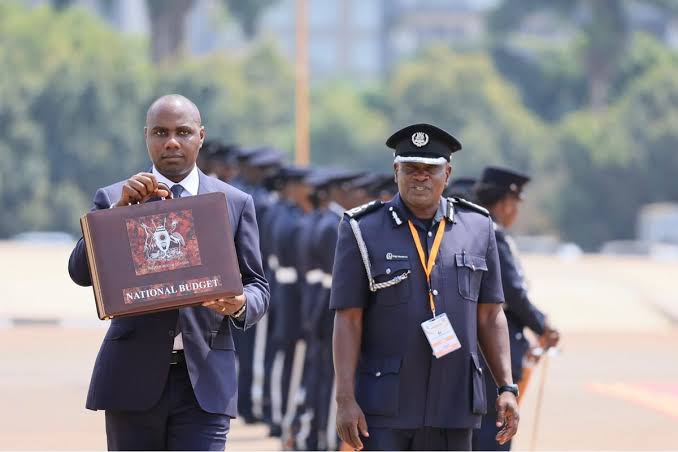
As the Finance Ministry trims the 2027/28 budget to Shs79.22 trillion, ACODE is urging planners to protect agro-industrialisation, solar irrigation and climate resilience. The numbers show how hard that will be.
Uganda's budget for the 2027/28 financial year has not yet been drafted, but the argument over it has begun. On 6 October 2026 the Advocates Coalition for Development and Environment (ACODE) told a Kampala press conference that agro-industrialisation, productive solar energy and climate resilience should be prioritised in the coming budget. The timing is deliberate. The Ministry of Finance, Planning and Economic Development has issued its first Budget Call Circular for the year, and ministries are now working out what they can ask for within tight ceilings.
The central fact is the ceiling itself. The proposed budget for 2027/28 is Shs79.22 trillion, down from Shs84.39 trillion this year, a reduction of 6.2 percent according to the Daily Monitor's reporting of 23 September. For agriculture, where most spending is on inputs, irrigation and extension that farmers can see, a smaller envelope means choices must be sharper.
Why the budget is shrinking
The Monitor reported that the Finance Ministry's rationale is to reduce government borrowing. Debt financing, its report notes, also reduces the money available for social services such as health and education. Related coverage cited by the paper puts public debt at Shs140 trillion, and says about Shs33.4 trillion, nearly 40 percent of the current budget, was planned for debt servicing alone. The government has also invested close to Shs11 trillion directly in wealth-creation initiatives for households in the subsistence economy under the 2026/27 budget.
Taken together, those figures describe a government trying to hold its spending in check while honouring heavy fixed obligations. For agriculture, which is a recurrent claimant on public funds through input programmes, irrigation and research, that means competition for a shrinking pool of discretionary money.
What ACODE is asking for
ACODE's Deputy Executive Director Onesmus Mugyenyi and researcher Anthony Buyinza set out a six-part case, reported by Nile Post's Hasfah Nakyanzi. First, prioritise agro-industrialisation, productive solar energy and climate resilience. Second, use solar more widely for irrigation and along agricultural value chains, including processing and storage; ACODE argues solar can power pumps, dryers, cold storage and agro-processing equipment, which could reduce post-harvest losses. Third, track climate-related public spending so the government can see how much goes to adaptation and whether it works. Fourth, ensure that solar panels and equipment are of good quality so that investments stay useful to farmers. Fifth, build local government capacity to plan and carry out climate interventions, because risks vary by region. Sixth, give agencies clearer guidance on financing agricultural transformation and climate resilience.
Mugyenyi's underlying argument is that weather is already costing production. Droughts and excessive rainfall continue to cause losses, and farmers in dry areas such as Karamoja and parts of Masaka need more reliable water. ACODE says its proposals complement the President's directive to scale up micro and small-scale irrigation, especially solar-powered schemes. The submissions have been sent to the Permanent Secretary and Secretary to the Treasury.
The agriculture share: small, spread thin
The scale of the challenge shows in analysis of this year's budget. A Monitor report of 21 August 2026 on a regional review by East African non-state actors found agriculture accounts for roughly 3 percent of Uganda's national budget for 2026/27. That report gives the budget as Shs86.6 trillion (US$22.8 billion), a figure that differs from the Shs84.39 trillion used in the Finance Ministry comparison above; the difference is likely down to what is counted, but readers should note the discrepancy when comparing. The Shs2.26 trillion Agro-Industrialisation Programme spans more than seven ministries, departments and agencies.
That spread is a key point. Rural roads, food-safety laboratories and storage sit under other agencies, so the Ministry of Agriculture's direct allocation can understate or overstate what the sector actually receives. The review described Uganda's implementation readiness as medium, said heavy debt servicing and large infrastructure commitments strain agricultural funding, and noted that donor support remains a key pillar. It scored East Africa's weakest areas against benchmarks: agricultural investment financing at 4.26 against 9.7, ending hunger at 3.79 against 9.24, and intra-African agricultural trade at 2.98 against 9.0.
The coalition behind the review, coordinated by Agnes Kirabo of the EAC CAADP Non-State Actors group, proposed ten actions including quarterly tracking of fund releases and expenditure, parliamentary scrutiny of agri-food agencies and publication of financing gaps. Its core message was that allocation, release, expenditure and results should all be tracked, not just headline percentages. That is a close cousin of ACODE's call for climate spending to be tracked.
The counterweight: donor-backed irrigation in Bunyoro
If domestic money tightens, external finance becomes more important. In June 2026 the African Development Bank approved $140 million from the African Development Fund for the Uganda Multipurpose Water for Climate Resilient Irrigation Development and Agro-Industrialisation Programme in the Bunyoro subregion, within a total package of $207 million. Co-financiers include the OPEC Fund for International Development, the End School Age Hunger Fund, the Government of Uganda and project beneficiaries.
The programme includes a large-scale water conveyance system linked to networks covering over 4,000 hectares in phase one, expandable to about 13,000 hectares in phase two; certified seeds and soil restoration; livestock watering facilities and mobile veterinary services; and storage, aggregation centres and cold-chain infrastructure. The bank says it will reach more than 121,000 households directly and about 21,000 children through school feeding, with women expected to be around half of beneficiaries, and create over 13,000 jobs. Alex Mubiru, the bank's East Africa Director General, described it as a comprehensive approach to unlocking agricultural potential and addressing barriers to rural development.
ACODE cites this loan as an example of the kind of investment that fits its agenda. But it also illustrates a risk: the Government of Uganda is itself a co-financier, so counterpart funding has to be found inside the same constrained budget. Loan approvals do not become irrigation canals until counterpart money, procurement and supervision are in place.
What a squeeze means for farmers
For a farmer, the budget is not an abstraction. It is whether the extension officer has fuel, whether the demonstration plot gets a pump, whether the cooperative's drier is powered and whether the district gets its share of micro-irrigation kits. The practical implications of a tighter ceiling are threefold.
First, projects with clear returns and multiple benefits will have an advantage. Solar-powered irrigation and processing, which ACODE champions, can cut reliance on diesel and rain, and the same panels can run a dryer or cold room. Second, quality control will matter more, not less. When money is tight, equipment that fails within two seasons is expensive. ACODE's call for quality assurance on solar equipment is, in budget terms, a call to avoid paying twice. Third, local governments will carry more of the load, and their capacity varies. ACODE's point on capacity is aimed at this.
What to watch
The Budget Call Circular is the opening move; the real signals come in the Budget Framework Paper, sector ceilings and the ministerial policy statements that follow. Three things are worth watching. Will the Agro-Industrialisation Programme's Shs2.26 trillion hold in nominal terms against a smaller total? Will counterpart funding for externally financed projects such as the Bunyoro irrigation programme be ring-fenced? And will the government adopt the idea, shared by ACODE and the regional coalition, of tracking releases and results, not just allocations? If the answer to the last question is yes, farmers may get more from a smaller budget than from a larger one that disappears into the gap between promise and release.
Published By | Features Editor