Written By | Staff Writer
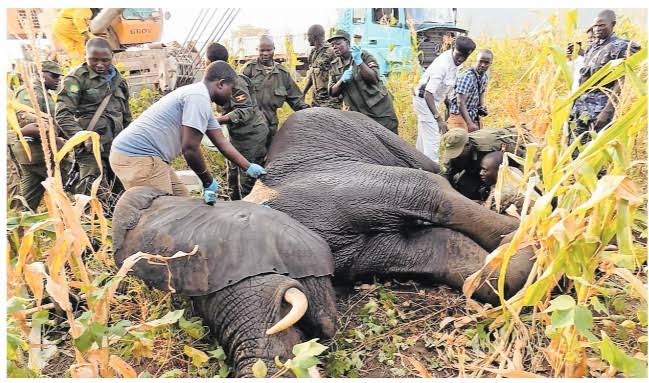
Buliisa Elephants
Agriculture Stories
In Nyamutete Village, Bugana Parish, Buliisa District, Robinah Bagadisa can still point to the exact spot where her household economy stopped. In 2020, elephants walked out of the Murchison Falls landscape and through two acres of her maize and cassava. She did what the law asks of a farmer in her position: she reported the raid to the Uganda Wildlife Authority (UWA), waited for rangers to come and assess the damage, went to the district agricultural office, completed the paperwork, and watched her file forwarded upward.
Six years later, she is still waiting. "I have written to UWA five times seeking an update on my compensation, but I have continued to be told to wait because my compensation is still being processed," she told the Media Houses in a report published on Tuesday. In the intervening years, the elephants came back and destroyed four more acres.
Her case is not an outlier. It is a window into a compensation scheme that exists in law, has been gazetted in regulation, and is being starved of the one thing that would make it work: money.
A decade of raids, and a food price signal
Buliisa sits on the north-eastern shoulder of Lake Albert, wedged between the Murchison Falls Conservation Area and the Albertine Graben oil development. Its farmers grow cassava, maize, groundnuts, bananas and mangoes on land elephants have used for generations. Charles Katusiime, 47, of Bugana Parish, says communities there have endured elephant incursions for about a decade. He lost maize and groundnuts last year and did not bother reporting it, reasoning that the compensation process would take too long to be worth the trouble. He claims seven people have died in elephant-related incidents in Bugana, a figure the Monitor said it could not independently verify. Godwin Kyosaba, another Bugana resident, dates the raids to 2017.
The clearest measure of what the raids have done is not in the claim files but in the market. Residents say a basin of dried cassava that previously sold for about Shs10,000 now fetches as much as Shs50,000 — a fivefold increase in the price of the district's fallback staple, at a time when the Uganda Bureau of Statistics put national food crop inflation at 2.1 percent. For a household that has just lost a garden, that is a double blow: no harvest to eat, and a replacement cost that has multiplied.
What the law promises
Uganda is one of the few African countries that has written wildlife compensation into statute rather than leaving it to discretionary goodwill. Section 83 of the Uganda Wildlife Act, 2019 provides for claims where death, injury or property damage is caused by a wild animal outside a protected area, and the Uganda Wildlife (Compensation Scheme) Regulations 2022 were gazetted on 5 August 2022 to give the scheme operational force. The financing model is equally explicit: two percent of the revenue UWA collects is to be allocated to the Compensation Fund. That is the hinge on which everything else turns — and it is the hinge that has not moved.
In February 2025, Parliament's Committee on Tourism, Trade and Industry, chaired by Hon. Sylvia Nayebare, reported that only Shs3.9 billion of a required Shs7 billion had been transferred to the scheme. "The law is clear that two per cent of revenue collected by the Uganda Wildlife Authority must be allocated to the Compensation Fund yet this has not been done. As a result, victims are left without the support they are entitled to," Nayebare said.
The committee found that just Shs682 million had been paid out in verified claims over two financial years, covering 121 cases nationally, while hundreds remained unsettled. It also found no consistent formula: although the law caps payment for a death at Shs20 million, MPs learnt that some families received Shs10 million and others Shs28.7 million. The committee recommended payment within 30 working days of verification and the use of mobile money to reach claimants.
The Buliisa file
Buliisa's own numbers show the bottleneck in miniature. When the then Minister of Tourism, Wildlife and Antiquities, Hon. Tom Butime, visited the district in February 2025, UWA recorded 98 compensation claims from Buliisa: 59 approved by the board, 39 still awaiting the Compensation Verification Committee. Only 10 people had actually been paid. Another 49 had not yet signed the consent agreements needed to release their money — a procedural step that, in a district where many claimants are elderly or semi-literate and live far from the district headquarters, is itself a barrier.
Nineteen months on, Wilson Kagoro, Community Education Officer at the Murchison Falls Conservation Area, says more than 100 people in Buliisa have now been paid, and UWA hopes to compensate more by October. Buliisa Resident District Commissioner Longino Byagagaine puts it more optimistically, saying about 90 percent of affected people have been helped.
Those claims are hard to reconcile with Bagadisa's six-year wait, and the gap between them is the story. A claim that has been board-approved but not disbursed is, from the farmer's side of the table, indistinguishable from one never filed. Katusiime's decision not to report his losses is the rational response — and it quietly corrupts the data on which the scheme is planned.
Fencing: the intervention that is actually moving
Where cash has stalled, steel and wire have advanced. Kagoro says UWA has constructed 141 kilometres of fencing in the Murchison Falls landscape, including about 40 kilometres inside Buliisa District. The Buliisa section runs from the River Nile to Beroya in Buliisa Sub-county, with further stretches between Zolea, Waiga and Waisoke in Butiaba Sub-county. About 6.5 kilometres remain between Beroya and Zolea, already under construction, which Kagoro expects to close "in less than two months", after which UWA intends to drive the remaining stray elephants back into the park. A further extension to Wantembo is planned.
Nationally, Parliament's 2025 report recorded 100.5 kilometres of fencing around Queen Elizabeth National Park and 153.5 kilometres around Murchison Falls. The then Minister of State, Hon. Martin Mugarra, framed fencing as the only durable answer: "Most of these animals like elephants used to roam sparsely populated areas with minimal human activity. They will always return to their traditional routes, and when they do, they encounter communities."
Fencing is the right physical response, but it is not a substitute for compensation. It is prospective — it does nothing for the six seasons Bagadisa has already lost — and an unfenced neighbour is a displaced neighbour, since pushing a herd off one corridor concentrates pressure somewhere else along the boundary.
A problem that is growing, not shrinking
UWA's own State of Wildlife Resources in Uganda Report 2026 makes clear this is not a legacy problem being wound down. It names persistent human-wildlife conflict among the major threats to Uganda's biodiversity, alongside invasive species, climate variability and illegal wildlife use. Uganda now records close to 7,000 conflict incidents a year, up from roughly 2,000 five years earlier.
Elephant numbers themselves are not surging: the national population was estimated at 6,352 between 2023 and 2025, slightly down from 6,621 in the 2021–2023 assessment, with the largest herds in Queen Elizabeth Protected Area followed by Murchison Falls. The conflict is being driven less by more elephants than by less space — cultivation pushing to the park edge, corridors narrowing, and oil infrastructure reshaping movement routes in the Albertine Graben.
Why this matters beyond Buliisa
Uganda has spent 2026 talking about agricultural risk in the language of drought, foot-and-mouth disease and aflatoxin. Wildlife damage belongs on the same list — and it is the one risk for which the state has already accepted statutory liability, then failed to fund it.
Consider how a Buliisa household absorbs the loss today. The Uganda Agriculture Insurance Scheme is built around crop and weather-index products and does not meaningfully cover elephant damage. Parish Development Model loans were not designed for a borrower whose collateral walks away in a night. A farmer who loses six acres to elephants has no insurer, no index trigger, and a claim that may sit in a verification queue for six years.
There is also a conservation cost. Compensation is not charity; it is the price of consent. Communities that absorb the cost of living beside a national park without reliable redress eventually withdraw their cooperation — on poaching intelligence, on fence maintenance, on tolerating animals that stray. Uganda's tourism economy, and the foreign exchange that comes with it, rests on that consent.
The fixes are already written down. Fund the scheme at the statutory two percent of UWA revenue. Publish a single compensation formula so that a death is not worth Shs10 million in one district and Shs28.7 million in another. Pay within 30 working days of verification and use mobile money, as Parliament recommended, and push the consent-agreement step down to the sub-county. And close the remaining 6.5 kilometres between Beroya and Zolea on schedule.
Kagoro's advice to farmers — report within three days, photograph the damage, work with the agricultural officer — is sound. But it only holds if the file at the other end moves. Until it does, the most rational thing a Buliisa farmer can do is what Charles Katusiime did: say nothing, and absorb the loss.



