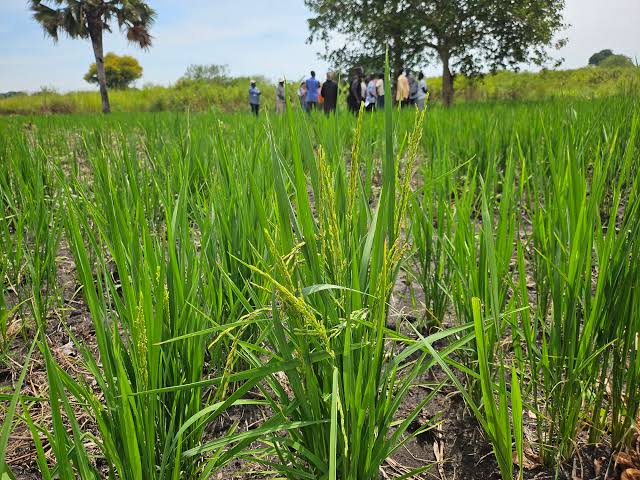
A Japan-funded, NARO-run project is teaching refugees and their hosts to grow NERICA 4 in lines rather than by broadcast. The yields are striking; the harder question is whether the gains can outlast the project.
Agriculture
In Pitia village, Kululu Sub-county, Yumbe District, rice farmer Taban Rashid used to scatter his seed by hand across the field. It was the way he had always done it. The method swallowed about 50 kilogrammes of seed an acre, made weeding a 15-day ordeal for every acre, and left him with grain that milled poorly because of the way it had been handled after harvest. His harvest averaged about eight bags an acre, worth roughly Shs800,000.
Since 2025 Rashid has trained under a project that treats rice as more than a crop. After adopting recommended practices, he told Nile Post, his harvest rose to about 25 bags an acre and his earnings to about Shs2.5 million. He now trains other farmers himself. Quality, he says, is determined in the garden and protected in storage; the milling machine only reveals the work done from planting onward.
His numbers are one farmer's account, not a controlled trial, and they should be read that way. But they sit inside a larger story that was on display this week, when officials from UN Women, Peace Winds Japan and the National Agricultural Research Organisation (NARO) toured demonstration gardens in Yumbe and Madi Okollo districts. The tour, reported by Nile Post on 19 October 2026, assessed progress, quality of implementation and a challenge farmers know well: a prolonged drought.

A peace project that grows rice
The initiative is formally called the Project for the Implementation of the Women, Peace and Security Agenda in Refugee Settlements and Host Communities. The Government of Japan funds it, UN Women Uganda is the grant recipient and Peace Winds Japan is an implementing partner. NARO runs the livelihood component, training farmers in improved rice production and distributing quality seed, mainly the NERICA 4 variety.
Natasha Butorac, UN Women's Women, Peace and Security Specialist, explained the logic. The project addresses the links between climate change, competition over natural resources and conflict. "Part of the aim of this intervention is to bring in drought-resilient and disease-resilient varieties of rice," she said. Higher productivity, she argued, can raise household incomes and food security and ease the economic pressure that can fuel disputes. The approach aligns with Uganda's Women, Peace and Security National Action Plan, which treats climate-related risk as an emerging security threat.
West Nile is a place where that framing is not abstract. The sub-region hosts some of the country's largest refugee settlements, including Bidi Bidi in Yumbe, and refugees and host communities share land, water, firewood and grazing. When rains fail, those shared resources are the first things people argue over. A crop that survives a dry spell is therefore also a quiet form of conflict prevention.
Why NERICA 4, and why now
NERICA 4 is one of the upland rice varieties bred for African conditions by crossing African and Asian rice. According to Dr Emmanuel Odama, a senior NARO research officer, it has disease tolerance and some drought tolerance. Demonstration gardens planted with it have shown encouraging results despite the extended dry spell. Local varieties, he said, would have produced nothing under those conditions. Amaku Shaban, chairperson of the Dongoloto Farmers Group in Kululu, agreed: line planting and NERICA 4 helped group members keep their crop when the weather turned poor, while the group's ordinary seed would have failed.
The choice of rice was not imposed. Dr Moses Biruma, director of research at NARO's Abi Zonal Agricultural Research and Development Institute in Arua, said a needs assessment before the project found rice to be the preferred enterprise among target farmers. The intervention was built around that preference: improved seed, practical training, and better production and post-harvest handling.
The timing matters. The Ministry of Water and Environment has warned of an El Nino-driven swing from a dry first part of the season to heavy rain in late October and November, and drought has already damaged crops in several parts of the country this year. A variety that tolerates dry spells helps with the first half of that pattern; the second half, waterlogging and flooding, is a different test that the early results do not yet address.
The method behind the yields
The agronomy is as important as the seed. The project uses the Musomesa field school approach. Farmers establish a "mother garden" where the group learns together, and "baby gardens" where each member practises on their own plot. Participants need access to at least half an acre of land.
The practice change that Rashid describes, from broadcasting about 50 kilogrammes of seed an acre to line planting, is the heart of it. Line planting uses less seed, makes weeding quicker because rows can be hoed or weeded between, and gives plants more consistent spacing. Better handling at harvest and drying then protects grain quality and milling returns. None of this is exotic technology. It is the sort of knowledge that the national extension system, stretched at roughly one worker for every 1,800 farmers against a recommended 1:500 according to figures cited earlier in our coverage, struggles to deliver at scale. Field schools substitute farmer-to-farmer teaching for scarce extension officers, and the project's early results suggest that works.
Women at the centre
Butorac said the project builds on lessons from the JICA-supported Eco-PRiDe Rice project, which demonstrated the potential of improved rice but reached too few women. This time, she said, most of the farmers taking part are women, which challenges stereotypes about who farms. That matters beyond fairness. Women do much of the labour in smallholder rice, but men often control land and sales. A project that puts women in the demonstration gardens and the training seats, and tracks their results, is trying to shift who gets the income.
Land: the quiet unlock
One of the more interesting findings is about land. Odama said cooperation between refugees and hosts has helped refugees access more land than the Office of the Prime Minister's settlement arrangements would normally provide, with some host community members sharing plots. Given that a half-acre minimum is required to join, access to land is the gatekeeper of the whole programme. If hosts are willing to share because the project gives both sides a stake in the outcome, that is a replicable design lesson. If it depends on goodwill that evaporates when the project ends, it is not.
What to watch
Three questions will decide whether this is a promising pilot or a durable change. The first is evidence. NARO says it is tracking progress against baseline data using indicators such as adoption of recommended practices and yield improvements. Published results, with sample sizes and comparisons against non-participating farmers, would turn individual testimonies into a case that planners and donors can rely on.
The second is seed. NERICA 4 benefits only reach farmers who can obtain true-to-type seed, season after season. If seed is distributed free during the project but no local multiplication or agro-dealer supply takes root, farmers will either recycle grain, with declining performance, or return to local varieties. Group-based seed multiplication, which NARO has used elsewhere in the north, is an obvious route.
The third is the market. A jump from eight to 25 bags an acre is only valuable if the extra rice finds a buyer at a decent price near the farm and can be milled without losing quality. Rashid's point about milling returns shows that value is lost long before grain reaches the market. Farmer groups that can aggregate, store and sell together, perhaps through a cooperative, would strengthen their bargaining position. Our own coverage of the cooperatives and credit sector has repeatedly noted the high cost of agricultural borrowing, with the Bank of Uganda reporting agriculture's weighted lending rate at 19.6 percent in August, so self-financing through higher incomes may matter more than loans for these farmers.
The bigger picture
Uganda has spent years trying to raise rice output and cut reliance on imports, and has restricted wetland rice growing, pushing production toward upland systems. A project that shows upland rice working in a dry year, under refugee-host conditions, adds a useful data point. For West Nile households, the immediate prize is food and income. For the country, it is a template for pairing climate adaptation with social stability.
For farmers like Rashid, the proof is already in the bags. The test for the project's funders, NARO and the districts is whether the next farmer, in the next village, in a year when the project has packed up, can do the same.
Published By | Features Editor