Written By | Staff Writer
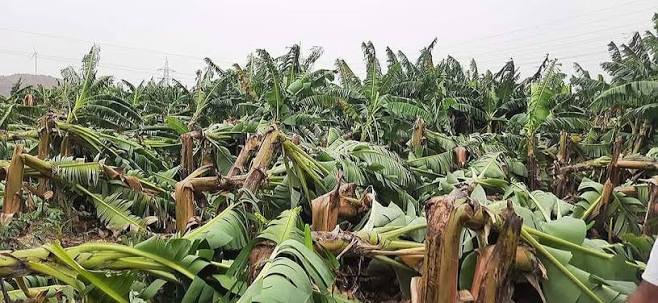
After nearly a year of failed rains, the downpours finally returned to Acholi last week — and arrived as hailstorms that flattened more than a thousand gardens in Unyama and Palaro.
Feature
Three days of rain, two days of ruin
For most of this year, farmers in Gulu District have been praying for rain. Last week they got it, and it took everything they had left.
Hailstorms struck Palaro Sub-county on Monday and Unyama Sub-county on Tuesday, destroying standing crops across both areas. In Unyama, LCIII chairperson Justin Kidega said more than 1,000 gardens containing vegetables, cereals and trees in Agung and parts of Oding villages were wrecked.
“The damage is too much. We carried out inspections and, in many of the gardens, there is nothing left,” Kidega said. “We estimate that more than 200 households have been affected. We are expecting serious hunger next year.”
In Palaro, LCIII chairperson Francis Joel Wokorach put the figure higher. Beans, sorghum, maize and simsim were completely destroyed, he said, and “a total of 410 households in Palaro Sub-county will need food support in the near future because they have lost all the food they expected to harvest.”
Gulu District LCV chairperson Justin Obol captured the cruelty of the sequence in a sentence. “We have had a dry spell for a really long time. The rains just started returning three days ago, but they are now too heavy,” he said. “The little food crops people have in their gardens that should have survived on the rain have now been destroyed.” Obol has directed LCI chairpersons to compile lists of affected households for submission to the Ministry of Disaster Preparedness and Relief.
Why hail is worse than it sounds
A hailstorm can sound like a bad afternoon. Agronomically it is close to the worst possible loss event, for reasons of timing rather than force.
Drought destroys a crop gradually and early. A farmer watching maize wilt in June still has the option — painful, but real — of abandoning the field and replanting something shorter-cycle. Hail destroys a crop instantaneously and late, at the point when every shilling of seed, every hour of weeding and every bag of fertiliser has already gone into the ground and the plant is carrying grain. The investment is fully sunk and the return is zero.
The crop mix in Palaro makes that worse. Beans, sorghum, maize and simsim are second-season crops in this part of Acholi, planted around August for a November–December harvest. Hail in mid-September catches beans in flowering or early pod-fill and maize in tasselling or grain-fill — stages at which a shredded canopy cannot regenerate. Simsim, with its brittle stems and shattering capsules, is particularly unforgiving.
And there is no replanting window. A crop sown in late September would need rain into January to mature, and after a drought year few of these households have seed to plant with anyway. For Unyama and Palaro, the 2026 second season is over.
Farmer in her garden destroyed by rain [File: Courtesy]
Falling on ground already cleared out
The storms did not land on a district with reserves. Much of the Acholi sub-region is already in food deficit, following prolonged dry spells in the second planting season of 2025 and the first planting season of 2026 — two consecutive failures before this one.
That history matters for how the 610-odd affected households will cope. In a normal year, a household that loses a garden sells a goat, borrows from a neighbour, or buys food with cash from a surviving crop. After eighteen months of poor harvests those buffers are gone: the small livestock has been sold already, the neighbours are in the same position, and there is no cash crop left.
Acholi district leaders raised the alarm about crop failure across the sub-region in August, citing tens of thousands of affected households across Agago, Lamwo, Pader, Kitgum, Gulu and Nwoya. A nationwide drought survey published earlier this month found the same pattern from Masaka to Soroti — including, pointedly, the failure of the drought-tolerant fallback crops farmers switch to when maize and beans fail.
What follows repeats the same script every time. Households shift from three meals to two, then one. Seed stock gets eaten. Children leave school because there is nothing to sell for fees. The next season's planting is undermined not by weather but by the absence of seed — which is why Kidega's phrase was “serious hunger next year” rather than next month.
A committee that exists but does not function
The most consequential detail in the Gulu reporting is not meteorological but administrative. Obol confirmed that the district disaster management committee — the body meant to coordinate community safety, disaster risk reduction and emergency response — exists but is largely inactive for lack of resources. That is why, days after the first storm, the response consists of village chairpersons walking through gardens with notebooks compiling lists of names.
The gap between having a structure and having a functioning one is where most of the harm sits. A working district disaster committee does things that cannot be improvised afterwards: it holds a contingency budget line, it has a pre-agreed damage-assessment methodology so numbers submitted to Kampala are credible on arrival, it maintains a seed buffer, and it can act without waiting for a ministry to schedule a verification visit.
Without those, a manual list joins a queue at the centre and is verified on somebody else's timetable. Relief arriving in January for a crop lost in September keeps people alive, but does not stop the seed stock being eaten in the meantime — the loss that carries into the following year. This is not a Gulu-specific failure: district disaster committees across Uganda are chronically unfunded. The committees are in the plan. They are rarely in the budget.
The forecast says this is the pattern, not the exception
The Ministry of Water and Environment's September-to-December 2026 seasonal climate outlook warned explicitly of increased risk of crop damage and yield losses from extreme rainfall, hailstorms, strong winds and flash floods. It projects the established El Niño episode to intensify through September, October, November and December over central, eastern and northern parts of the country — which includes Gulu.
That is the crucial framing. The Unyama and Palaro storms are not the tail end of a bad run now over; they are the opening of the season the forecast described. A country that spent June to August watching crops die of thirst is entering three months in which the main hazard is too much water arriving too violently.
It is also a familiar physical signature. A long dry spell bakes the soil surface and strips vegetation cover; when intense rainfall finally arrives, less water infiltrates and more runs off, so a storm that would have been absorbed in a normal year produces flash flooding and erosion instead. Drought does not simply precede flood damage — it amplifies it.
The forecast itself ran into the problem it always runs into. Uganda's meteorological service has repeatedly acknowledged that seasonal outlooks do not reach smallholders in usable form — constrained by budget, by translation into the dozens of languages farmers speak, and by the absence of district-level staff who could turn a national bulletin into advice about a specific parish. A warning published in Kampala is not an intervention in Agung village.
What would have helped, and what will
Very little physically protects a maize crop from hail. Hail nets are used in high-value horticulture; at millions of shillings an acre they are not a smallholder cereal technology anywhere in the world.
What does exist is financial protection, and it is almost entirely absent here. The Uganda Agriculture Insurance Scheme covers roughly a million farmers with a state premium subsidy, but its weather-index products are built around rainfall deficit — drought — rather than localised destructive events. A hailstorm that flattens 1,000 gardens in two villages while leaving the sub-county's rainfall totals looking healthy is precisely the loss an index product is designed not to pay on. Closing that gap needs named-peril or area-yield cover, and someone willing to distribute it at parish level.
Three things would change the arithmetic for districts like Gulu. First, a funded standing disaster committee with a contingency line and a pre-agreed assessment protocol, so damage lists are compiled to a national template within 72 hours rather than improvised afterwards. Second, a seed buffer held at district level — because the most valuable intervention after a total crop loss is not food aid but seed in time for the next planting. Third, cover that actually pays on the perils farmers face, distributed through the SACCOs that already hold the credit relationship in these parishes.
None of that is exotic, and all of it is cheaper than emergency relief. For the 200 households in Unyama and the 410 in Palaro, it is also too late. Their next real chance at a harvest is the first season of 2027, which begins with land preparation in February — and whether they reach it with seed in hand depends almost entirely on decisions taken, or not taken, in the next eight weeks.



