Written By | Staff Writer
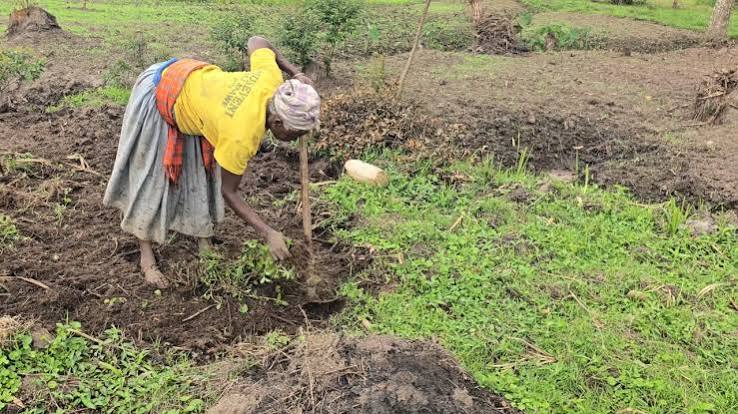
From Ntungamo's replanted fields to a hail-struck Tororo and a Wakiso expo promising quick-maturing seed, the second season is exposing how little cushion smallholders have.
In Ntungamo, farmers who planted beans and other crops for the second season are digging the same fields again. In Tororo, a hailstorm on Sunday afternoon flattened maize, bean and soybean gardens a month before some households expected to harvest. In Wakiso, scientists and ministry officials were telling a crowd of farmers that quick-maturing seed and irrigation are the answer, while admitting the irrigation money has not yet arrived. Taken together, three Nile Post reports from the past three days sketch a second planting season that is being decided by weather, seed prices and credit far more than by agronomy.
What is new this week is not that the climate is erratic; Ugandan farmers have been hearing that for months. It is that the cost has now become concrete: replanting bills, a higher price for bean seed, and a ministry that concedes market interest rates are "very high" for the farmers it wants to mechanise and irrigate.
Ntungamo: planting twice
Nile Post's Bridget Nsimenta reported on 26 October that delayed rains disrupted the second season in Ntungamo District in south-western Uganda. Seeds sown during a prolonged dry spell failed to germinate or withered in the field, and farmers are now replanting in October, which adds to their production costs. The second season normally begins with land preparation in August and planting in early September, so replanting in late October pushes harvests deep into the dry months, or beyond what the rains can support.
The cost shock is visible in seed. Bean seed in the district now costs Shs4,500 to Shs5,000 a kilogram, up from about Shs3,000 in the previous season, according to the report. For a household that has already lost one planting, buying a second round of seed at a price that is roughly 50 to 67 percent higher is a heavy blow. Farmers who had access to water kept their crops alive, the report noted, while others lost them, a reminder that the gap between irrigated and rain-fed plots is now the main source of inequality within a single parish.
Officials in Ntungamo struck an optimistic tone. Resident District Commissioner Miriam Kagaiga Mugisha urged farmers to plant crops with reliable markets: "The rains have come. Let's go plant matooke, coffee, cassava because there is market." District Production Officer Dr Yake Basulira advised planning around weather patterns, using drought-tolerant varieties, certified seed and extension advice, and making use of tractors allocated to SACCOs and institutions. The district has also distributed organic fertiliser. The forecast supports cautious hope: the Department of Meteorological Services expects near-normal to above-normal rainfall for September to December, with warmer-than-average temperatures.
That hope sits against a hard recent record. The report notes that from April to August, high temperatures hit livestock, coffee, bananas and other crops in the area. Elsewhere, the agriculture ministry said in September that drought in Greater Masaka, Kyotera, Sembabule and Luwero had cut coffee out-turn by about 10 percent in affected areas. In Rubanda, an earlier Nile Post report described cabbage prices rising from Shs500 to Shs3,000 after months without rain.
Tororo: when the rain turns violent
If Ntungamo shows the cost of rain arriving late, Tororo shows the cost of it arriving badly. Nile Post's David Ochieng reported on 26 October that a hailstorm struck Tororo Municipality on Sunday 25 October between about 2:00 and 3:30 p.m., followed by heavy rain that flooded roads. By 6:00 p.m., hailstones were still lying in gardens and along roads. Maize, beans and soybeans were damaged, including in Amagoro A Central.
One affected farmer, Grace Atheino, had been struggling to feed her family and expected to start harvesting within about a month. Farmers are assessing losses and have asked the government for help. Residents also blamed municipal authorities for poor drainage, saying it causes recurring flooding and road damage; Tororo Municipality could not be reached for comment and had not responded publicly at the time of publication.
Hail is a localised hazard, and the loss may be modest in national terms. But it exposes a gap in the safety net. Uganda has a government-backed agriculture insurance scheme: Nile Post reported on 24 October that the Uganda Agriculture Insurance Scheme, with more than ten insurers, has the government paying half of the premium, and 80 percent in drought-prone areas, with claims promised within six weeks. Whether a farmer in Tororo had cover is not stated in the report, and for most smallholders the answer is probably no. A UNDP assessment in August 2026 put cumulative claims at Shs53.8 billion for about one million farmers, a fraction of the farming population.
Wakiso: the policy answer, and its limits
On 23 and 24 October, at the 2026 Central Region Agribusiness Expo at IITA's Sendusu station in Namulonge, Wakiso District, the government's answer was laid out. Nile Post's Kenneth Kazibwe reported that the Eastern Africa Grain Council and IITA co-hosted the two-day event, which targeted 5,000 farmers and 55 exhibitors, with demonstration plots of drought-tolerant varieties.
Dr Mary Teddy Asio of the agriculture ministry's seed certification department said IITA and NARO have developed maize, millet and sorghum varieties that yield with little rain or mature early, many of which have gone to Karamoja. IITA breeders are adding pest, disease and drought resistance to local bananas such as Nakitembe and Mpologoma rather than replacing them. IITA's Dr Violet Akech said the improved hybrids "are not new things, it is just simply what the farmer is already growing". IITA also handed Aflasafe, a biological control against aflatoxin developed with NARO, to NARO Holdings Limited for commercialisation.
The harder admissions concerned money. Asio said the ministry is developing a national irrigation project that will roll out nationwide only if the Ministry of Finance provides funding. Earlier small-scale schemes had farmers paying 20 percent of equipment cost and government 80 percent, but not every district was covered, while the World Bank-funded Uganda Climate Smart project supplies irrigation systems free of charge. "We are trying to roll out irrigation because there is no other option at the moment," she said. On credit she acknowledged that current interest rates, at 12 percent by her account, are very high, though set by market forces, and said the ministries are talking to financial institutions about grace periods. Tractors remain beyond many smallholders, she said, so the government encourages group farming.
This matches the record in the minister's sector statement to Parliament on 21 October: irrigation had reached 7,203 hectares across ten schemes, and 1,080 tractors had been distributed since 2018 against a target of 10,000. Quick-maturing seed is the cheap part of the answer. Irrigation and mechanisation are the expensive part, and they are still waiting for the budget.
The seed rules matter, too. Asio explained that one regulation makes certification mandatory for varieties, while another allows "quality declared seed", a looser system under which farmers choose seed on disease resistance and yield, and may keep using older varieties that withstand pests, disease and drought. The balance matters because counterfeit seed remains a concern: EPRC estimates quoted in earlier coverage put counterfeit seed at 30 to 40 percent of the market.
Back to the seed bank
The same week offers a different kind of answer. PELUM Uganda, with the agriculture and trade ministries, opens an Agroecology Week today, Tuesday 27 October, running to 30 October. It begins with the 8th National Agroecology Actors' Symposium, followed on 28 October by the 5th Agroecology Market Systems Expo at Hotel Africana, Kampala, and on 29 and 30 October by the 16th Annual Indigenous Food and Traditional Seed Fair, according to Nile Post. PELUM's Josephine Luyimbazi said the aim is to address challenges facing food systems amid rising food prices. The organisation says its members cover 122 districts and reach more than three million smallholders.
Indigenous seeds and farmer-managed varieties are, in effect, the low-cost end of the climate-adaptation spectrum. They are not a substitute for improved drought-tolerant lines, but a farmer who saves local seed does not face a Shs5,000 per kilogram price when the first planting fails.
What to watch
For the next six weeks, the forecast for above-normal rainfall will test every field that has been replanted. Heavy rain on newly planted ground brings its own risks, from waterlogging to erosion, and the Tororo hailstorm shows how quickly it can turn destructive. Watch whether bean prices in Kampala markets, already high, rise further as the replanted harvest is delayed. Watch also whether the Finance Ministry funds the national irrigation project, and whether lenders respond to the ministry's request for longer grace periods at a time when borrowing is expensive.
The lesson of the second season is that technology is arriving faster than the finance to deploy it. Seeds that mature in three months are only useful to farmers who can afford to buy them twice.



