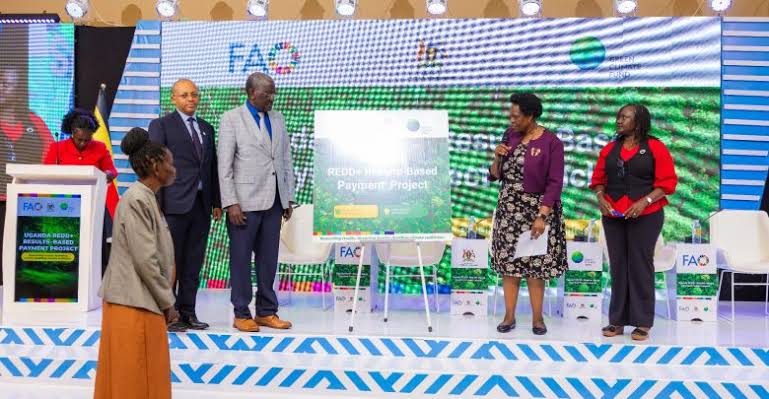
Uganda became the first African country to win a results-based payment from the Green Climate Fund for cutting deforestation. With implementation now under way, the money's success will hinge on an uncomfortable fact: agriculture drives most forest loss, and the farmers who clear land need something better to do with it.
Feature
When the Green Climate Fund approved a results-based payment of $31 million for Uganda, the headline was about carbon. The first Green Climate Fund payment of this kind to an African country, it rewards Uganda for verified emission reductions of roughly eight million tonnes of carbon dioxide equivalent achieved between 2016 and 2017 through reduced deforestation and forest degradation. The Daily Monitor put the shilling value at about Shs118.8 billion; The Independent reported Shs113 billion. Exchange rates explain the gap, and the dollar figure is the constant.
But the more consequential story is now unfolding on the ground. In a report on 20 September, the Monitor called the moment a 'big test' for the project. The question it raises is whether Uganda can reduce pressure on forests without worsening the economic vulnerability of rural households. Put differently, it is a question about farming.
What the money is for
According to The Independent, the project is expected to benefit about 105,000 people across 17 priority districts in central and eastern Uganda, including areas around Mount Elgon. The FAO, as the GCF-accredited entity, manages the funds and works with the Ministry of Water and Environment under a multi-stakeholder governance structure. FAO says the funding will support sustainable land management and agroforestry, natural forest restoration, and monitoring and verification systems. The Independent adds that delivery will include climate-smart agriculture and sustainable energy technologies for communities.
Minister Beatrice Atim Anywar said the payment shows how countries that take credible action to protect and restore forests can be financially rewarded. Officials describe it as seed capital for scaling forest conservation rather than an endpoint. The Economic Policy Research Centre's Christine Alum wrote that the government intends to reinvest proceeds in community-based timber and pole plantations, bringing income-generating trees closer to villages and reducing pressure on natural forests. She named four conditions for scaling the model: stronger measurement and verification, integration of carbon revenue into national development plans, affordable alternatives to forest clearing, and community awareness of how carbon credits work.

The agricultural pressure behind the forest loss
The scale of the challenge is set out in FAO's own account. Uganda has about 2.36 million hectares of forest, and agricultural expansion accounts for nearly 90 per cent of forest loss. Forests regulate rainfall, protect soils and supply firewood, poles and timber to millions of households. Government aims to restore forest cover to 24 per cent by 2040, according to the Monitor.
That 90 per cent figure changes how the payment should be understood. It is not a conservation grant sitting alongside agriculture. It is, in practice, a farm-policy instrument, because the surest way to keep land under trees is to make the land already under crops more productive and more profitable. A farmer who can double yields on two acres has less reason to clear a third.
Where soil, inputs and forests meet
Uganda's most direct productivity gap is fertiliser. When the agriculture ministry began distributing 173,913 bags of free fertiliser on 31 August, the Monitor reported that Ugandan farmers apply only 2 to 3 kilograms per hectare, against a continental average of 22 kilograms and the regional Abuja target of 50. Depleted soils push households toward fresh land, and fresh land often means the forest edge, the wetland fringe or the hillside.
Evidence from the field reinforces the point. In Mityana, where Buganda Kingdom and government officials visited coffee communities on 27 September, farmers listed pests, prolonged drought, limited fertiliser access and inadequate knowledge of modern techniques among their main obstacles, Nile Post reported. Similar constraints cause yields to fall short in many of the districts where forest pressure is highest. Agroforestry, one of the FAO-listed uses of the GCF money, is therefore well aimed: trees on farms can supply fuelwood and poles, improve soil, and provide shade for crops such as coffee, taking some pressure off natural forests while supporting household income.
The drought adds urgency. Farmers in Nyakyera, Ntungamo, who lost coffee to a dry spell that ran from April to mid-September, told Nile Post that recovery may take years. When crops fail, households turn to charcoal, tree-cutting and land clearing to fill the gap in income. A forest-protection programme that ignores that reality risks being overwhelmed by it.
The risks: verification, benefit-sharing and time
Three risks deserve attention. The first is delay. The payment rewards results achieved in 2016 and 2017, and the project is only now moving into delivery. Communities living beside forests today may struggle to see the link between a payment for past results and their present choices, unless benefits reach them quickly and visibly.
The second is benefit-sharing. With about 105,000 direct beneficiaries across 17 districts, the money is spread thinly compared with the number of households that farm near forests. Transparent selection, and clear rules for who receives seedlings, energy technologies or training, will matter. The Monitor's framing of the project as a test of whether household vulnerability can be avoided points to exactly this.
The third is durability. FAO has stressed the long partnership behind the achievement, more than 16 years of cooperation with the World Bank, the Austrian Development Agency and the UN-REDD Programme. Protecting the emission reductions already achieved is the immediate priority, according to the Monitor, and additional financing will depend on credible measurement of further results.
What it means for farmers and the economy
For farmers near forests, the best outcome is a package that pairs conservation with tangible income: tree nurseries, pole and timber plots, efficient stoves, and access to inputs and advice that lift yields on existing land. For the wider economy, the payment is a proof of concept that performance can attract climate finance without adding to public debt, as the EPRC commentary argued. It is also a reminder that agricultural productivity, land use and climate policy are one conversation.
The signal to watch over the next year is not the size of the grant but the visible change in the gardens around the forest edge. If farmers in the 17 districts gain more from a hectare of crops than from clearing another, the $31 million will have done what it was meant to do. If not, Uganda will have earned a payment for past forest protection without securing its future.
Published By | Features Editor