Written By | Staff Writer
From Bugisu to Teso to West Nile, district ledgers show single-digit and low-double-digit repayment on government revolving funds, and officials say a belief that the money was a gift is a big part of why.
Uganda Agriculture
A fund that was never meant to be a gift
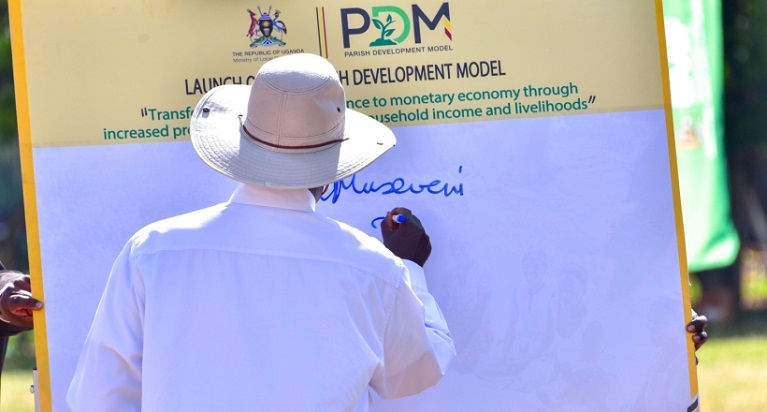
On 8 October, in a meeting with district leaders from the Bugisu sub-region, Rita Namuwenge, the national coordinator of the Emyooga monitoring team, said something that officials in several districts have been quietly repeating for months. When recovery teams knock on doors, she said, some beneficiaries tell them that President Yoweri Museveni gave them the money. Nobody, in that telling, is owed a repayment.
That belief, more than any single act of fraud, sits at the heart of a revolving-fund problem that is now surfacing in district after district. Emyooga, the presidential initiative that channels seed capital to enterprise-based savings and credit cooperatives, has absorbed about Shs766 billion since its launch, according to Namuwenge. The Parish Development Model (PDM), which routes money through parish SACCOs, is far larger. Both were designed on the same principle: money lent to one household must come back so that it can be lent to the next. Where it does not come back, the model stops working, and the people who pay are the farmers who were meant to be next in line.
This is not a story about one district. It is about what the numbers coming out of Bugisu, Teso, Mityana and West Nile in the past six weeks say, taken together, about the future of cheap rural credit in Uganda.
What the district ledgers show
Nile Post's report from the Bugisu meeting gives the starkest side-by-side figures. Namisindwa District received Shs1.2 billion and has recovered Shs450.4 million. Sironko received Shs2.8 billion and has recovered Shs556 million. Bulambuli received Shs1.6 billion and recovered Shs240 million. Bududa received Shs2.5 billion and has recovered about Shs534.4 million. Recovery rates in those four districts therefore range from roughly 15 per cent in Bulambuli to about 38 per cent in Namisindwa, on my arithmetic from the reported figures.
Those are the better-looking numbers. In Teso, the Daily Monitor reported on 9 September that Kalaki District had recovered only Shs5 million of roughly Shs12 billion disbursed under PDM, following an oversight visit by the Minister of State for Economic Monitoring, Sandra Santa Alum. In Bukedea, a district commercial officer told the State Minister for Microfinance, Haruna Kasolo, that only Shs27 million of Shs550 million advanced to 17 SACCOs had been recovered, about 5 per cent, according to NTV. Kasolo ordered those who had diverted money, including to school fees, to refund their SACCOs within 30 days.
In Mityana, New Vision reported on 16 September that the district had received Shs30.5 billion under PDM since 2020/21 for 23,004 households. Lands Minister Judith Nabakooba, who is also the district's Woman MP, said that of 17 Emyooga SACCOs in Mityana North, each of which received roughly Shs30 million, only three had recovered their money and qualified for the extra Shs20 million. In Kalangaalo Sub-county, the best-performing parish had repaid just Shs3 million; some parishes had returned as little as Shs40,000.
The latest data point came from Nebbi, where Nile Post reported on 16 October that across the district only Shs2.7 million had been recovered from Shs6.6 billion disbursed to 6,600 beneficiaries. The two-year grace period for the first cohort expired in February 2026. In Nebbi Hill Ward alone, Shs369 million went to 369 beneficiaries and Shs1.2 million has come back.
Why money does not return
Officials offer overlapping explanations, and they are worth separating because they point to different fixes.
The first is perception. Masindi's district commercial officer, Moses Kalyegira, told the Daily Monitor in June that many borrowers wrongly thought the money was a political reward or personal donation: 'This money is not a handout.' Mityana's commercial officer, Ivan Kisakye, said some beneficiaries who received funds around the 2021 general election saw them as government assistance. The timing of disbursement relative to elections is not a coincidence that lenders can ignore. A loan that arrives with a campaign poster is hard to collect as a loan.
The second is selection and targeting. In Nebbi, officials blamed irregular beneficiary selection in 2023 and missing database records. Many members who chose cassava, the district's production officer Andrew Yangchon acknowledged in the Nile Post report, did not have farmland; the groups' chairperson, Yofesto Okecha, said bluntly that most of the farmers had no gardens. A farming loan to someone without land is, in practice, a consumption transfer with a repayment schedule attached.
The third is diversion and fraud. Emyooga's head of operations, John Turinawe, alleged in Bugisu that people posing as State House officials, soldiers and veterans had obtained funds, and described a Bududa case in which about six or seven SACCOs drew Shs29 million to Shs30 million with the involvement of staff of an implementing agency and a bank. Namisindwa's commercial officer, Bernard Kitongo, said some beneficiaries and SACCO leaders had left the country. In Bududa, LCV Chairperson Geoffrey Natubu said some SACCOs include members who do not practise the enterprises the groups were formed for.
The fourth is weak governance of the SACCOs themselves. Members are expected to save at least a third of the loan amount, yet Turinawe said some save only the minimum. In Nebbi, about Shs5 million is stuck with five beneficiaries who lost their passwords to the Wendi digital account system.
The fifth, which officials mention less often, is the farm itself. A cassava crop takes close to a year to mature; Nebbi's trainers are now steering members to cabbages and onions that can be harvested in about three months, so that borrowers start earning within a repayment window. That is a sensible adaptation, but it is also an admission that enterprise choices were made without regard to the repayment clock. A second-season harvest wiped out by drought, as in many parts of the country this year, makes the maths worse.
The state's response: carrots, sticks and a bigger cheque
The policy response has two strands that pull in opposite directions. On enforcement, the pressure is rising. Masindi's Resident District Commissioner, Darius Nandinda, ordered demand notices and warned that defaulters risk arrest and prosecution. Kasolo's 30-day refund order in Bukedea and Nabakooba's instruction to Mityana leaders to step up recovery follow the same line. Nabakooba also said beneficiaries could repay in instalments, such as Shs80,000 a month, a notable softening of terms.
On expansion, the signal is quite different. In Bugisu, the monitoring team told leaders that each Emyooga SACCO is meant to receive an extra Shs20 million every financial year, a reward that Namuwenge warned could be withheld from regions with poor repayment. Cissy Mulondo, the State Minister for General Duties, closed a Microfinance Support Centre leadership training in Kyankwanzi on 13 October with the message that 'Emyooga seed capital is a revolving fund, not free money.' Meanwhile the government's broader agricultural credit push, including partnerships with SACCOs, continues.
The tension is plain. Recovery campaigns led by security officers and NRM local chairpersons, as in Masindi, risk reinforcing the very perception, that the money is political, that officials say is the problem. A fund that is collected through the party machine will continue to be seen as the party's money.
What it means for farmers and the wider economy
For farmers, the immediate cost is access. Repayment performance determines who gets the top-up money, so honest borrowers in a district full of defaulters lose out alongside the defaulters. That penalty is collective and it falls hardest on the SACCOs that are functioning: the three of 17 in Mityana North that recovered their capital, for example.
For the financial system, the picture matters because the state is attempting to graduate large SACCOs into the regulated sector at the same time. Bank of Uganda has set out a licensing path for large SACCOs, and the Bank's August Monetary Policy Report put the weighted agricultural lending rate at 19.6 per cent, well above transport at 14.8 per cent. Subsidised revolving funds are the government's answer to that gap. If they leak, the case for private lenders to step into agriculture at lower rates becomes harder to make, because the visible evidence is a public programme with recovery rates in single digits in some districts.
What would actually change the numbers
The data point to a small set of fixes. First, clean the beneficiary registers before disbursing again, since district officials themselves say selection and records were the weak point in Nebbi and elsewhere. Second, match the enterprise to the repayment calendar, as Nebbi's switch to short-cycle vegetables attempts to do. Third, pair lending with real financial-literacy and savings requirements, so that the one-third savings rule is enforced rather than minimally met. Fourth, publish district recovery league tables so that communities, not only ministers on oversight visits, can see which SACCOs are performing. Finally, separate the political messaging from the lending. The most effective recovery tool may be the plainest: a clear, repeated public statement, from the very top, that the money is a loan.
Until that happens, the early pattern in the ledgers is likely to hold: strong repayment in a handful of well-run groups, and silence from the rest. The risk is that a model meant to move households from subsistence into the money economy ends up teaching a different lesson, that public money in the village is not meant to come back.



