Written By | Staff Writer
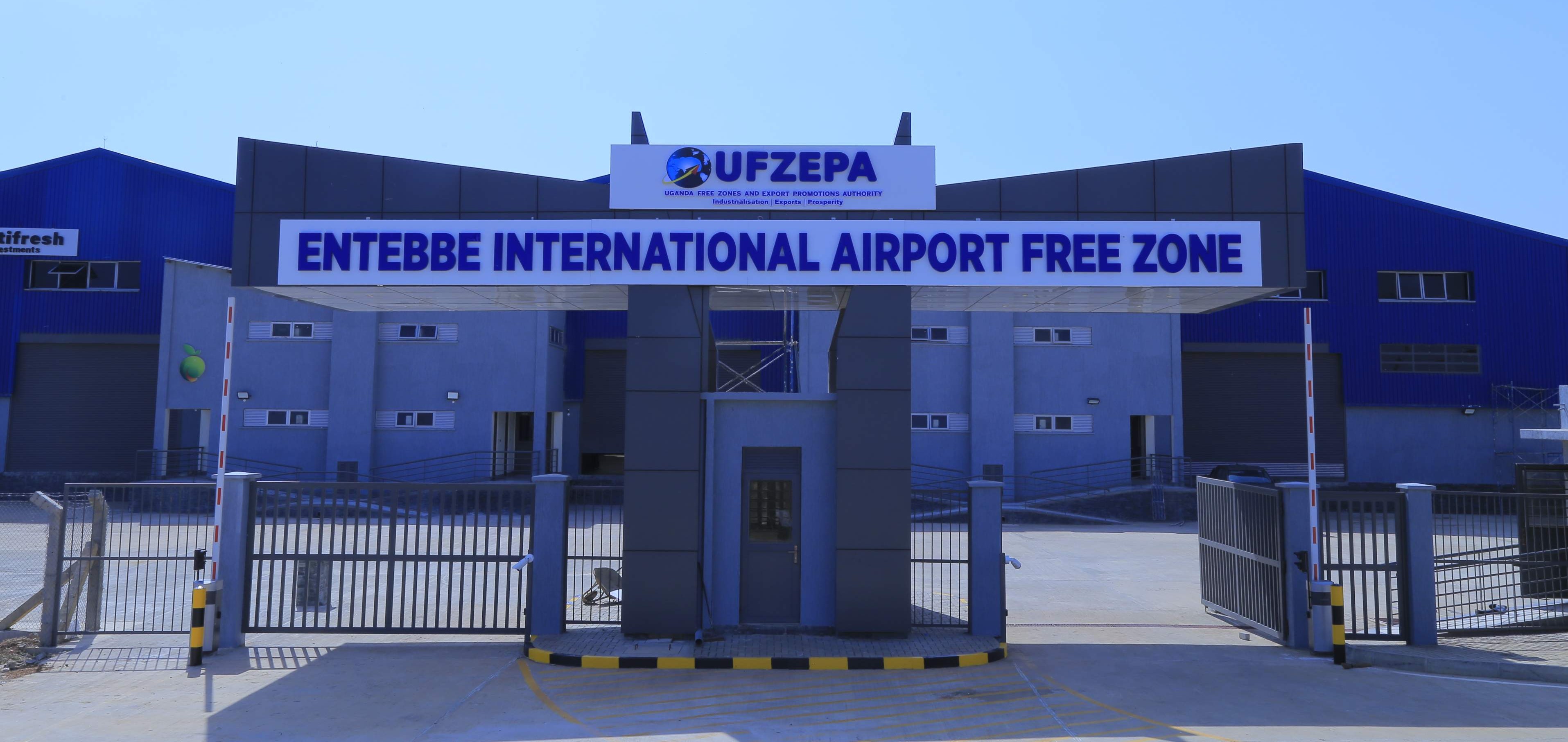
Nearly two years after commissioning, exporters at the UFZEPA–Uganda Manufacturers Association Business Forum said they are still waiting for the authority behind it to function properly
Entebbe
Standing before manufacturers, exporters and private-sector players gathered at the Entebbe International Airport Free Zone on August 15, Trade, Industry and Cooperatives Minister Sanjay Tanna delivered an unusually blunt ultimatum: the Uganda Free Zones and Export Promotions Authority (UFZEPA) has two months to become fully operational, or answer for why it has not. The setting was deliberate. The Entebbe Airport Free Zone — commissioned by President Museveni back in December 2024 as Uganda's first public free zone, purpose-built to fast-track high-value, time-sensitive exports like fresh flowers, fruits, vegetables, fish and coffee through the country's main international air-cargo gateway — is precisely the kind of facility whose promise has outpaced its delivery. Nearly two years after commissioning, exporters at the UFZEPA–Uganda Manufacturers Association Business Forum said they are still waiting for the authority behind it to function properly.
The gap between ambition and administrative reality is not new, but it has become acute enough that a sitting Cabinet minister felt compelled to set a public deadline. Tanna's frustration, according to accounts of the forum, centred on what officials describe as administrative limbo inside UFZEPA itself — a consequence of the 2024 merger of the former Uganda Free Zones Authority and the Uganda Export Promotion Board into a single statutory body under the Free Zones (Amendment) Act. That restructuring, intended to streamline Uganda's export and industrial-zone architecture into one agency with a clearer mandate, has instead left basic services stalled: export certifications and compliance verifications essential for clearing international shipments have been delayed, in some cases for prolonged periods, leaving exporters with stranded cargo and missed shipping windows.
A trillion-shilling gap, and one lost deal
The scale of what is at stake becomes clearer in UFZEPA's own numbers. The authority estimates it needs roughly Shs1.198 trillion to fully build out Uganda's public free-zone infrastructure — money for land acquisition, utilities, customs facilities and cold-chain logistics — against a financing envelope that has consistently fallen short. Beyond the money, UFZEPA is also grappling with a shortage of large, contiguous parcels of land suitable for new public free zones, and with the awkward task of harmonising 15 separate investment-incentive schemes inherited from predecessor agencies and other parts of government into something coherent for investors to plan around.
The human cost of the resulting delays has already shown up in hard numbers. Industry accounts of the merger's fallout point to at least one documented case in which prolonged uncertainty around UFZEPA's status contributed to the loss of a potential Shs180 billion export deal — a single transaction roughly equivalent to a third of the entire financing gap the authority says it needs to fix its own infrastructure. For an economy that has set a target of $26 billion in total exports and is counting on 43 licensed private free zones plus a network of public ones to help manufactured and processed goods — not just raw commodities — take a larger share of that figure, a stalled promotion-and-certification agency is not a bureaucratic footnote. It is a bottleneck sitting directly across the route to market for the country's most competitive export sectors.
Why agriculture has the most riding on this
Nowhere is that more visible than at Entebbe airport itself, which functions as Uganda's principal artery for perishable agricultural exports. Fish accounts for roughly 45 percent of air cargo leaving the airport, fresh flowers around 20 percent, and other fresh horticultural produce — tomatoes, cucumbers, green peppers, various fruits — most of the remainder. A $10 million solar-powered perishable cargo handling centre, built with support from the EU and Denmark's DANIDA, has already lifted the airport's cold-chain capacity, part of a broader push that industry projections put at growing horticultural export volumes from under 10,000 metric tonnes worth roughly $49 million toward 25,000 metric tonnes worth an estimated $150 million. Coffee and cocoa, Uganda's premier cash crops, also move disproportionately through Entebbe when destined for premium, time-sensitive markets rather than bulk sea freight.
The free zone concept at Entebbe was designed explicitly around this reality: locate certification, customs clearance, quality inspection and value-addition facilities for food processing (fish, beef, dairy), horticulture and logistics right at the cargo apron, cutting the hours — sometimes days — that perishable goods currently lose to fragmented processes spread across multiple agencies and locations around Kampala and the airport. Every hour a flower consignment or a batch of Nile perch fillets sits waiting for a certificate of origin or a compliance sign-off is an hour closer to a rejected shipment, a discounted sale, or spoiled product — the same underlying problem that hit Uganda's flower exporters hard in July when Middle East belly-hold cargo capacity collapsed and freight costs spiked, and the same fragility that shows up whenever Uganda's avocado, fish or horticultural exporters run into a snag with EU or Gulf market requirements. A properly functioning free-zone authority, with export certification and compliance verification running smoothly on-site, is meant to be part of the insulation against exactly those kinds of shocks. An authority still finding its administrative feet is the opposite: one more point of failure in an already fragile export chain.
What Tanna is actually demanding
The minister's two-month deadline is aimed squarely at closing that gap. While the full text of his remarks at the forum was not published in detail, the thrust — confirmed across multiple accounts of the event — is that UFZEPA must resolve the internal restructuring issues that have left it unable to reliably deliver the certifications and verifications that exporters depend on, and do so on a fixed and fairly short timeline rather than an open-ended one. That is a notable shift in tone from government's previous posture, which had largely framed UFZEPA's teething problems as an unavoidable consequence of merging two agencies and building new institutional capacity from scratch. A public ultimatum, delivered at the flagship free zone itself and in front of the manufacturers and exporters most affected, signals that patience inside government has a limit — and that the political cost of continued delays, measured in lost deals like the Shs180 billion shipment, has become too visible to absorb quietly.
For Uganda's agricultural exporters, the next eight weeks will be a genuine test of whether that pressure produces results. If UFZEPA can restore reliable certification and compliance services and make tangible progress on the Entebbe free zone's core promise — faster, cheaper, more predictable passage for coffee, fish, flowers and horticultural produce onto outbound flights — it could meaningfully improve the competitiveness of exporters already squeezed by high freight costs, tightening EU documentation requirements, and volatile regional cargo capacity. If the deadline passes with the same administrative bottlenecks in place, it will simply confirm what exporters gathered at the forum already suspect: that institutional reform in Uganda's export infrastructure remains easier to announce than to deliver, leaving the country's highest-value, most time-sensitive agricultural exports to keep absorbing the cost of delay.




