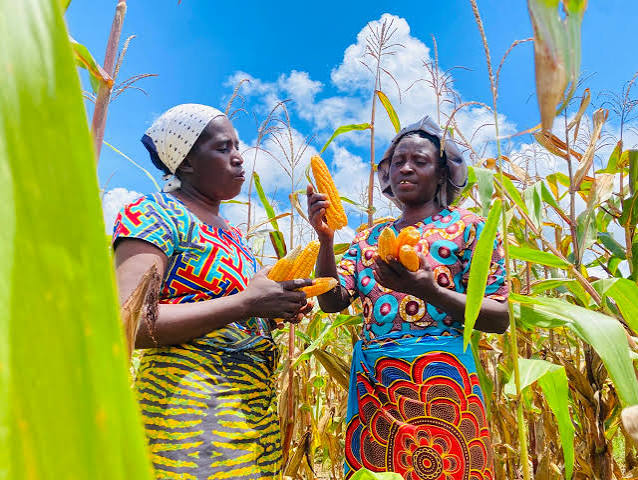
In one of Uganda's big maize districts, a network of paid community facilitators is carrying drought-tolerant seed, minimum tillage and simple planting tools to thousands of farmers. The story is about technology, but mostly about who delivers it.
Agriculture
Zaake Solomon is a maize farmer in Mubende District who used to harvest about 200 bags a season using traditional methods. Today, he told Nile Post, he harvests between 350 and 400. The difference, he says, came from training through the Sasakawa Africa Association (SAA) and a hand tool called the Jab Planter, which lets one person plant more than two acres of maize a day.
The returns, by his account, have gone well beyond the field. He is expanding into poultry, with a farm expected to start soon, has bought a tipper truck and more land, employs about 30 workers and pays school fees for 13 children. His advice to young people is blunt: keep your land and do not sell it to move to town. "Farming is the only way to go," he said.
Those are one farmer's figures, reported on 20 October 2026, and not a controlled measurement. But Zaake's story illustrates something larger that is worth examining: how a model built on local, commercially motivated extension agents is trying to make climate-smart farming practical in a district where weather has become the biggest risk.
A district under climate pressure
Mubende is a major maize-producing district, and its farmers are living with what Nile Post describes as prolonged dry spells, floods, unpredictable weather and rising crop diseases. That description will be familiar across the country. Earlier this year drought hit crops from Masaka to Nakasongola, and the Ministry of Water and Environment has since warned that the September to December season could swing toward heavy and erratic rain under El Nino conditions. For a maize farmer, the problem is a double one: a poor start to the season from dry soils, followed by a risk of waterlogging and disease when rain finally comes.
Robert Anyang, Country Director of the Sasakawa Africa Association, put it plainly. Climate change is forcing farmers to abandon old practices. He recalled that a planting spacing of 75 by 60 centimetres was once the standard recommendation, but that increasing floods, droughts and diseases have changed what works. His prescription is zero or minimum tillage, drought-tolerant seed, and practices that build soil organic matter and conserve water. "The soil is the key," he said.
The toolkit: simple, not glamorous
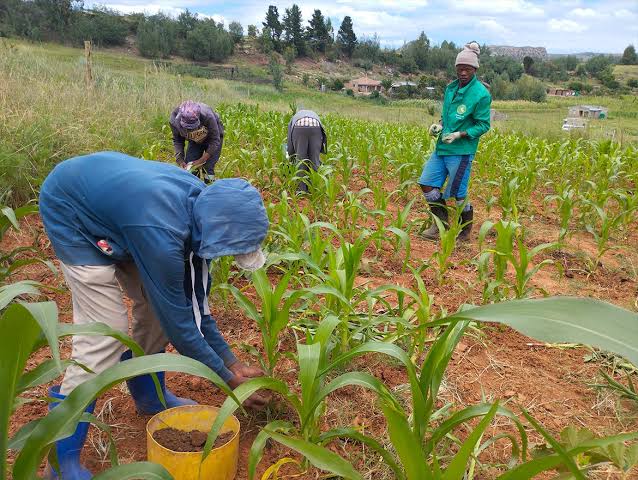
The package SAA promotes is deliberately modest. Farmers are connected to seed producers who supply drought-resistant, quality seed. Simple planters, including the Jab Planter, place seed and fertiliser at the same time, which supports correct spacing and minimum tillage by disturbing less soil. Training covers soil conservation and crop spacing.
Each piece has an agronomic rationale. Minimum tillage conserves soil moisture and reduces erosion, which matters in a dry spell and in a deluge. Placing fertiliser next to the seed rather than broadcasting it concentrates a scarce input where the young plant can use it. Precise spacing improves light and water use. And a planter that covers over two acres a day removes a labour bottleneck at the moment timing matters most: planting as soon as the rains arrive. Justine Katusabe Nayiga, a Sasakawa facilitator, said maize planted this way held up reasonably well during the recent drought.
This also speaks to the debate about mechanisation. Earlier this autumn the Ministry of Agriculture handed over 150 walk-behind tractors to farmer groups, in a country where only a small share of mechanisable land is worked by machine. Tractors are costly and need fuel, operators and maintenance. A hand planter sits at the cheap end of the mechanisation ladder, within reach of an individual farmer or a small group, and shows that not every labour-saving step needs an engine.
The real innovation: Commercial Community-Based Facilitators
What distinguishes the Sasakawa model is less the tools than the delivery system. SAA uses what it calls Commercial Community-Based Facilitators, or CCBFs, local agents who carry knowledge and technology directly to farmers and earn their living doing so.
Nayiga is one of them. She works with about 20,000 farmers through a network of 46 agents, and says the network has created jobs for 46 young people. Her method is demonstration: field days and plots where neighbours can see results with their own eyes, because farmers adopt practices more readily when the evidence is in front of them. The model is a pragmatic answer to a well-known gap. Uganda's public extension system is thin; figures cited earlier in our coverage put the ratio at roughly one extension worker per 1,800 farmers against a recommended 1:500, and digital advisory services reach a minority. Paid village agents, who earn from selling inputs, services or training, can fill part of that gap without waiting for government recruitment.
They also carry risks. Agents who depend on commissions may lean toward products that pay, not necessarily those that fit a farmer's needs. Quality of advice varies. Nayiga herself names uneven adoption as her main challenge: farmers take up training at different rates. Anyang says SAA aims for communities and local institutions to sustain these approaches after NGOs withdraw, so that "the country, not the NGO, owns them". That is a goal, not yet a track record, and independent evaluation would be useful.
Beyond maize: regeneration in coffee
The same Nile Post report profiled Izidolo Bikanshobera, 47, of Kabulamuliro Village in Madudu Sub-county. Four years ago, after regenerative agriculture training, he moved from growing many crops to concentrating on coffee. His output rose from 300 kilogrammes to 500 kilogrammes, and he says his earnings climbed from about Shs1 million to Shs8 million. He has trained around 36 other farmers and reinvested in livestock and land. He also said his resilience improved "from 20 per cent to 80 per cent", though the article does not say what that figure measures, and it should be treated as a personal estimate.
The rise in earnings is larger than the rise in volume, which suggests price, quality or other changes at work, and the report does not break it down. Readers should also note that coffee farmers across the country have faced a tougher year, with the Ministry of Agriculture reporting robusta farm-gate prices roughly 14.5 percent lower in early September than a year earlier. Reported gains should be read against that backdrop.

What it means for markets and the economy
Maize matters well beyond Mubende. It is a staple, a feed input and an export, and neighbouring Kenya's large maize shortfall this year has pulled prices up in border districts and raised feed costs for Ugandan poultry farmers. A district that lifts yields without opening new land adds supply when it is most needed and eases pressure on food and feed prices. Nile Post's report mentions Zaake's plan to enter poultry, a reminder that maize income is already feeding into other enterprises and local jobs, from his 30 workers to the facilitators themselves.
Yet there are limits to what better planting alone can do. Smallholders face high borrowing costs, with agriculture's weighted lending rate at 19.6 percent in August, according to the Bank of Uganda. Post-harvest losses and aflatoxin risk can erase gains if grain is poorly dried and stored. And irrigation covers under two percent of cropland, so even the best-adapted maize remains rain-dependent.
What to watch
Three things will show whether this model scales. First, data: SAA and its partners have described yields of about two tonnes an acre for some farmers in a separate 17-district programme with the Ministry of Agriculture, but the article gives no detail on methods or numbers of farmers reached. Independent, published comparisons with neighbouring non-participating farmers would carry far more weight than testimonials.
Second, the economics of the agents. If a facilitator can earn a sustainable income without donor top-ups, the model can spread. If not, it will shrink when funding ends. Third, access to quality seed and affordable inputs. Drought-tolerant seed and planters help only if they are available, trusted and priced within reach, and fake or poor-quality seed remains a national concern.
Anyang's phrase about moving from five bags to 20 captures the ambition. Zaake's 200 to 400 bags shows it can be done on a good farm with good support. The question for Mubende, and for Uganda, is how many ordinary farmers can follow before the next dry spell arrives.
Published By | Features Editor