Agriculture
Two days after a windstorm and an eight-hour rainstorm tore through Ndorero and Kanyinya wards in Rukungiri Municipality on August 11, ripping up banana mats, cassava gardens and sugarcane fields belonging to more than 300 farmers, the familiar question resurfaced: who, if anyone, would help them recover? For most of the farmers whose gardens were flattened that night — as for most smallholders across Uganda — the answer, historically, has been almost no one. It was the second such disaster to hit the area in two years, following a 2025 hailstorm, and it landed just as Uganda's Ministry of Water and Environment was warning that the country should brace for above-normal rainfall between August and December, driven by a weak-to-moderate El Niño and a positive Indian Ocean Dipole, with elevated risk of flooding and landslides in Mount Elgon, the Rwenzoris and other vulnerable highland areas.
Into that gap has quietly grown one of Uganda's more significant, if underappreciated, agricultural policy successes of the past decade: the Uganda Agriculture Insurance Scheme (UAIS), a public-private partnership that has expanded from around 20,000 insured farmers in 2016 to more than one million today, according to the scheme's implementing body, the Agriculture Insurance Consortium (AIC). As Uganda enters a rainy season officials are already flagging as higher-risk than normal, the scheme's growth — and its limits — offer a window into how the country is, and is not, managing the financial fallout of an increasingly unpredictable climate.

From a hard sell to a million policies
When UAIS launched in 2016 as a partnership between the Ministry of Finance and a consortium of 14 private insurers, agricultural insurance was a difficult sell in Uganda, as it has been across much of Africa. The original model relied on traditional multi-peril insurance, which required a physical assessor to visit an insured farm at every stage of the growing season, from planting to harvest. Each visit added cost, and insurers passed those costs on to farmers as premiums that were, for most smallholders, simply unaffordable.
The shift that unlocked mass uptake was technological. AIC moved to index-based insurance, using satellite monitoring to track rainfall, temperature and vegetation conditions in real time across the country. When a drought or an excess-rainfall event is detected by satellite, it can trigger a claims payout automatically, without a farmer needing to report a loss or wait for a ground assessment. "Farmers regularly receive payouts before they have even thought to call, because the satellite data has already identified and flagged their loss," Attra Atukunda, AIC's Business Development and Partnerships Lead, said in an interview describing how the model works. That shift — from a reactive, assessor-driven claims process to a proactive, data-driven one — is what AIC credits with taking the scheme from roughly 20,000 policyholders to over a million in less than a decade.
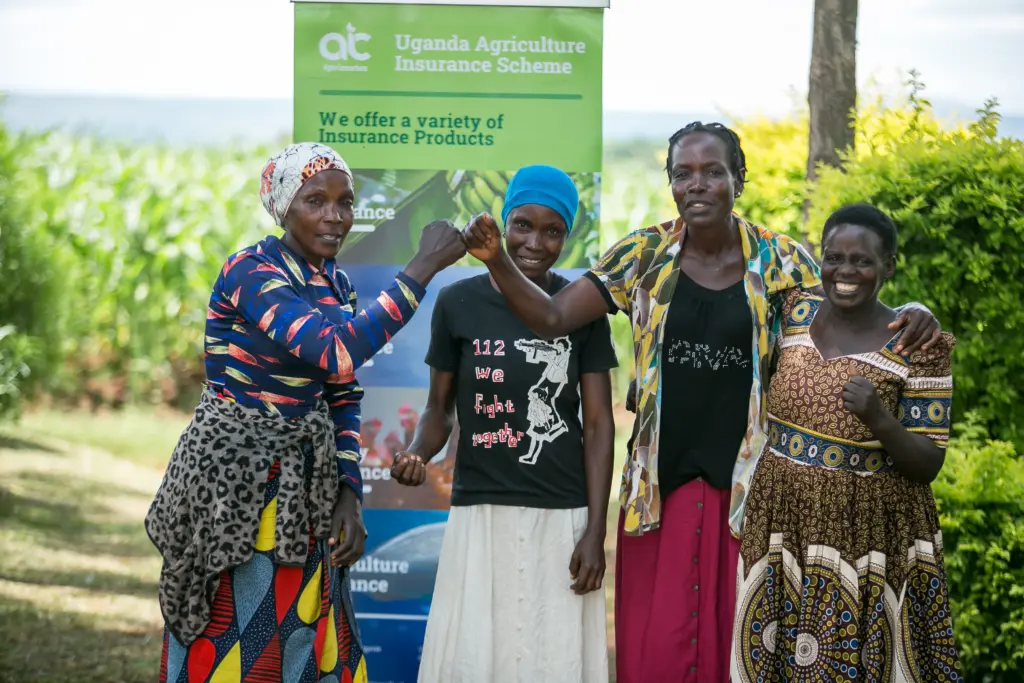
The scheme now covers crops, livestock and aquaculture nationally, from maize growers in eastern Uganda to coffee farmers in the west and fish farmers along Lake Victoria. Ninety-five percent of insured farmers hold five acres or less, and 30 percent of policyholders are women — a proportion AIC says reflects deliberate outreach to women's farmer groups and gender-sensitive product design rather than an incidental outcome.
How the subsidy — and the payout — actually works
The government underwrites a large share of the cost. Ministry of Finance figures show an annual premium subsidy of UGX 5 billion for the 2025/26 financial year, applied automatically at the point of sale rather than through a separate application process. The subsidy is tiered: smallholders with five acres or less have 50 percent of their premium covered by government, larger farms above five acres receive a 30 percent subsidy, and farmers in officially designated high-risk areas — regions with a documented history of severe drought or persistent flooding — receive an 80 percent subsidy regardless of farm size.
In practice, that makes cover strikingly cheap relative to what it protects. AIC's own worked example for a one-acre maize plot, assuming an 800-kilogram yield and a selling price of UGX 800 per kilogram, puts the insured value at UGX 640,000. At a 5.5 percent index premium rate, the full premium would be UGX 35,200 — but after the standard 50 percent smallholder subsidy, the farmer pays just UGX 17,600 to protect a harvest worth well over thirty times that amount. In the event of a qualifying total loss — drought, excess rainfall, pests or another covered peril — the farmer receives 70 percent of the insured value, with the remaining 30 percent treated as the farmer's own excess, a structural feature designed to guard against fraud and to keep farmers invested in managing their gardens even after taking out a policy. "If you have insured your garden, it does not mean you don't weed," Atukunda said. "You need to do exactly what you would do whether there was insurance or not."
Since 2016, AIC says it has paid out more than UGX 54 billion (roughly $14.3 million) in verified claims, and that agricultural loans worth over UGX 3 trillion (about $798 million) have been extended by banks, MFIs and SACCOs that gained the confidence to lend against insured harvests. That credit-unlocking effect may be as significant as the direct payouts: lenders who once treated smallholder agriculture as prohibitively risky now have a mechanism to de-risk their loan books, widening the pool of farmers who can borrow for inputs in the first place.

The trust problem, and the coverage gap that remains
None of this has been automatic. "The biggest challenge is trust, and rightfully so," Atukunda acknowledged, noting that insurance asks farmers to pay upfront for a benefit they hope never to need, a difficult proposition for households that have often been let down by financial products not designed with them in mind. AIC's response has leaned heavily on visible proof: publicising verified payout stories, running field training that combines insurance literacy with practical agronomy, and operating a toll-free multilingual helpline (0800 300 021) alongside regional offices in Gulu, Fort Portal, Mbale, Jinja and Kampala. Farmers typically access the scheme collectively, through cooperatives, SACCOs, off-takers or input dealers who have their own commercial reasons to want members insured — protecting supply contracts, loan repayments or produce deliveries against a bad season.
Even so, a million policyholders is a fraction of Uganda's estimated 8 million or more agricultural households, and the government-backed target is to reach three million farmers by 2027 with support from the UN Development Programme's ongoing digital transformation and capacity-building work with the scheme. The Rukungiri windstorm is a case in point of the gap that persists: there is no indication the roughly 300 affected farmers there were covered, and localised, sudden-onset events like wind damage sit awkwardly within an index-insurance model built primarily around rainfall and drought triggers rather than storm damage. Uptake also remains uneven geographically, concentrated where cooperatives, banks and NGOs have actively promoted the product, leaving isolated or poorly organised farming communities — often the same communities most exposed to climate shocks — least likely to be covered.
A season that will test the model
The coming months will offer a real test of both the promise and the limits of the scheme. With meteorologists projecting above-normal rainfall through December and a documented history of flood and landslide damage in Uganda's highland farming zones — the 2020 floods alone caused an estimated $152.2 million in damage — insured farmers in high-risk zones stand to find out in real time whether satellite-triggered payouts arrive as promptly as AIC describes. For the far larger number of farmers still outside the scheme, the Rukungiri storm is a reminder of what remains at stake: without insurance, a single bad night of weather can erase a season's income and, for many households, the working capital needed to plant again.
For a country whose Ministry of Finance and international partners are increasingly framing climate resilience as central to agricultural policy — alongside irrigation investment, drought-tolerant seed varieties and early-warning systems — the insurance scheme's growth from a niche pilot to a million-farmer programme in under ten years suggests that affordability and trust, not merely awareness, were the binding constraints all along. Closing the remaining gap, particularly for farmers facing risks the current model was not designed to price, is likely to determine how much protection Uganda's coffee, banana and grain belts actually have when the next storm — or the next drought — arrives.
Published By | Features Editor