Written By | Staff Writer
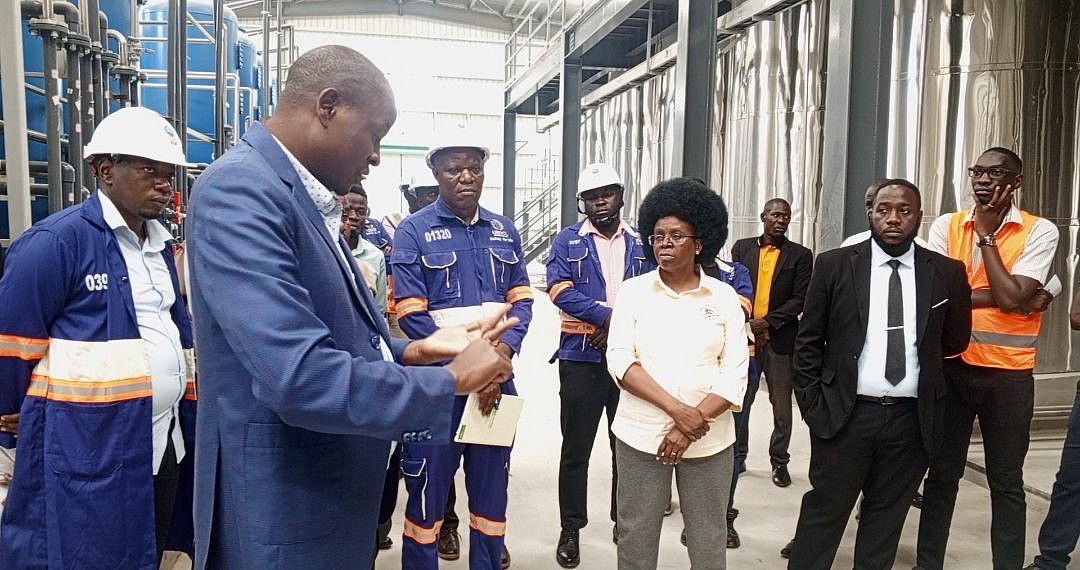
Energy Minister Monica Musenero has given UEDCL two weeks to connect Dei BioPharma's cassava starch plant to the grid
Agriculture
A finished factory, running once a week
The cassava starch plant at Namasagali in Kamuli District has been mechanically complete for about eighteen months. President Museveni commissioned it on 20 November 2025. It has not once run at capacity.
The reason is not the market, the technology or the crop. It is a power line. The plant is not connected to the national grid, and to make anything at all its owner has been burning diesel. “It has been painful having completed this facility for about one and a half years,” Dei BioPharma proprietor Dr Matthias Magoola said this week. “We started production in June last year when we began testing it, but we have been using very expensive means of running generators.”
How expensive: about Shs15 million to run a single generator for a single shift, by Dr Magoola's account. The plant needs more than 5 megawatts to operate fully. At generator prices, full-time operation is arithmetic that does not close, so production has been throttled back to roughly one day a week.
On Wednesday, Energy Minister Dr Monica Musenero visited the facility with officials from the Uganda Electricity Distribution Company Limited (UEDCL) and issued a deadline. “I am a hands-on minister, and my coming to this facility demonstrates that. I called my team at UEDCL to find a solution to this problem,” she said, adding that government had given itself two weeks. “We are not only working to solve the power problem at this plant. We want to ensure that unreliable electricity supply is no longer a challenge to industries.”
Dr Magoola said UEDCL had committed to connecting the plant and upgrading the infrastructure, including replacing conductors, within the fortnight. “They have assured us that this will be done in two weeks. When you come back here, you will be shocked because we are going to start full production,” he said.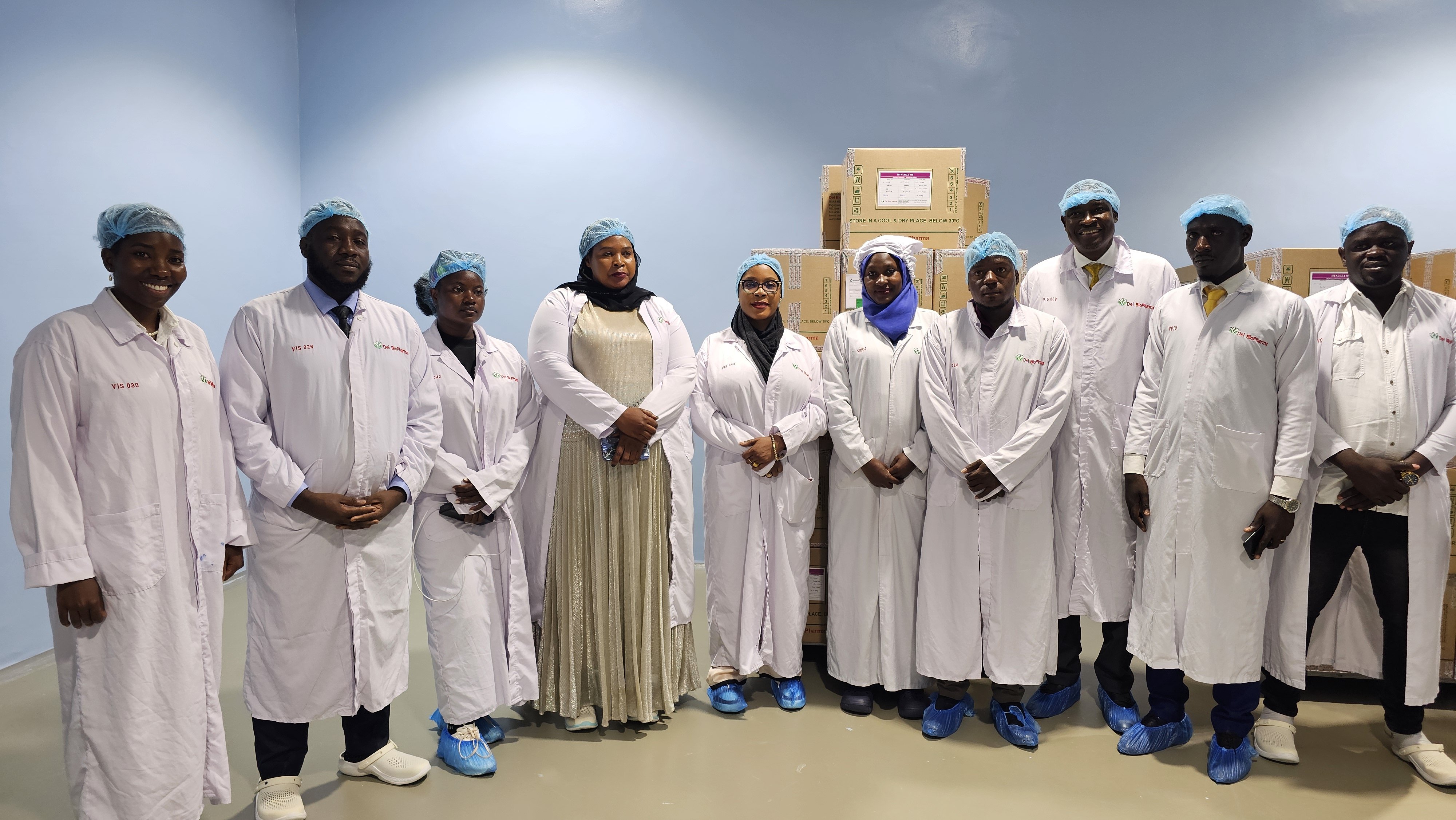
Staff at Dei Boi Fama
Why this matters to cassava farmers, not just to Dei
Strip away the pharmaceutical framing and this is, for the eastern and northern smallholder, a demand story.
At full capacity the Namasagali plant requires approximately 500 metric tonnes of fresh cassava roots every day. Dr Magoola says the company already buys from across Busoga and from Teso, Arua, Gulu, Lira and Bukedea — and still cannot get enough. “We have been buying cassava from everywhere, but because of power we produce once a week. Even with that production, we are not getting the required quantities of cassava,” he said.
Put 500 tonnes a day against Uganda's production base and the significance becomes clear. Uganda produces somewhere in the region of 2.5 to 3.5 million tonnes of cassava a year, overwhelmingly consumed at household level as a food-security crop rather than sold into industry. A single buyer taking 500 tonnes a day, if it ran 300 days, would absorb roughly 150,000 tonnes annually — a material share of anything that currently reaches a formal market at all.
That is the difference between cassava as a hunger crop and cassava as a cash crop. Uganda's food-crop inflation figures from UBOS in August 2026 showed cassava flour rising 20.4 percent year-on-year to an average Shs2,212 per kilogramme, a price signal driven largely by drought-hit supply rather than by industrial demand. A consistent industrial offtaker changes the character of that signal — it gives farmers a reason to plant for sale, to buy clean planting material, and to treat cassava as something other than the crop you fall back on when maize fails.
The fallback role is not hypothetical this year. The Independent/URN nationwide drought survey published on 12 September found that in parts of Teso and the north, the sorghum, millet and cassava that farmers turn to when the main crops fail had themselves failed. A guaranteed buyer does not fix a drought. But it does change what a surviving crop is worth.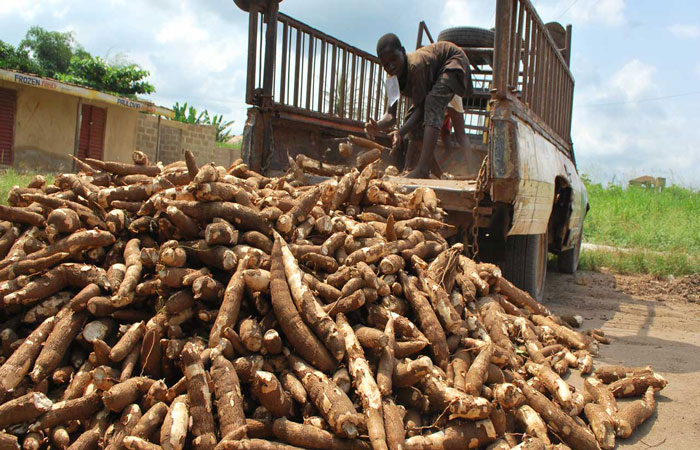
What the plant actually makes
The Namasagali facility is not a flour mill. It processes cassava into pharmaceutical-grade starch and industrial sugars — glucose, maltose and fructose — products Uganda has imported for decades. Uganda spends an estimated US$20 million a year on pharmaceutical-grade starch alone.
The starch plant is a US$50 million investment sitting on a 5,000-acre estate, itself one component of the Dei Biopharma Advanced Agro-Processing and Biotech Park launched by the President in November last year. Dr Magoola says the facility will ultimately extract more than 100 derivatives from cassava, maize and potatoes, and that the output feeds directly into the group's pharmaceutical and vaccine complex at Matugga in Wakiso. “Our campus in Matugga cannot produce vaccines and drugs without the products we produce here,” he said.
The wider blueprint — a stated US$10 billion, ten-year plan — includes an organic fertiliser plant running on animal waste, a 1,000-bed hospital for sickle-cell and cancer treatment, and a veterinary vaccine complex with capacity for 100 million doses a year, including a foot-and-mouth disease vaccine facility. Dr Magoola puts full-scale employment at about 50,000 direct jobs. He also says every one of those facilities depends on reliable, adequate electricity.
That FMD vaccine line is worth marking. Uganda vaccinates against foot-and-mouth disease under chronic supply and cost pressure — the cost-recovery scheme announced on 8 September charges farmers Shs8,000 per head of cattle or pig and Shs4,000 per goat or sheep per cycle, roughly Shs16,000 a year per animal across the mandatory six-month cycle, against a susceptible national herd of some 44.5 million animals. Nakasongola District banned all livestock movement on 15 September after 55 cattle deaths. Domestic vaccine manufacture at scale would be a structural change in that equation — and it is downstream of a cassava plant that cannot get five megawatts.
The pattern this fits
Uganda's agro-industrialisation strategy is not short of plants. It is short of plants that run.
The pattern has repeated all year. In Soroti, an aflatoxin-removal machine at the industrial park has sat idle since 2018 while MP David Beecham Okwere told Parliament in August that 80 percent of cereals bought by PELA Commodities tested aflatoxin-positive; the Uganda Development Corporation has been moving to privatise the equipment rather than run it. In Nakasongola, the Kikyusa Pineapple Farmers Cooperative told visiting ministers on 7 September that 640 acres of fruit are constrained by financing cost, roads, transport, cold storage and processing capacity — not by the ability to grow pineapples. The Rwenzori barley programme, the Teso sweet potato facility, the Igara tea factory: in case after case, the growing works and the last mile does not.
Electricity is the version of that failure with the clearest price tag. Shs15 million per generator per shift is not a subtle inefficiency; it is the difference between a viable plant and a monument. And the cost lands twice — once on the investor, and once on the farmers whose crop the plant cannot buy, who have no way of knowing that their unsold cassava is a function of a conductor that needs replacing.
The macro numbers make the same point from the other end. Permanent Secretary Ramathan Ggoobi warned this week that domestic bottlenecks could blunt the gains Uganda is chasing through economic diplomacy, and the Finance Ministry has trimmed the preliminary FY2027/28 resource envelope to Shs79.22 trillion. The World Bank has cautioned that approval delays threaten some Shs18 trillion in projects. Against the Tenfold Growth Strategy's target of US$20 billion in agro-industrial exports by 2040, an idle US$50 million plant is not a rounding error; it is the strategy in miniature.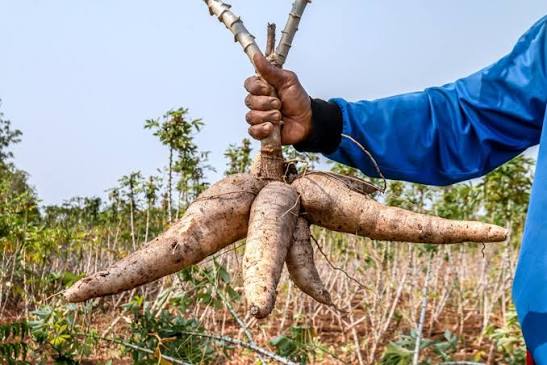
Two weeks, and what comes after
If UEDCL meets the deadline, the interesting question moves immediately to the other side of the gate: can 500 tonnes of cassava a day actually be assembled and delivered, every day, from smallholder plots spread across Busoga, Teso, Lango, Acholi and West Nile?
Nothing in the current arrangement guarantees that. Uganda has no functioning contract-farming law — the Contract Farming Bill 2023 was withdrawn in March 2026 — which leaves the terms between a single large buyer and thousands of dispersed growers to be settled informally, the same gap that left Rwenzori barley farmers taking Shs1,700 a kilo for a crop whose seed costs Shs5,000. Cassava is bulky, perishable once lifted, and expensive to move on poor feeder roads; post-harvest losses nationally run at 22 to 30 percent by World Bank estimates. And cassava brown streak disease, which has spread more than 1,000 kilometres from its 2004 Ugandan detection point and can cut usable production by up to 70 percent by rotting the root flesh, sits underneath any plan to scale supply on old planting material.
Those are solvable problems — aggregation centres, clean seed multiplication, a published price, transport. They are also problems nobody solves for a factory that runs one day a week. Grid connection is not the finish line; it is the precondition that makes the rest of the work worth doing.
Dr Magoola says he wants visitors to come back and be shocked. The more consequential test is whether, six months from now, a cassava farmer in Bukedea or Lira has a standing order, a known price, and a truck that comes.



