Written By | Staff Writer
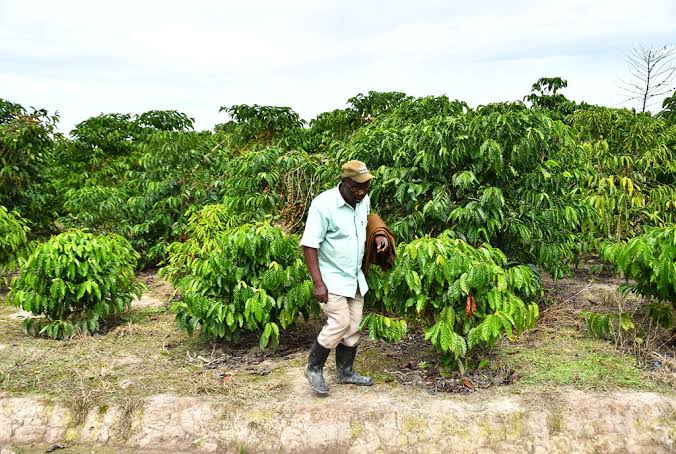
With Busoga's smallholdings shrinking and sugarcane under political pressure, the Church of Uganda's Busoga Diocese plans a model farm of coffee, bananas, oil palm and cocoa.
Agriculture
In a region where the average family holds less than an acre of land and the President has publicly called sugarcane and rice mistakes, an unusual institution is stepping forward to test the alternative. New Vision reported this week that the Busoga Diocese of the Church of Uganda will promote President Museveni's four-acre model by establishing a demonstration farm at its headquarters in Bugembe next year, with a full-time extension officer and one acre each devoted to coffee, bananas, oil palm and cocoa.
The plan was announced by Rt Rev. Prof. Grace Lubaale, Bishop of Busoga, after a 15-person delegation visited an oil palm centre in Buvuma and Kalangala, the two island districts where Uganda's oil palm industry took root. The delegation included First Deputy Prime Minister Rebecca Kadaga, Mayuge LC5 chairperson David Ziija and Fred Bwino Kyakulaga, a former state minister for agriculture. The diocese has also earmarked 100 acres at Busoga College Mwiri in Jinja District for tree planting and more than 50 acres for coffee, cocoa and oil palm.
Why a church, and why now
The announcement lands against a backdrop set by the President himself. Speaking at a thanksgiving ceremony in Buyende District in late September, Museveni faulted Busoga leaders over land fragmentation and urged a shift away from sugarcane, according to Nile Post. Fragmentation is the core problem: as each generation divides its inheritance, plots shrink. SoftPower News reported the President's own list of alternatives for small plots, including dairy, poultry and fish farming, and his insistence that a family need not do all seven activities of the four-acre model so long as what it does lifts it out of poverty with calculation.
Churches are a logical delivery channel. They own land, hold regular gatherings, command trust and reach households that government extension workers seldom visit. Uganda's extension coverage is thin, so an institution with parishes in every sub-county could, if it hires and trains its extension officer well, multiply the reach of a single demonstration. The diocese is effectively proposing to make church land a classroom.
The oil palm case
The numbers cited at the visit explain the choice of oil palm as the centrepiece. New Vision reported that oil palm earns Shs500,000 to Shs1 million per acre, produces a harvest every ten days for 25 years, and matures in about four years, compared with 12 to 16 months for sugarcane. It also noted that Uganda spends roughly Shs1.1 trillion a year on imported edible oil, a figure that has driven the government's interest in domestic production. The report also mentioned Shs717 billion channelled through IFAD for smallholder farmers, though the reporting did not detail how that money would reach church or community projects, and the link should be treated as context, not a commitment to the diocese's plan.
For a sense of what success looks like, consider Constantine Nsubuga, a 73-year-old farmer profiled by Daily Monitor on 6 October. Nsubuga arrived on Kalangala's Ssese Islands in 1983, started with 2.5 acres and now farms 45 acres of oil palm, alongside livestock, a family home, a vehicle and a school built for local children. He was a civil servant who supplemented his income with coffee before switching. His story is the type the diocese hopes to replicate, though it also illustrates the timeline: his farm is the product of four decades of patient expansion, not a four-year pivot.
Reading the arithmetic
Several cautions apply. First, the Shs500,000 to Shs1 million per acre figure is the headline return cited in the New Vision report, and the report does not specify the period, the grade of land, or whether it is gross or net of costs. A farmer deciding whether to plant should ask for those details, together with the price paid for fresh fruit bunches and the distance to a mill. Oil palm is bulky and perishable: bunches must be processed quickly after harvest, so the value of an acre depends heavily on the proximity and pricing practices of a processor.
Second, the four-year wait before the first harvest is a financial gap that a household with half an acre cannot easily bridge. The diocese's model of one acre each of four crops spreads risk, and bananas and coffee can offer earlier income, but a family in Namayingo or Bugiri that has less than an acre in total cannot replicate it by planting all four. The four-acre model presupposes four acres, and the data from Busoga suggests that few households have them. Nile Post's reporting on the President's Buyende remarks put average Busoga holdings at 0.6 of an acre against the model's four-acre commercial threshold.
Third, the comparison with sugarcane is not purely agronomic. Cane farmers have an assured buyer in the nearby mills, and a short cycle. A switch to oil palm means a bet on a processing chain that, in the east, is still developing. If farmers plant before a mill is in place, they risk trees with no market. The diocese's pilot, by being small and supervised, can help surface those questions at low cost, which is perhaps its most valuable function.
What it could mean for the region
If the Bugembe model works, it could give Busoga something it currently lacks: a visible local proof that a household can earn from a diversified acre-by-acre system, backed by a trusted institution and a resident extension officer. Government programmes such as the Parish Development Model have so far put money in the hands of savings groups, but the hard constraint in Busoga is land and know-how. Demonstration plots can address the second even if they cannot solve the first.
Success will also depend on matching crops to place. Coffee and cocoa need particular soils and rainfall; Busoga's district leaders asked the President in September for community irrigation projects and technical institutes, which suggests that water and skills are as pressing as seed. The diocese's extension officer will be judged by whether farmers in the surrounding parishes adopt what they see, not merely whether the plants thrive in a church compound.
What to watch
The diocese has set a timeline: the model farm next year. Observers should look for the published cost of establishing the acre of each crop, the source of seedlings and whether they are certified, and the partnership with a mill or buyer for the oil palm. They should also watch whether other dioceses and religious institutions follow, since the Church of Uganda, Catholic and Muslim communities collectively hold substantial land. If they do, the four-acre model could gain a network of demonstration sites without a new government budget line.
The idea is sound, the risks are knowable, and the test is cheap. A bishop with a plot and an extension officer cannot undo generations of land division, but he can show a district of small farmers, in the field and over several seasons, which combinations of crops pay and which only look good in a speech.



