MBARARA, Uganda
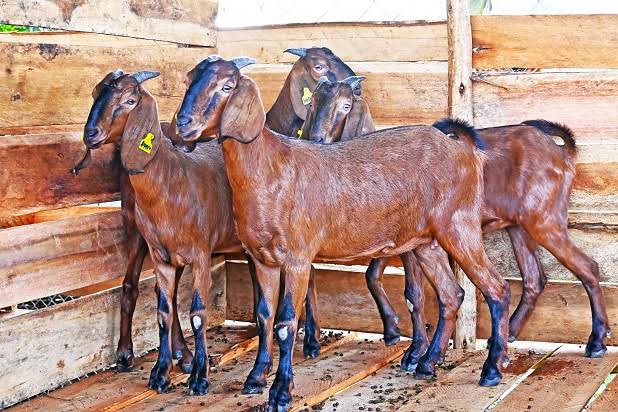
In a modest pen at the Mbarara Zonal Agricultural Research and Development Institute (MBAZARDI), a small herd of goats is putting on weight faster than almost anything Uganda's livestock scientists have seen from a small ruminant before. They are Jianzhou big-eared goats, a Chinese meat breed introduced under the Food and Agriculture Organization's China South-South Cooperation (SSC) programme, and Uganda has the distinction — rare in African livestock research — of being the first country on the continent to receive them.
The numbers behind the experiment explain why researchers are paying close attention. According to Dr Andrew Wange Bugenyi, a senior research officer at MBAZARDI, the imported goats are already gaining around 145 grams a day under Ugandan conditions, with a target growth rate of roughly 200 grams a day once fully acclimatised. By comparison, Uganda's indigenous goat breeds — prized for their hardiness and disease resistance but not their speed to market — typically gain a fraction of that, closer to 40 grams a day by some local benchmarks cited by researchers on the project. "It is a stabilised breed called the Jianzhou big-ear goat," Dr Bugenyi told The Independent Uganda. "This breed has attained stability and it is a very fast-growing variety for meat." The institute received six goats in October and has since multiplied the herd, adding seven kids — three males and four females — with none of those born before late January weighing in below 17 kilograms.
For a country where livestock keeping is both a livelihood and a cultural cornerstone, a growth-rate improvement of this magnitude is not a minor technical footnote. It goes to the heart of an economic problem that has quietly constrained Uganda's meat sector for years: farmers raise goats, but slow growth rates mean long production cycles, low turnover, and thin margins that keep smallholder goat farming a subsistence activity rather than a commercial one. Dr Jacob Mukose, the national livestock counterpart for the FAO-China programme, frames the entire exercise around closing that gap. "The purpose of the big-ear goat is basically to improve the quality of our local goats because of the size and early maturing age," he said. "They are very good animals to better the multiplication and the volume in the shortest time possible."

That volume matters because Uganda is chasing two markets simultaneously — and currently falling short on both. Domestic demand for meat is rising alongside population growth and urbanisation, but according to Dr Mukose, "meat is not even enough for the local market" even before export ambitions enter the picture. Beyond the border, Uganda has been positioning itself to supply goat and sheep meat to Middle Eastern markets, particularly the United Arab Emirates, where demand for East African livestock products has grown as Gulf states diversify food-security strategies. Realising that export ambition, however, depends on precisely the kind of productivity gains the Jianzhou trial is testing — a country cannot credibly promise reliable export volumes off the back of slow-maturing indigenous stock alone.
Crucially, the research team is not simply importing a foreign breed and hoping it thrives. Much of the work at MBAZARDI has focused on stress-testing the goats against Ugandan realities: local feed, local parasites, local climate. "We want to look at how they grow under various nutritional conditions, how does it resist the diseases, how does it tolerate the temperatures," Dr Bugenyi explained. Early signs are encouraging — the goats have shown resilience against intestinal worms without significant health setbacks, according to the research team, and the herd has adapted to standard local feed formulations rather than the high-protein diet, including beans, that the animals arrived on. "You cannot tell a farmer to give his beans to a goat," Dr Bugenyi noted dryly. "So we have given them what we give our local goats, and they are thriving."
That adaptability is the difference between a laboratory curiosity and a genuine agricultural intervention. Uganda's research history includes plenty of imported livestock genetics that performed brilliantly in controlled conditions and collapsed once handed to smallholders without matching feed systems, veterinary support or extension advice. The MBAZARDI team appears alert to that risk, and its strategy for scaling reflects it: rather than attempting to distribute limited numbers of pure Jianzhou goats widely, researchers plan to use crossbreeding with local goats as the primary route to impact. "We plan to crossbreed it with our native goats," Dr Bugenyi said. "If we have been having a goat gaining maybe 40 grams a day, can we have a stable cross and gain maybe 100 grams a day?" It is a deliberately incremental ambition. "Those small improvements are what matter to us as researchers aiming to develop agriculture in our country."
The project sits inside a much larger and longer-running relationship between Uganda and China on agricultural development. The FAO-brokered South-South Cooperation framework has operated in Uganda for more than a decade, deploying dozens of Chinese agricultural experts across crops, aquaculture, poultry and livestock since 2012 as part of a broader push to transfer technology and skills rather than simply provide aid. As that phase of the programme approaches its formal review, FAO's South-South Triangular Cooperation specialist, Debel Gutta, said the priority now is documenting what has worked and ensuring it survives the transition once the current cohort of Chinese experts departs. "Even though the project is coming to an end, we need to sustain the results," Gutta said. "The technologies introduced need to be adapted to Uganda's context," adding that new experts specialising in breeding and feed are expected to support that handover.
Locally, the stakes are tangible. Mbarara district, where the trial is based, is one of Uganda's most significant livestock zones, contributing heavily to national milk production alongside its role in meat and goat farming, according to district production officer Mathias Byamukama. He points to complementary interventions — including training extension officers in hay preservation to help farmers manage feed shortages through dry seasons, and the rollout of improved pasture varieties — as necessary companions to any genetics-driven productivity push. Better breeding stock alone will not rescue a farmer whose animals go hungry for three months of the year; feed security and breeding improvements have to move together.
If the Jianzhou goat trial scales successfully, its significance for Uganda extends well past one research station in western Uganda. The country's livestock population is projected to approach 13 million head by 2026, a modest rise from roughly 11.5 million five years earlier, but that growth in numbers has not been matched by proportional growth in output per animal — precisely the inefficiency this project is designed to attack. A shift toward productivity-per-animal, rather than simply herd expansion, would mark a meaningful change in how Uganda approaches livestock development altogether: fewer, more productive animals rather than ever-larger herds straining grazing land and water resources, particularly as recurring dry spells make extensive grazing systems increasingly precarious.
For now, the experiment remains carefully bounded — a handful of animals, a research pen, incremental gains measured in grams per day. But in a sector where small efficiency gains compound quickly across millions of household herds, Uganda's scientists are betting that this quiet trial in Mbarara could ripple outward into real income gains for smallholder farmers and a credible new export line for a country still working out how to turn its considerable livestock numbers into equally considerable livestock earnings.
Published By | Features Editor