Written By | Staff Writer
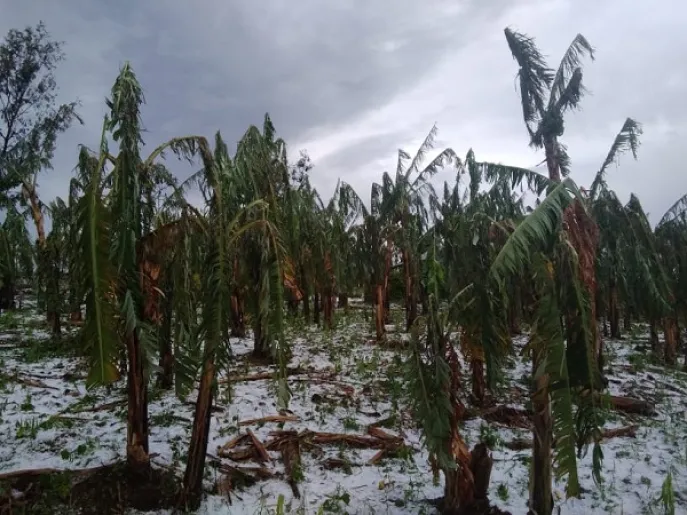
Rwampara's flooding arrived just as that second warning window was opening, and it is unlikely to be the last.
Agriculture
Eleven days after Uganda's Ministry of Water and Environment warned the country to brace for above-normal rainfall through the rest of 2026, the forecast stopped being an abstraction for households in Rwampara District. Heavy rain and wind tore through the district on or around August 24, blowing the roofs off five classrooms, destroying school property, submerging a marketplace and farmers' crops, and leaving displaced residents appealing to local leaders for food assistance, according to Daily Monitor reporting published August 25, 2026.
The scale of the damage in Rwampara — a southwestern district in Uganda's Ankole sub-region carved out of Mbarara District in 2020, and one of the country's core banana, coffee and matoke-growing areas — has not yet been fully quantified in hectares or shillings. But the pattern is now familiar enough in western Uganda this year to count as a trend rather than a one-off: a district loses its food and cash crops to sudden, violent rain, local leaders find themselves overwhelmed, and residents turn to appeals for emergency relief because no other safety net catches them in time.
A season of whiplash
What makes the Rwampara flooding notable is not just the damage itself but where it sits in Uganda's weather story this year. From June through August, the Ministry of Water and Environment had forecast a dry spell across much of the country, warning of stress on crops, livestock and water resources — conditions that contributed to a hunger crisis in the Karamoja region as rains arrived early, stopped almost immediately, and returned too weak to sustain a harvest. Then, in a public advisory signed by Permanent Secretary Dr Alfred Okot Okidi and reiterated in mid-August, the same ministry flipped the warning entirely: above-normal rainfall was now expected across the country between September and December 2026, driven by a weak-to-moderate El Niño event interacting with the Indian Ocean Dipole, raising the risk of floods, flash floods, landslides, damage to infrastructure and disease outbreaks.
Rwampara's flooding arrived just as that second warning window was opening, and it is unlikely to be the last. The Ministry's own advisory flagged exactly this kind of drought-to-flood cascade as the defining risk of Uganda's 2026 agricultural calendar, and other parts of western and southwestern Uganda have already lived through smaller versions of the same story this month. In Rukungiri, a windstorm and eight-hour rainstorm on August 11 tore through Ndorero and Kanyinya wards, destroying banana, cassava, sweet potato and sugarcane crops for more than 300 farmers — the second such disaster to hit the area in two years after a 2025 hailstorm. Districts including Bulambuli and the wider Mt Elgon area carry a longer history of landslide destruction under similar rainfall conditions, and the country's 2020 floods caused an estimated $152.2 million in damage nationally, a benchmark officials have cited when warning that this year's El Niño season could rival or exceed it.
Crops, classrooms and a widening gap in coverage
For farming households in Rwampara, the immediate loss is straightforward: bananas, cassava and other food crops submerged or flattened mean both a lost harvest and lost income in a single event, in a district where matoke and coffee farming are the backbone of most rural livelihoods. The secondary damage — a marketplace submerged, meaning traders lose stock and farmers lose their nearest outlet to sell what survived, and a school losing roofing on five classrooms, disrupting learning for local children — compounds the economic hit in ways that do not show up in crop-loss statistics but shape how quickly a community recovers.
That recovery gap is where Uganda's agricultural safety net is most visibly thin. The country's flagship Uganda Agriculture Insurance Scheme passed the milestone of one million insured farmers in mid-August, a genuine expansion built substantially around satellite-index products and backed by roughly five billion shillings a year in government subsidy, with claims paid since 2016 reaching about 54 billion shillings. But index insurance products have so far concentrated on specific value chains and pilot regions, and there is no indication that the smallholder banana and cassava growers hit in Rwampara this week were covered by any policy at all. The same coverage gap was evident in Rukungiri less than two weeks earlier, where farmers hit by wind and rain had no weather-index product to fall back on despite living in a district that had already suffered a nearly identical disaster the previous year. Until index insurance products expand beyond their current footprint — and until premiums or subsidies reach far enough down the income ladder to include subsistence-oriented banana and cassava growers rather than mainly commercial farms — flooding of this kind will keep translating directly into hunger appeals rather than insurance claims.
There is also a land-use tension sitting quietly underneath the flood story. Rwampara's wetlands have been the subject of environmental enforcement this year, with the National Environment Management Authority carrying out restoration operations against farmers who had encroached on wetland areas in the district — part of a wider national crackdown that has also hit Rukungiri, Wakiso, Mbale and the Lubigi and Busabala wetlands around Kampala, with fines up to 600 million shillings and jail terms of up to 12 years for violators. Wetlands function as natural flood buffers, absorbing and slowing runoff before it reaches farmland and settlements; when they are drained or cultivated, that buffering capacity disappears, and rainfall that might once have dispersed into a swamp instead moves directly into gardens, markets and classrooms. Uganda's enforcement agencies and its agriculture ministry are, in effect, pulling in different directions on the same landscape — one restoring wetland buffers for long-term climate resilience, the other trying to keep smallholders farming every available acre for food security — and flood events like Rwampara's land in the gap between those two policy goals.
What comes next
The Ministry of Agriculture has not yet detailed a district-specific relief response for Rwampara, and local leaders' appeals for food assistance suggest none had arrived by the time Monitor's report was filed. For a district whose district chairperson, Womugasho Richard, oversees an area still building out basic service infrastructure since its 2020 creation, an unbudgeted disaster response is a real strain on local government capacity.
The bigger question the Rwampara flooding raises is whether Uganda's early warning systems can translate into anything more than a warning. The Ministry of Water and Environment did its job: it told the country, in writing, weeks in advance, that above-normal rains and flood risk were coming this season. What has not yet materialised is the operational layer that would have mattered to a banana farmer in Bugamba sub-county — pre-positioned relief stock, expanded insurance enrolment ahead of the risk window, or drainage and wetland-buffer maintenance timed to the forecast rather than reactive to the damage. With the September-to-December rains still to come and the Ministry's own advisory warning that this could be a season of repeated, not isolated, flooding events, Rwampara may end up being the first of several similar stories out of western Uganda this year rather than an outlier.



