Kaabong
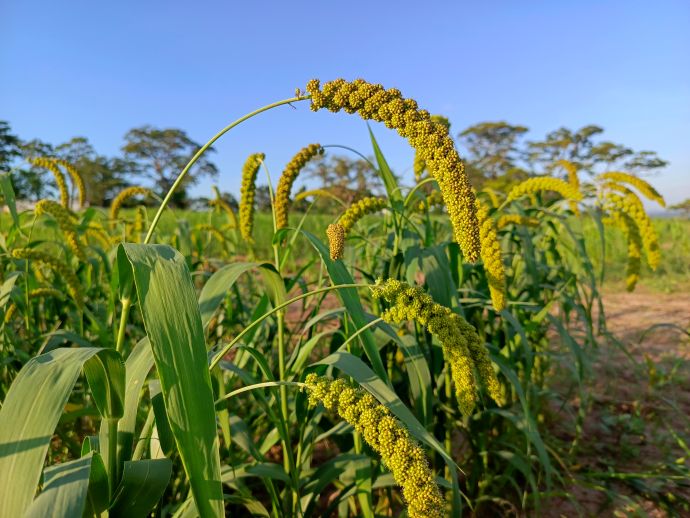
Kaabong — On a five-acre demonstration plot in Katile Sub-county, in the far northeast of Karamoja, a sorghum crop is standing where almost everything else this season has failed. Maize gardens across the sub-region wilted months ago. Cattle have been walked to the last wet patches of the cattle corridor or sold off at a fraction of their value. Relief trucks carrying maize flour and beans have become a routine sight on the roads into Moroto, Kotido and Nakapiripirit. But on this particular plot, a new variety bred by Uganda's National Agricultural Research Organisation — NAROSORG2, or NARO Sorghum 2 — has just been harvested after only 80 days in the ground, and both the scientists who bred it and the farmers who planted it are calling it the first genuinely good agricultural news Karamoja has had in months.
"This is a good variety which can manage the conditions in Karamoja better than the one we have been growing," said Apui John Baptist, one of the farmers who worked the demonstration plot from land preparation through to harvest. Miriam Akitwi, the extension worker who has walked farmers through the trial, put it more bluntly: people are "appreciating NARO SORG 2 as a rare variety" precisely because of how it performed against a drought that has flattened almost every other crop attempted this year.
Bred for a region that keeps running out of options
NAROSORG2 was developed at NARO's Nabuin Zonal Agricultural Research and Development Institute (Nabuin ZARDI), the research station most directly responsible for adapting crops to Karamoja's semi-arid conditions. According to Dr Walter Odongo, the institute's Director of Research, and Dr Ijara Anthony Raphael, a senior research officer involved in the breeding programme, the variety was designed around two problems that have dogged sorghum farmers in the region for years on top of drought itself: a growing cycle long enough that crops are routinely caught out by erratic rains, and heavy losses to seed-eating birds that can strip a nearly mature field in days. NAROSORG2 matures in roughly 80 days — dramatically faster than the varieties it is replacing — and was bred with traits that make it markedly less attractive to bird predation, while still tolerating extended dry spells that would kill off maize.
The speed of maturity is not a minor technical detail. In a region where the growing window has become shorter and less predictable as rainfall patterns shift, a crop that can be planted, grown and harvested in under three months opens the door to something Karamoja's farmers have rarely been able to plan around: a second harvest within the same year, if a second window of rain arrives. Local leadership in Kaabong has pointed to exactly that possibility as one of the variety's most significant practical benefits, since it would let households build a buffer stock rather than depending entirely on a single, increasingly unreliable main season.
Nabuin ZARDI's approach has been to distribute the variety through parish-level demonstration gardens of five to ten acres, established across all six Karamoja districts, rather than simply handing out seed. Farmers participate at every stage — preparing land, planting, weeding, watching the crop through the dry weeks and harvesting it themselves — so that the knowledge of how to grow the variety successfully spreads alongside the seed itself. Dr Damalie Akwango, who coordinates the Uganda Climate-Smart Agriculture Transformation Project's work in the region, and district agricultural teams are now working with Nabuin ZARDI on seed multiplication, the unglamorous but essential next step that determines whether a promising trial plot becomes a crop grown by tens of thousands of households rather than a handful of demonstration farms.

The scale of the problem this is meant to solve
The backdrop makes clear why a single new sorghum variety is being treated as genuinely significant news. An Integrated Food Security Phase Classification assessment released in August found roughly 473,000 people across Karamoja facing acute food insecurity between April and July 2026, with more than 5 percent of the population in the worst-affected areas — including Kaabong, Kotido, Karenga, Moroto and Nabilatuk, the same district cluster at the centre of the sorghum trials — already in emergency conditions and up to 45 percent facing crisis-level food access or worse. President Museveni, addressing the region's cultural leaders in Moroto earlier this month, announced a three-phase stabilisation strategy that explicitly named sorghum, green gram and white peas as the crops the government wants to see replace maize across much of Karamoja, alongside goats, beekeeping and, in wetter pockets, cassava and bananas. Government relief agencies say they are currently distributing food aid to more than 313,000 households across nine districts.
NAROSORG2 is, in effect, the seed-science half of that policy pivot — the specific variety that could make "grow sorghum instead of maize" a realistic instruction rather than a wish. It also lands in a delivery system that is badly stretched: Uganda's national extension worker-to-farmer ratio stands at roughly one to 1,800, against a recommended standard of one to 500, and Karamoja's agricultural departments are chronically short-staffed. The demonstration-garden model Nabuin ZARDI is using is partly a response to that constraint — extension workers cannot reach every household individually, so the strategy is to make the demonstration plots themselves the training ground, with farmers who participate expected to carry the knowledge back to their neighbours.
Reasons for caution alongside the hope
Karamoja's history with promoted crop-substitution efforts counsels against declaring victory too early. Programmes to shift farmers toward drought-tolerant varieties and away from maize have been tried before in the region with mixed results, often undone by seed supply bottlenecks, weak follow-up extension support, or a poor season that discourages farmers from persisting with an unfamiliar crop. Irrigation coverage in Uganda remains under 2 percent nationally, and Karamoja has less of it than almost anywhere else, meaning NAROSORG2 and similar varieties are being asked to substitute for water infrastructure that does not exist rather than complement it. The Ministry of Water and Environment's seasonal outlook has flagged a late but potentially above-normal rainy period for the remainder of 2026 as El Niño conditions strengthen — which could either give the new variety's second-harvest potential a real test, or bring the kind of erratic, hail-heavy rainfall that has damaged crops elsewhere in the country this season.
There is also the multiplication gap to close. A five-to-ten-acre demonstration garden in six districts is a proof of concept, not a seed system capable of supplying Karamoja's tens of thousands of sorghum-growing households. Nabuin ZARDI and district agricultural offices say seed multiplication is underway, but the transition from research station to open-market seed availability is typically where promising varieties in Uganda have stalled in the past, whether for sorghum, potatoes or maize.
Still, for farmers like Apui John Baptist, watching a crop survive to harvest in a season when almost nothing else has is not a small thing. If NAROSORG2's seed multiplication keeps pace with the demand its early results are generating, it could become one of the more consequential, if quietly delivered, pieces of Uganda's response to a drought that has already reshaped livelihoods across the cattle corridor and the far northeast — not through a headline-grabbing government programme, but through eighty days in the ground and a harvest that actually came in.
Published By | Features Editor