Agriculture
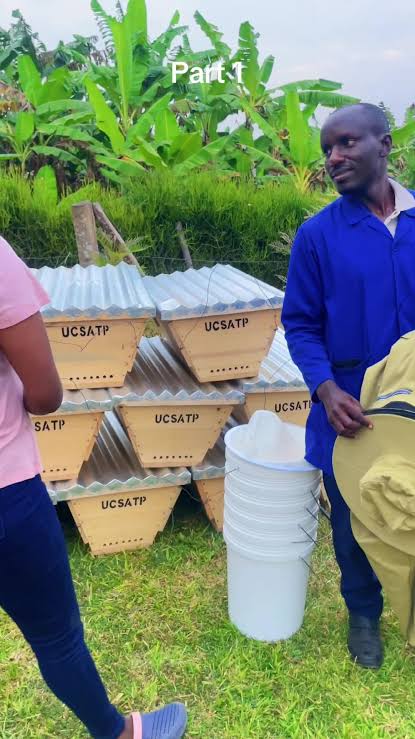
On Sunday, at the Kisoro district headquarters tucked into Uganda's misty southwestern highlands, eight farmer groups lined up to collect wheelbarrows, organic fertiliser, protective gear, farm sprayers, modern beehives, bee smokers and sieves — a haul worth Shs259.2 million. It was, on its face, a modest handover: four beekeeping groups and four coffee-farming groups, benefiting a few hundred households in a single district. But the equipment handed over in Kisoro on July 12 is the leading edge of one of the largest agricultural interventions in Uganda's history, and the way it was delivered — through a co-financing arrangement that forces farmer groups to organise, contribute and take ownership — is arguably as significant as the equipment itself.
The Kisoro handover falls under the Uganda Climate Smart Agricultural Transformation Project (UCSATP), a six-year, $350 million initiative — roughly Shs1.3 trillion — financed by the World Bank and implemented by the Ministry of Agriculture, Animal Industry and Fisheries alongside the National Agricultural Research Organisation, the National Animal Genetic Resources Centre and Data Bank, and the Uganda National Meteorological Authority. Since its launch, the project has set an ambitious target: reach 3.9 million Ugandans directly and a further 9.5 million indirectly, across 69 districts spanning all 13 of the country's regions, by improving the productivity, market access and climate resilience of selected farming value chains.

A model built on shared risk
What distinguishes UCSATP from many past government input-distribution schemes is its financing structure. Rather than handing out free equipment, the project operates on an 80–20 co-funding arrangement: government covers 80 percent of the cost of inputs and equipment, while beneficiary farmer groups must raise the remaining 20 percent themselves. In Kisoro, apiary equipment worth Shs149.7 million and coffee-farming inputs worth Shs109.4 million were distributed on that basis to groups including Kirundo, Chintale and Kasemisego Bee Keepers, and Gatete, Bukerahe and Muramba Coffee Farmers.
District Agricultural Officer Harriet Mutuzo, who presided over the handover, described it as only the first phase of a rollout that will extend to Chahi, Chahafi Town Council, Kirundo, Central Division, Southern Division, Murora and other parts of the district. District Production Officer Richard Abomugisha said more than 270 farmer groups across Kisoro have already been earmarked to benefit as the project scales up locally — a scope that, if realised, would touch a large share of the district's farming households.
The logic behind requiring farmers to contribute a fifth of the cost is deliberate: project designers and district officials argue that co-financing builds a sense of ownership that pure handouts often fail to generate, reducing the risk that donated equipment sits unused or is resold. Kisoro Assistant Resident District Commissioner John Nizeyimana used the handover ceremony to press that point directly to beneficiaries, telling them government had "played its role" by providing inputs and wealth-creation support, and that it was now farmers' responsibility to use it productively. Kisoro District LCV Chairperson Richard Ndyana struck a similar note, arguing that higher farm earnings from better-managed equipment would translate into school fees paid and living standards raised — the kind of household-level payoff the project is ultimately designed to deliver.
Why coffee and bees, and why Kisoro
The choice of coffee and apiculture as the entry point for Kisoro is not incidental. The district's cool, high-altitude terrain in Uganda's southwest — abutting the Virunga volcanic range — has long supported both Arabica coffee cultivation and beekeeping as complementary livelihoods, with bees pollinating coffee blossoms and diversifying household income when coffee prices swing. Both activities are also acutely climate-sensitive: erratic rainfall and shifting temperature bands affect flowering times for coffee and forage availability for bees alike, which is precisely the vulnerability UCSATP is designed to address.
The timing carries its own irony. Even as Kisoro farmers were receiving climate-resilience equipment on Sunday, residents elsewhere in the district were being warned by local officials to brace for a prolonged dry season, part of the broader El Niño-linked dry spell forecast to affect much of Uganda through August. That juxtaposition — investment in resilience arriving in the same week as warnings about the very stress the investment is meant to buffer — illustrates the race against time that climate-adaptation projects like UCSATP are running across Uganda's farming districts.
A national project, one district at a time
Nationally, UCSATP's ambitions extend well beyond apiary equipment and coffee sprayers. Earlier phases of the project have prioritised dairy and beef value chains, with more than 3,300 farmer groups already selected for support — 2,160 in dairy and 1,290 in beef production — under the same co-financing model. Dairy groups have been receiving average grants of Shs126 million and beef groups around Shs106 million, again contingent on farmer groups raising 20 percent of the cost themselves. Kisoro's coffee-and-apiary rollout suggests the project is now widening its value-chain focus as it moves into new districts, adapting its interventions to whatever crops and enterprises are locally dominant rather than applying a single template nationwide.
That flexibility is likely necessary given the project's scale and the diversity of Uganda's farming systems, from the cattle corridor's beef and dairy economies to the highland coffee belts of the southwest and east. But it also raises a question that will only be answered over the project's remaining years: whether a $350 million initiative spread across 69 districts and multiple value chains can sustain the kind of close monitoring — verifying that farmer groups are genuine, that co-financing is actually being raised rather than fudged, and that equipment is put to productive use — that its own design assumes.
For now, in Kisoro at least, local officials are treating the rollout as a proof of concept. Abomugisha's promise that 270 more farmer groups stand to benefit signals confidence that the co-financing model is working well enough to expand. Whether that confidence is borne out will depend on whether the beehives now sitting in Kirundo, Chintale and Kasemisego villages, and the sprayers now in the hands of Gatete, Bukerahe and Muramba coffee farmers, translate into the higher yields, steadier incomes and climate resilience the project promises — the same test facing every one of the thousands of farmer groups UCSATP is banking on across the rest of the country.
Published By | Features Editor