Written By |
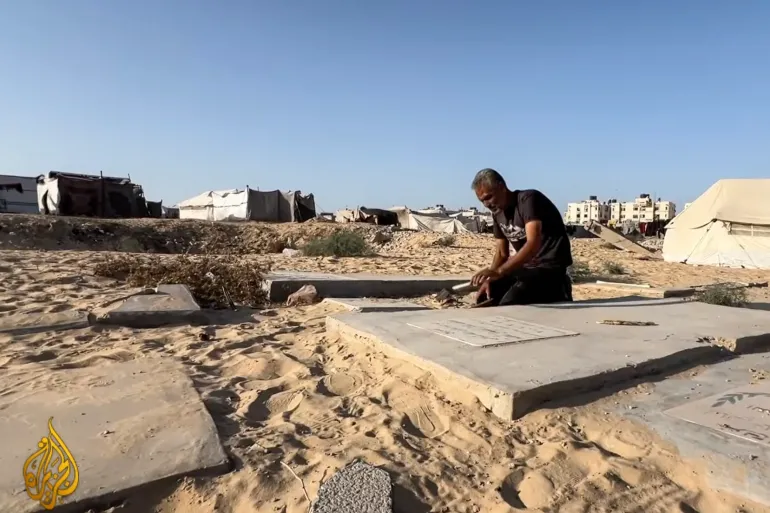
Graveyards have become shelters not out of choice, but out of desperation
Tens of thousands of displaced Palestinians, left without homes after Israeli bombardments destroyed residential areas across Gaza, are now pitching tents in graveyards — a haunting symbol of despair as the humanitarian crisis deepens despite a fragile ceasefire.
“This graveyard wasn’t meant for the living,” Al Jazeera’s Hind Khoudary reported from the southern city of Khan Younis. “But today, it’s home to dozens of families who have nowhere else to go.”
Khoudary said Palestinians are camping in cemeteries “not because they want to, but because it’s the last free space available.”
“Graveyards have become shelters not out of choice, but out of desperation,” she added.
Rami Musleh, a father of 12 displaced from the northern town of Beit Hanoun, said he had no alternative but to seek refuge among tombstones. “For parents, the emotional toll is heavy. The psychological trauma of war is made worse by having to raise children among graves,” Musleh told Al Jazeera.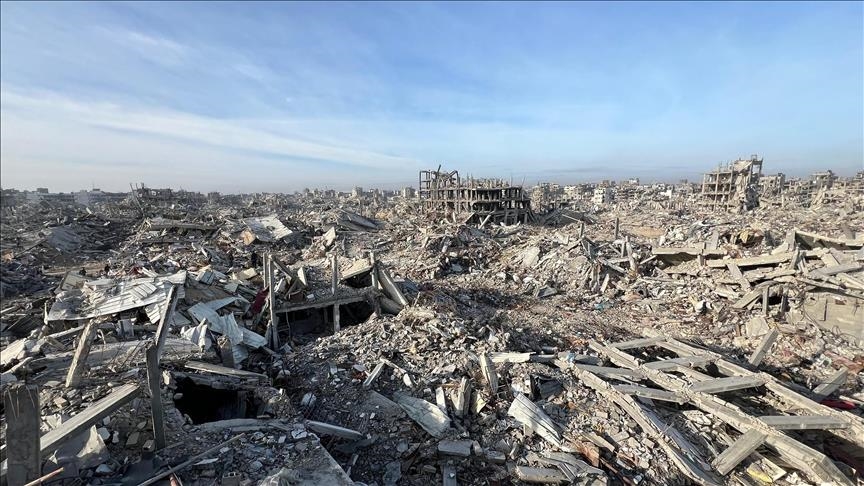
Gaza ruins
Another resident, Sabah Muhammed, said the cemeteries have lost all sense of sacredness.
“Graveyards, once holy spaces for the dead, are now silent witnesses to a living crisis. There’s no water, no electricity, and no privacy — only the bare minimum to survive,” she said.
“In Gaza, even the land for the dead is now the only refuge for the living.”
According to the United Nations, at least 1.9 million people — about 90 percent of Gaza’s population — have been displaced since the war began. Many have been forced to move multiple times, some more than ten.
In southern Gaza, overcrowded shelters are bursting at capacity after Israeli evacuation orders pushed residents from the north, only for many to face renewed airstrikes as they fled.
The cost of renting even a small patch of land to pitch a tent is beyond reach for most displaced families, many of whom have no income and rely entirely on scarce humanitarian aid.
The UN agency for Palestinian refugees (UNRWA) estimates that 61 million tonnes of debris now cover Gaza, with entire neighbourhoods wiped out. Families are scavenging through the ruins in search of shelter and water.
Although a fragile ceasefire has been in effect since October 10, Israel continues to impose severe restrictions on humanitarian aid. The International Court of Justice ruled on Wednesday that Israel must allow assistance into Gaza, emphasizing that starvation cannot be used “as a method of warfare.”
Currently, most aid enters Gaza through the Karem Abu Salem (Kerem Shalom) crossing in the south, while crossings in the north remain closed.
Source: Aljazeera



