Written By | Fashion and Design Desk
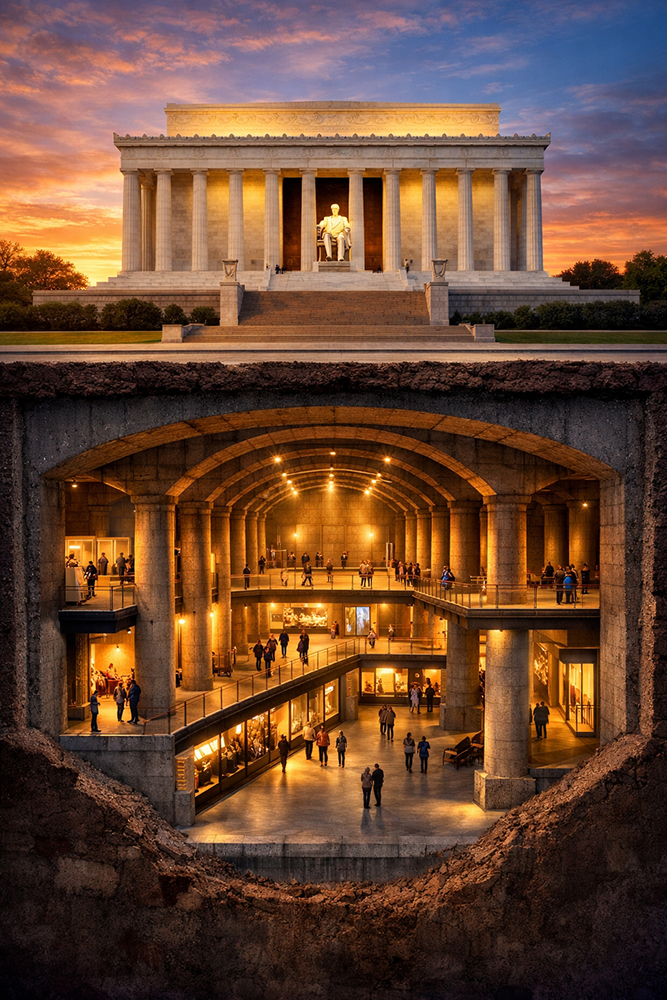
A $69 million transformation turns the undercroft beneath one of America's most visited monuments into an immersive museum, timed to the nation's 250th birthday.
WASHINGTON, D.C.
Beneath the marble steps where visitors have posed for photographs for more than a century, the Lincoln Memorial has kept a secret: a cavernous, unfinished undercroft, its raw concrete columns and stalactite-like mineral deposits visible only to maintenance crews and the rare tour granted to VIPs. That secret is now public. The Lincoln Memorial Undercroft Museum opened its doors to visitors this summer, transforming roughly 15,000 square feet of previously inaccessible space into a fully realized museum experience — one of the most significant additions to the National Mall in recent memory, and a design achievement that required threading new architecture through a century-old National Historic Landmark without disturbing the monument sitting directly above it.
A Century Underground
The undercroft has existed, unseen, since the Lincoln Memorial itself was completed in 1922. Built as structural support for the monument above, the space was never intended for public use, and for decades it functioned purely as a mechanical and maintenance area — a strange, cathedral-like void of bare concrete piers directly beneath one of the most photographed public spaces in the country. The new museum preserves that architectural rawness rather than concealing it: designers built the exhibition program around the original columns rather than around them, letting visitors walk among the same century-old concrete supports that have held the memorial in place since Warren Harding's presidency.
The project's timing was deliberate. The museum opened to the public on June 25, positioning it as one of the marquee cultural openings tied to America's 250th anniversary celebrations culminating around July 4. That timing turned what might otherwise have been a purely architectural or preservation story into a genuine cultural moment, with the museum framed explicitly as a new way to encounter the country's founding ideals through the lens of Lincoln's presidency and legacy.
The Design Challenge
Executing the project required an unusual architectural discipline: everything added had to defer to the existing structure rather than compete with it. The design team introduced floor-to-ceiling glass walls and a dedicated immersive theater space without altering the load-bearing elements supporting the memorial above — a constraint that shaped nearly every decision in the roughly $69 million build-out. Projection technology throws archival imagery directly onto the original pillars, including footage of Marian Anderson's landmark 1939 concert on the memorial's steps and Martin Luther King Jr.'s 1963 'I Have a Dream' speech, effectively turning the building's own bones into the exhibition's screens rather than adding conventional gallery walls that would have covered them up.
That approach reflects a broader trend in museum design toward what curators sometimes call "architecture as artifact" — treating a building's existing structure as content in its own right rather than a neutral backdrop for objects placed inside it. Few recent American museum projects have had as literal an opportunity to apply that philosophy as this one, given that the space itself, previously invisible to the public, is arguably the most compelling object in the collection.
The undercroft joins a small but growing category of American cultural projects built around revealing rather than replacing existing infrastructure, alongside efforts like adaptive reuse of industrial waterfronts and formerly closed transit tunnels converted into public space. What sets the Lincoln Memorial project apart is the degree of symbolic weight already attached to the structure above it; designers had essentially no room for creative license on the exterior or the main chamber, making the undercroft one of the only places left on the entire site where an entirely new architectural statement could be made without touching Bacon's original vision.
Funding a Century-Delayed Vision
The project's financing tells its own story about how major public monuments increasingly get built in the United States: through a blend of federal stewardship and private philanthropy. The National Park Foundation led fundraising for the effort, ultimately raising more than $43 million toward the roughly $69 million total, including an early $18.5 million gift from financier and philanthropist David Rubenstein back in 2016 that helped set the project in motion nearly a decade before its completion.
That long runway between initial funding and public opening is not unusual for projects of this technical complexity, particularly ones that involve building new infrastructure inside a protected historic landmark, where every design decision requires extensive review to ensure the memorial above remains structurally and aesthetically untouched.
What This Means for Visitors
Access to the museum requires a timed-entry ticket, reservable online for a nominal $1 fee, or available for free the day of a visit at the Korean War Veterans Memorial kiosk nearby — a system designed to manage crowds in a space that, however large by underground-museum standards, remains far more intimate than the open plaza above it. Once inside, visitors move through tactile and audio elements built with accessibility in mind, alongside the immersive theater component, giving the museum a sensory range well beyond the traditional glass-case, placard-driven museum experience.
For architecture and design enthusiasts, the undercroft offers something increasingly rare: an entirely new public space carved out of one of the most scrutinized and beloved structures in the country, executed with enough restraint that the addition reads as a natural extension of Henry Bacon's original 1922 design rather than a modern intrusion on it. For the roughly seven million people who visit the Lincoln Memorial each year, it also means an entirely new reason to linger — a hidden chapter of the monument's history, quite literally, finally brought into the light.
Early visitor reaction has centered as much on the sensation of the space itself as on any individual exhibit component — the disorienting experience of standing directly beneath a monument millions have visited without ever suspecting what sat below it. That reaction is, in many ways, the clearest measure of the project's success: a design brief built around revealing hidden structure rather than adding to it only works if the structure itself is compelling enough to carry the experience, and nearly every account from the museum's opening weeks suggests it is.



