Written By |
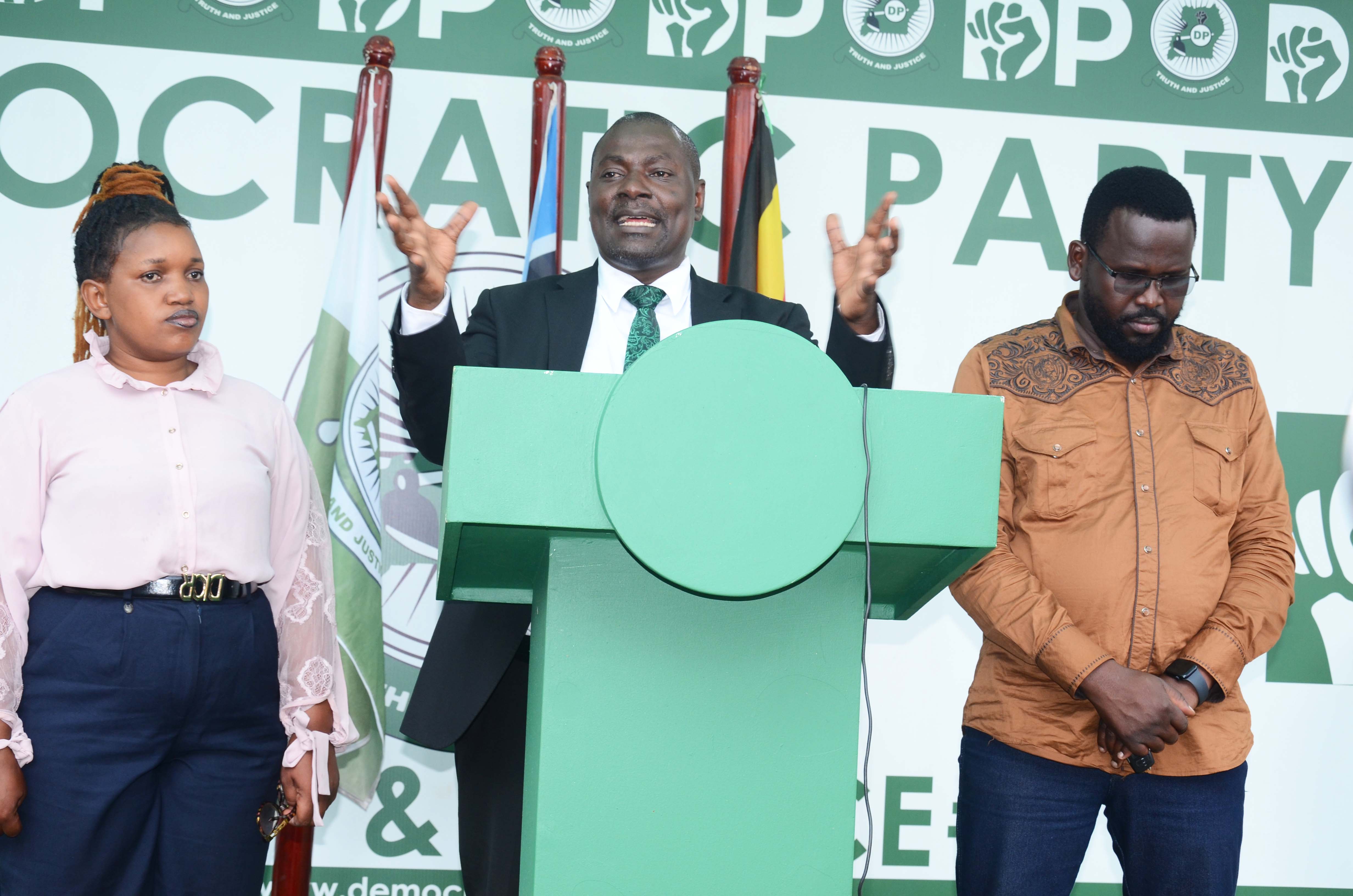
Kenneth Nsubuga, the DP legal advisor, DP Spokesperson, Okoler Opio Lo Amanu and DP member addressing press conference at Balintuma Road offices in Kampala. (Photo by Milton Niinga)
By Milton Niinga
The bill, which seeks to restructure military courts and align the Uganda Peoples’ Defence Forces (UPDF) Act with recent judicial rulings and government policies, has sparked controversy and drawn sharp criticism from lawmakers, human rights advocates, and legal experts.
Following a dramatic walkout by opposition MPs on Tuesday, the Democratic Party (DP) has appealed to National Resistance Movement (NRM) legislators to use their numerical advantage in Parliament to block the passing of the UPDF Bill, which proposes allowing civilians to be tried in military courts under certain circumstances.
The bill has met strong opposition from various political parties, human rights organizations, and a section of opposition legislators.
Kenneth Nsubuga, DP’s legal advisor, while addressing a weekly press conference at the DP National Campaign Headquarters on Balintuma Road in Kampala, urged NRM MPs to vote against the bill. He argued that it undermines civilian authority and contradicts judicial oversight established by the Supreme Court.
“This is a critical moment when we need support from our NRM colleagues in Parliament. As guided by the Supreme Court under Chief Justice Alfonse Owiny-Dollo, the bill dilutes civilian protections and violates international norms which limit military courts to service personnel and offenses of a military nature—not civilians,” Nsubuga stated.
He warned that if passed, the bill could pave the way for the military persecution of opposition politicians, disguised under legal reforms.
Nsubuga emphasized that only NRM MPs, who hold a majority in Parliament, can block or amend the bill.
“We in DP are determined to oppose this bill, but NRM dominates the House. There are allegations that over 317 NRM MPs—along with some from the opposition—were controversially bribed with Shs100 million each to support the bill, but we are here to strongly denounce such corruption,” he asserted.
He cautioned lawmakers against supporting repressive laws, citing historical examples.
“When you take part in passing draconian laws, you may end up like former Prime Minister John Patrick Amama Mbabazi, who spearheaded the Public Order Management Act (POMA), which was later used against him during his presidential campaign in Mbale,” he said.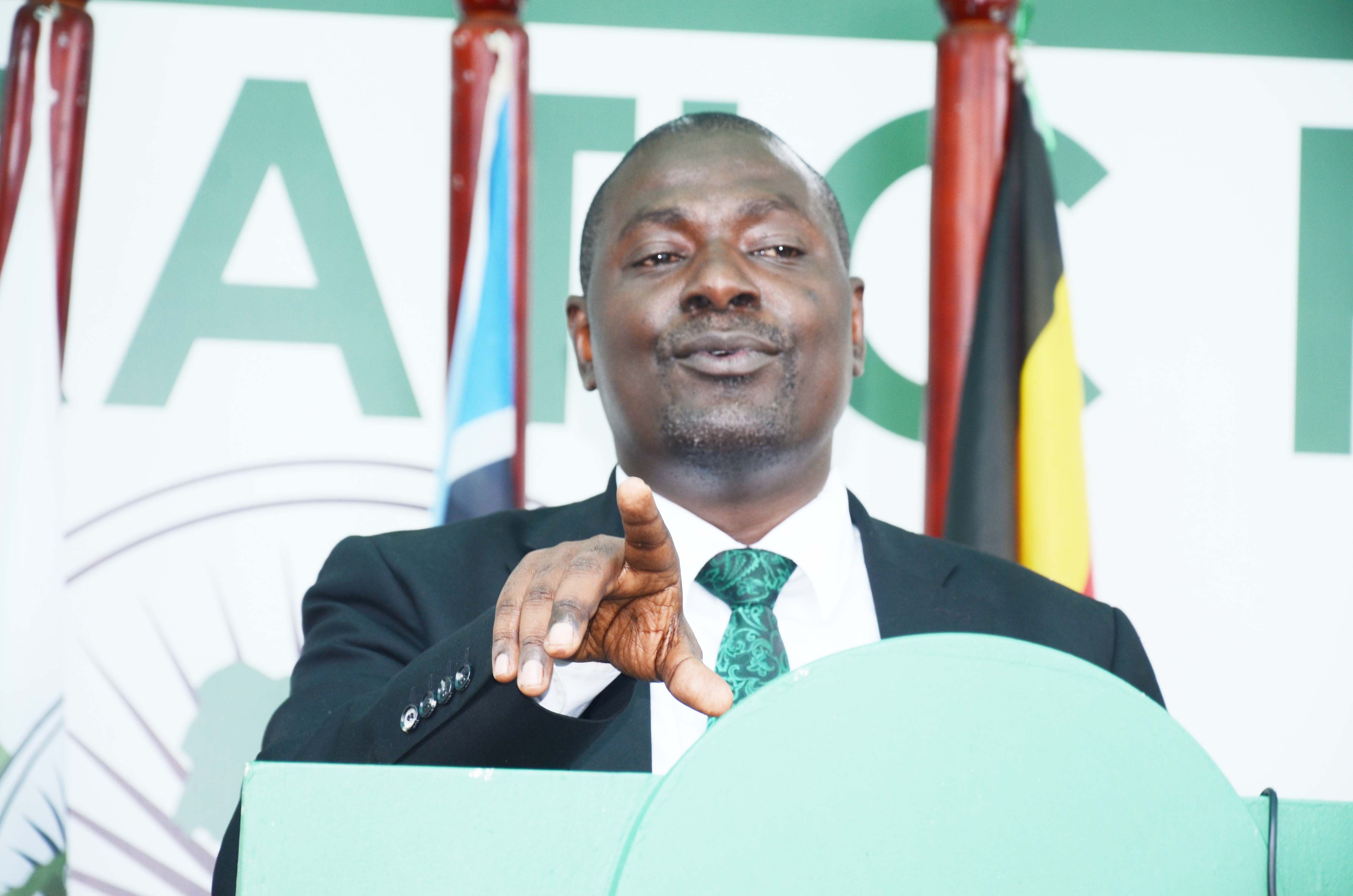
Kenneth Nsubuga, the DP legal advisor and DP Spokesperson, Okoler Opio Lo Amanu addressing press conference at Balintuma Road offices. (Photo by Milton Niinga)
Kayihura’s ordeal a warning
Nsubuga further recalled the case of Gen. Kale Kayihura, former Inspector General of Police, who once resisted constitutional bail procedures—only to later suffer their consequences.
“In 2018, Kayihura spent two and a half months in military detention at Makindye Barracks, held under 24-hour surveillance. His lawyers contested the detention, noting he was held for over 72 hours without being charged—contrary to the 48-hour constitutional limit,” he said, warning NRM MPs of a similar fate.
The bill was introduced by Minister of Defence and Veteran Affairs, Jacob Oboth Oboth, who claims it is intended to align Uganda's legal framework with the Supreme Court’s January 2025 ruling, which barred the trial of civilians in military courts.
Oboth maintains that the bill balances respect for the court’s decision with the need to confront emerging national security threats.
The controversial law had previously been annulled by the Supreme Court, in a case involving former Nakawa West MP Michael Kabaziguruka versus the Attorney General.
“This draconian law was already outlawed by the Supreme Court. Now it is being reintroduced—again—with the backing of civilian leaders who are constitutionally mandated to protect their constituents,” Nsubuga emphasized.
NUP’s Ssenyonyi speaks out
Joel Ssenyonyi, spokesperson of the National Unity Platform (NUP) and Leader of the Opposition, expressed concern that the bill could be passed even in their absence.
“We have no option. We are few in number, but the people we represent expect us to present their views before the bill is passed or rejected,” he said.
FDC threatens legal action
The Forum for Democratic Change (FDC), led by acting party president Hassan Kaps Fungaroo, rejected the bill in its entirety, calling it a blatant violation of the Constitution.
“The entire legislative process is flawed. There has been no public participation—one of the cardinal principles of lawmaking. The bill was tabled on May 13, 2025, and now, less than seven days later, it is being rushed through Parliament without adequate time for debate,” he said.
Fungaroo further noted that government bodies like the Ministry of Justice and the Attorney General are discussing the bill internally without public engagement. “This bill must be thrown out. If it is passed without public consultation, we will take the matter to the Courts of Law,” he warned.
PFF Reacts: Military courts targeting politicians
Ibrahim Ssemujju Nganda, spokesperson for the People’s Front for Freedom (PFF), condemned the bill and criticized the hurried process of its reintroduction despite an earlier Supreme Court ruling.
“Parliament should not entertain this bill. The Supreme Court already nullified it. We condemn the continued trial of political prisoners in military courts,” he said.
Ssemujju cited the ongoing detention of Dr. Kizza Besigye and Hajj Obeid Lutale, who were remanded by a military court on November 20 last year without formal evidence.
“Besigye and others have now spent six months in jail, despite the Constitution guaranteeing mandatory bail. They’ve never even been presented with any credible evidence—only secret applications by the State to access private phone data,” he stated.



