OTTAWA / WASHINGTON
At 12:01 a.m. Eastern on Tuesday, September 8, Canada began collecting tariffs of 15, 25 and 50 per cent on more than 700 categories of American goods worth roughly $20bn — steel and aluminium, household appliances, agricultural equipment, dairy, seafood, wood and paper products, electronics and clothing. It was, in Prime Minister Mark Carney's formulation, a dollar-for-dollar answer to the 50 per cent duties Washington imposed on an equivalent value of Canadian exports in late August after trade negotiations collapsed.
By the end of the same day the American response had escalated the dispute into a different category of conflict. President Trump signed five proclamations banning the import of a broad range of Canadian products outright, effective September 29: most alcoholic beverages, including canned and bottled beer, rye whisky and many wines; dairy products including whey protein; molasses; and motorcycles. Tariffs raise the price of a good. An import ban removes it from the market. Between two countries that have operated a free-trade area for more than thirty years, and whose supply chains in autos, agriculture and metals were built on the assumption that the border barely exists, that is a qualitative change.

Background
The rupture has been building since July, when Trump announced 50 per cent tariffs on a slice of Canadian goods, citing what he called "discriminatory treatment" of American products. The trilateral North American trade pact — USMCA in Washington, CUSMA in Ottawa — was not renewed in July, removing the scheduled process that had been expected to contain exactly this kind of dispute. Negotiators from both countries spent August racing to reach a deal before the tariffs took effect. A deadline was pushed back by several days. It was not enough.
On August 21 and 22, Carney suspended the talks, saying American negotiators had introduced terms he regarded as unfair and that Ottawa had walked away from a bad deal that would have disproportionately benefited the United States. He was unusually blunt about the framing: "You're at war when you get attacked. We got attacked." Trump's account was the mirror image — that Canada had been taking advantage of the United States for decades — and he posted on Truth Social: "Canada wants the benefits of being a State, without being one!!!"
On August 25 Ottawa unveiled the retaliation list: C$27.6bn, approximately US$19.94bn, across roughly 700 product lines, at three tariff bands, with the headline measure a 50 per cent duty on American steel and aluminium — a doubling of the previous rate. Alongside it came a C$7.5bn package (about US$5.4bn) of new and enhanced support for small and medium-sized businesses and for workers judged at risk. The measures were set for September 8, which gave both governments a fortnight either to find an off-ramp or to prepare for impact. They used it to escalate.
The asymmetry of the confrontation is the central fact of it. Canada's economy is roughly a tenth the size of the American one and sends about 70 per cent of its exports south. Trump has separately threatened 50 per cent tariffs on all car products beginning January 1 — a measure that, as analysts have noted, would take effect months after the November midterm elections, when the political cost of consumer price increases falls away.
Key Developments
Tuesday's escalation was not confined to the import bans. Trump also directed the General Services Administration, the agency that manages federal procurement, to coordinate with the Office of the U.S. Trade Representative to strip Canadian suppliers from federal contracting schedules — instructing it to "REMOVE Canadian-origin products from GSA's Multiple Award Schedules unless Canada restores full and fair reciprocity for American Farmers and Companies." Treasury Secretary Scott Bessent said Carney "needs to stop campaigning and start governing," adding that Washington remained unsure why Canada had left the table.
On the eve of the Canadian tariffs taking effect, Trump threatened to block the aircraft manufacturer Bombardier from selling its planes in the United States unless it moved manufacturing there. The company noted that it employs thousands of American workers and said it valued its partnerships with American firms. Flavio Volpe, president of the Canadian auto-parts trade group APMA, pointed out on X that Bombardier's jets fly on American-made GE and Honeywell engines — a compact illustration of why a border-drawn line through North American manufacturing is difficult to draw at all.
Carney's public posture has been steady rather than combative. In a video message shared as the tariffs took effect, he told Canadians: "We have everything we need to pivot and prosper. That pivot will come at a cost. There's always a cost to action. But it doesn't come close to the cost of standing still." He has argued that Canada retains the strongest fiscal position in the G7 and has accused the administration of trying to "break" the country with tariffs.
The dispute has also acquired a register of symbolic provocation that has no obvious precedent between allies. In August Trump signed an order renaming Lake Ontario as "Lake America" for United States federal use — Carney replied that "Ontario" is an Indigenous name more than four hundred years old, predating both Confederation and the American Declaration of Independence. Manitoba Premier Wab Kinew dismissed the gesture as a tired act: "You know when a rock band is really over the hill, and you see them in a casino playing some song from like 50 years ago? I think that's the part of Donald Trump's presidency we're at now. It's not his best work." On Sunday Trump posted an illustration of himself standing over Carney in an ice-hockey rink with the caption "Get up, governor," a reference to his repeated suggestion that Canada should become a fifty-first state. Ottawa has treated the annexation talk as noise; a substantial part of the Canadian public does not.

Reactions
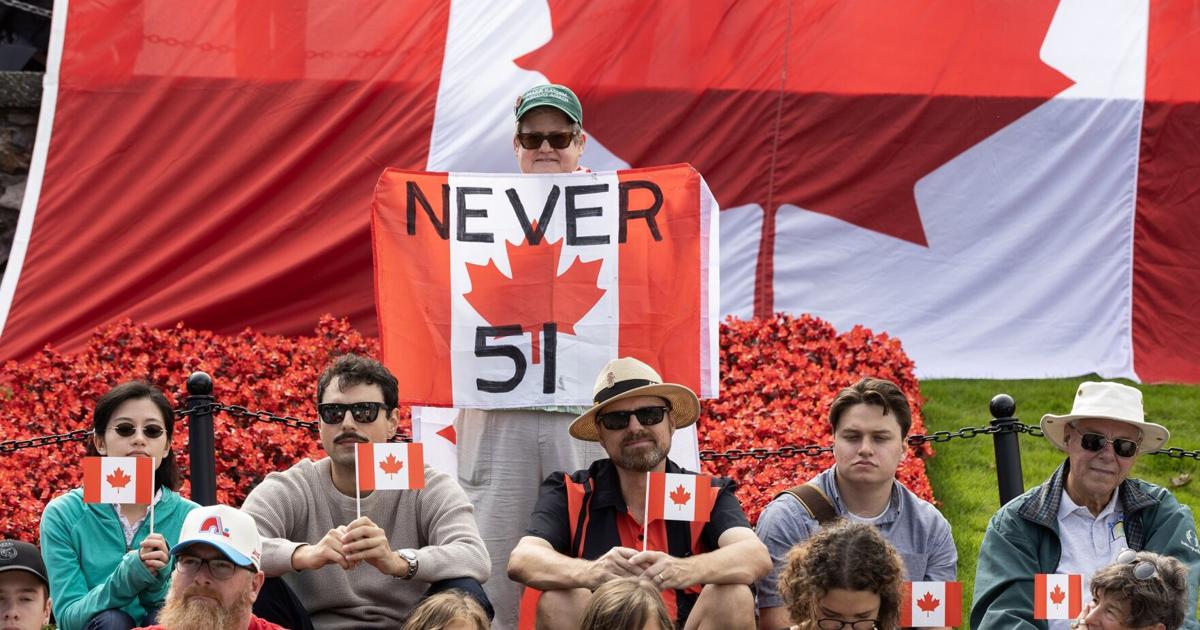
Canadian retaliation has produced a surge of national feeling that both governments are now betting against each other's ability to sustain. "People feel very energised by the idea of Canada standing up to Trump, and there's a palpable sense of patriotism in Ottawa, but I don't know how long it will last," said Vina Nadjibulla, co-founder and chief executive of the Centre for Strategic Statecraft in Canada.
Business groups are more anxious than the politics suggests. "This absolutely is a trade war," said Ashley Kalyn of Peacock Tariff Consulting in Toronto, adding that Canada should expect upwards of 100,000 jobs to be lost and that some clients were already planning to close factories and lay off workers if the tariffs persist. Michael Harvey, executive director of the Canadian Agri-Food Trade Alliance and a member of Carney's advisory committee on bilateral economic relations, told Reuters: "What we are worried about is an escalatory spiral. But at the same time, we totally understand that the prime minister needs to find areas of leverage." Matthew Holmes of the Canadian Chamber of Commerce struck a similar note: "A war of attrition will help neither economy. But Canada is showing itself to be very resilient," adding that he hoped negotiators would return to the table rather than retaliate indefinitely.
Provincial governments are not aligned on how far to go. Ontario Premier Doug Ford has argued that everything should be on the table, including restricting electricity exports to bordering American states and limiting critical-mineral shipments. Alberta and Saskatchewan, whose economies rest on oil and potash, have declined to countenance export taxes on natural resources. That split is the practical limit on Canada's escalation ladder: its most painful instruments are concentrated in provinces least willing to use them.
American consumers are not insulated. Analysts expect price increases across roughly 550 consumer goods imported from Canada, and a Kiel Institute for the World Economy study cited in the reporting estimates that American importers and consumers absorb some 96 per cent of the tariff burden. Because Canada is the largest single buyer of American-made vehicles, the retaliation lands directly on carmakers, and Oxford Economics' lead U.S. economist Bernard Yaros has warned that the threatened 2027 doubling of auto tariffs would disproportionately hurt Midwestern states — Michigan, Ohio, Indiana — whose plants depend on Canadian-made components.
What's Next
The immediate date to watch is September 29, when the American import bans take effect. Between now and then, Canadian distillers, brewers, dairy processors and motorcycle exporters face a hard stop rather than a price adjustment, and Ottawa must decide whether to answer prohibition with prohibition — a step it has so far avoided.
The larger question is the fate of USMCA itself. The agreement still shields the majority of Canadian exports from American tariffs, which is why Canada's effective tariff rate has remained among the lowest in the world: about 5.1 per cent before the latest measures, rising to an estimated 6.9 per cent after them. Oxford Economics estimates the current tariffs will shave roughly 0.3 percentage points off Canadian GDP next year — painful but survivable, with the damage concentrated in manufacturing in Quebec, Ontario and New Brunswick and among exporters in British Columbia. The collapse of the agreement is a different order of harm: Tony Stillo, the firm's director of Canada economics, warns that it would "push Canada's economy into a recession and leave it on a permanently lower path." That is the escalatory spiral Harvey named, and neither capital has yet described an exit from it.
Politics on both sides now works against de-escalation in the short run. Trump faces midterm elections in November and has consistently found confrontation with Canada to be low-cost domestically; the auto tariffs he has scheduled for 2027 are timed to arrive after voters have been consulted. Carney, for his part, cannot be seen to fold after telling Canadians the country was attacked. The most plausible near-term outcome is therefore not a settlement but a stalemate in which both sides absorb losses and wait for the other's domestic politics to shift — with the difference that one economy is ten times the size of the other, and the smaller one is the one that sends seven of every ten export dollars across the line now being drawn.
There is a wider audience for the result. "Whether Canada is able to hold this line has implications for others as well," Nadjibulla said. Every American trading partner facing tariff pressure is watching to see whether dollar-for-dollar retaliation by a mid-sized economy produces concessions or only punishment. September 29 will supply the first real evidence.
Published By | News Editor