Rabat, Morocco
Morocco's 15.8 million registered voters head to the polls Wednesday to elect all 395 members of the House of Representatives, in a parliamentary election unfolding less than a year after the largest youth protest movement in the kingdom's recent history — and amid open, unusually public infighting inside the coalition that has governed since 2021. The vote will determine not only the composition of parliament but whether Prime Minister Aziz Akhannouch retains the post, whether the once-dominant Islamist opposition can begin to claw back from a historic collapse, and whether the government's promises to young Moroccans after last autumn's unrest amount to anything more than campaign talk.
Twenty-seven political parties are contesting Wednesday's vote, according to reporting by Al Jazeera, in a system where the king ultimately appoints the head of government from the party or coalition that wins. That constitutional arrangement — a hybrid of parliamentary politics and monarchical authority — has defined Moroccan governance for decades and remains untouched heading into this election. What has changed is the political temperature surrounding it.

Background: A Coalition Born From Collapse
To understand Wednesday's stakes, it helps to look back to the last election, in 2021, when Morocco's political map was redrawn overnight. The National Rally of Independents (RNI), led by business magnate Aziz Akhannouch, surged from a minor party to the largest bloc in parliament, winning 102 seats — a gain of 65. The Authenticity and Modernity Party (PAM) took 87 seats, and the Istiqlal Party won 81, up 35 from its previous total. Those three parties — RNI, PAM and Istiqlal — formed the governing coalition that has run the country for the past five years, with King Mohammed VI nominating Akhannouch as prime minister on September 10, 2021, and the government taking office that October.
The story of that election, though, was really the collapse of the Justice and Development Party (PJD), Morocco's Islamist party, which had led the government for the preceding decade. The PJD fell from 125 seats to just 13 — a loss of more than 90 percent of its parliamentary representation, one of the most dramatic single-election wipeouts in the country's modern political history. Then-Prime Minister Saadeddine Othmani resigned as the party's secretary-general and lost his own seat in Rabat.
The Gen Z Reckoning
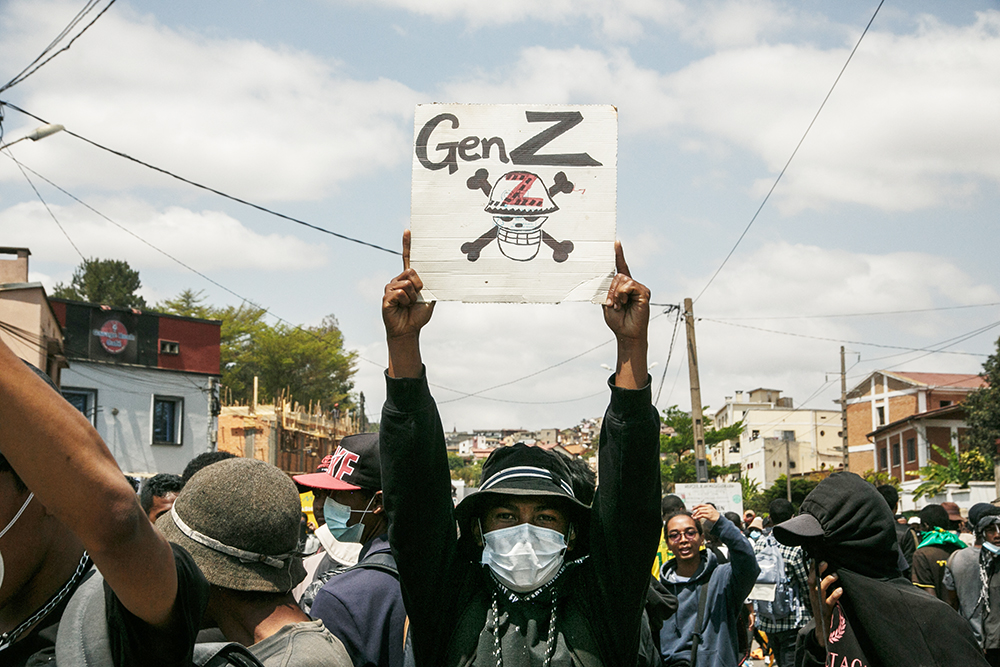
That backdrop alone would make Wednesday's vote significant. But the more immediate context is the wave of youth-led protests that swept Morocco from September 27 to October 18, 2025. Organized largely through Discord by decentralized groups calling themselves GenZ 212 and Moroccan Youth Voice — the server grew from fewer than 1,000 members on September 18, 2025, to roughly 250,000 by October 7 — the demonstrations were triggered by the deaths of eight women during childbirth at a public hospital in Agadir, which crystallized broader anger over the state of public healthcare, education, unemployment and perceived corruption.
The protests' defining slogan, "Stadiums are here, but where are the hospitals?", captured their central grievance: that the government was pouring billions of dollars into infrastructure for the 2025 Africa Cup of Nations and the 2030 FIFA World Cup, which Morocco is co-hosting with Spain and Portugal, while public hospitals and schools deteriorated. According to a Wikipedia summary of the unrest corroborated by regional reporting, three protesters were killed and 28 injured, including one critical case in the eastern city of Oujda; more than 2,400 people were arrested and over 1,500 face trial. Security forces reported 326 officers injured and 271 police vehicles damaged. Protesters' demands included free quality education, accessible healthcare, affordable housing, job creation, reduced sports spending, anti-corruption measures — and, pointedly, the dismissal of Akhannouch himself.
The government's response came largely through its 2026 budget, which proposed roughly $15 billion in combined health and education spending, a 16 percent increase, alongside the creation of 27,000 public-sector jobs and draft legislation to encourage youth political participation, including campaign-expense subsidies covering up to 75 percent of costs for young candidates. GenZ 212 organizers have remained skeptical, saying any reforms "must be accompanied by firm measures against corruption and conflicts of interest" — a direct challenge to a government now asking for a renewed mandate.
An Economy Still Squeezing the Young
The economic numbers underlying the anger are stark. Youth unemployment for Moroccans aged 15 to 24 stood at 37.3 percent in 2025, according to an International Monetary Fund estimate, against an overall unemployment rate of 13 percent. More than a quarter of young people — 25.2 percent as of the third quarter of 2025 — were neither employed nor in education or training. Morocco's economy grew 4.9 percent in 2025 and is projected to grow 4.4 percent in 2026, respectable by regional standards but not enough, critics say, to absorb the roughly 4 percent of the registered electorate aged 18 to 24, compared with 29 percent aged 60 and older — a generational imbalance that has fueled complaints that Moroccan politics structurally underrepresents the young. A March 2026 Afrobarometer survey found that only about a third of Moroccans aged 18 to 35 trust parliament, the head of government or political parties, even as young people are far more likely than their elders to engage politically online and in street demonstrations.
The Islamist Comeback Bid
Against this backdrop, the PJD is attempting a political resurrection under Abdelilah Benkirane, the veteran politician who led Morocco's government from 2012 to 2017 and has since returned to the party's helm as secretary-general. Benkirane, described by Al Jazeera as carrying a personal political "brand" independent of his party's institutional weakness, has staked the PJD's campaign on a platform of 467 specific policy measures spanning five areas: identity and family, political and institutional reform, public services and social protection, the economy and employment, and foreign policy. Party official Saad al-Sabahi framed the platform as a renewed contract with voters, saying the commitments "form the basis of the agreement between the party and voters" and are intended to "restore the gains that citizens previously enjoyed." Party figure Yassine Elachiri, addressing the youth question directly, cautioned that "earning the trust of young people cannot be reduced to electoral mobilisation," calling instead for sustained engagement beyond the campaign season.
The PJD's own diagnosis of its 2021 defeat blends acknowledgment of internal organizational failures with allegations of outside interference and electoral irregularities — a mixture that leaves open whether the party has fully reckoned with the causes of its collapse. Notably, the party continues to oppose Morocco's 2020 normalization of relations with Israel even though it was in government, under Othmani, when that normalization occurred — a tension that has followed the PJD since.

Cracks in the Governing Coalition
Perhaps the most politically damaging development of the campaign has been the public unraveling of unity within the outgoing coalition itself. A leaked audio recording attributed to RNI parliamentary speaker Rachid Talbi Alami surfaced criticizing the potential reappointment of Fouzi Lekjaa, the sitting budget minister, to an economy and finance role in any future government — a dispute that exposed how RNI, PAM and Istiqlal, despite governing together for five years, are simultaneously competing against one another for votes, candidates and parliamentary seats in Wednesday's election. RNI President Chouki sought to tamp down the controversy, saying the focus should remain on "winning the election rather than distributing government posts in advance," while Lekjaa dismissed the criticism, remarking that "dividing up the spoils without having hunted them" was not his concern.
The episode illustrates a structural contradiction embedded in Morocco's coalition politics: parties that must cooperate to govern are also direct electoral rivals, and public evidence that coalition partners are already negotiating post-election power-sharing arrangements — before voters have cast a single ballot — risks reinforcing exactly the cynicism about political process that fueled last year's protests.
What to Watch
The immediate outcome to watch Wednesday is the overall seat distribution among RNI, PAM and Istiqlal, and whether that trio can or will reconstitute their coalition, a decision that will determine whether Akhannouch — deeply unpopular with the protest movement that explicitly demanded his removal — remains head of government. Equally significant will be the PJD's seat count: a meaningful recovery from 13 seats would signal that Morocco's Islamist opposition retains a durable political base despite 2021's rout, while a marginal gain would suggest the party's decline reflects deeper structural problems rather than a single bad election cycle.
Beyond the seat count, analysts and youth organizers alike will be watching turnout among registered voters under 35, and whether the political class treats the results as a mandate to accelerate the healthcare, education and anti-corruption commitments made in the 2026 budget — or reverts, once ballots are counted, to the coalition math and patronage politics that both PJD critics and Gen Z 212 organizers say defined the outgoing government. With King Mohammed VI retaining ultimate authority to appoint the next head of government, the final shape of Morocco's leadership may not be settled by Wednesday's vote count alone, but by the negotiations that follow it.
Published By | News Editor