Written By | Fashion and Design Desk
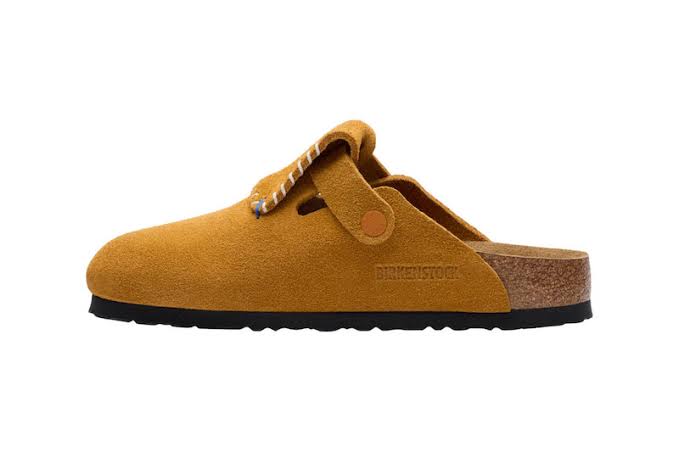
Birkenstock's most divisive silhouette gets a second reunion with the Seoul design collective, reworking five decades of orthopedic cool into two sculptural, stitched-up new takes.
FASHION
Fifty years ago, Birkenstock introduced a shoe that broke its own rules. Where the brand had built its reputation on open-toed sandals designed to let feet breathe and splay naturally, the Boston — a closed-toe clog with a single wide strap and a buckle across the instep — was something closer to house-slipper-meets-orthopedic-device. It became, almost despite itself, one of the most quietly influential shoes of the late twentieth century: the footwear of architecture students, chefs, nurses, and eventually, decades later, of the exact fashion-forward crowd that once mocked it. This year, as the Boston marks its fiftieth anniversary, Birkenstock is celebrating not with a nostalgia lap but with another collision — its second collaboration with Ader Error, the genre-blurring Seoul design collective known for treating clothing like conceptual sculpture.
The new capsule, unveiled this month, splits into two distinct silhouettes: the Boston Cap and the Boston Flap. Both take the familiar wide-strap clog and push it somewhere stranger. The Boston Cap arrives in black and camel, built around a dual-layer leather upper topped with a utilitarian leather cap that reworks the toe box into something closer to workwear than house shoe. The Boston Flap, offered in Ader Error's saturated Ultra Blue and a warmer honey tone, goes further still, adding an exaggerated flap fixed across the upper with a visible white whipstitch — a detail that turns what is normally a hidden construction seam into the shoe's entire visual statement.
The Concept Behind the Stitch
Ader Error has built the collection around a single word: Thread. In the brand's telling, the concept is less about literal sewing than about connection itself — the idea that a thread, as the simplest possible medium, is capable of linking two entirely separate worlds into something new. "As the simplest medium capable of connecting two distinct worlds, a thread creates relationships and forms new connections," the brand explained of the concept, describing the visible stitch running across both new silhouettes as "a trace left behind as separate elements come together to form a new relationship." It's a fittingly self-referential idea for a collaboration that is itself a reunion: Ader Error and Birkenstock first worked together in 2022, and this second outing reads less like a repeat than a deepening of that original creative rapport.
The zigzag embroidery that has become one of Ader Error's signature visual motifs recurs throughout both styles, threaded across the strap and cap in a way that turns Birkenstock's most utilitarian shoe into something closer to a display piece — a wearable argument for stitching as ornament rather than just structural necessity.
Why the Boston, and Why Now
The choice to build an anniversary moment around the Boston, rather than Birkenstock's more famous Arizona sandal, says something about where the brand sees its cultural momentum. The Arizona has long been the company's flagship — the two-strap sandal that launched a thousand imitators and a thousand op-eds about the "ugly shoe" trend of the past decade. The Boston, by contrast, has spent the last several years quietly becoming fashion's preferred cold-weather Birkenstock, embraced by both minimalist "quiet luxury" dressers pairing it with wide-leg trousers and by more maximalist streetwear crowds drawn to its slipper-like, faintly domestic strangeness.
That dual appeal — equally at home styled with tailoring or with sweatpants — has made the Boston an unusually flexible canvas for collaborators. Birkenstock's collaboration slate over the past two years has included partnerships with Repetto, the storied French ballet-flat maker, and Sacai, the Japanese label famous for hybridizing garment silhouettes, both of which generated significant online attention and rapid sell-outs. The Ader Error reunion arrives explicitly in that lineage, positioned by trade press as the continuation of a run of collaborations that have kept Birkenstock relevant to an audience far younger than its orthopedic-shoe origins would suggest.
The Price of Reinvention
The Boston Flap will retail at $370 — a striking figure for a shoe whose unadorned, mainline version typically sells for well under $200, and a price point that signals how thoroughly the collaboration economy has reshaped what "sneaker culture" pricing logic can do to a basics brand. The Boston Cap's pricing had not been finalized as of the collection's announcement. Both styles are unisex, following the sizing logic Birkenstock has used across most of its recent collaborative capsules, and launched globally on August 6 through 1774.com (Birkenstock's dedicated collaboration and archival platform), Ader Error's own site, and a curated list of retail partners.
The 1774.com platform itself is worth noting as part of this story: launched by Birkenstock in recent years specifically to house its higher-concept collaborative and archival releases, separate from the brand's mainline retail channels, it signals how seriously the company now treats its collaboration pipeline as a distinct business — closer to a limited-edition sneaker drop model than traditional footwear retail.
What This Means for Shoppers
For anyone who has watched the "ugly shoe" movement calcify into permanent mainstream acceptance over the past several years, the Ader Error Boston capsule is a useful marker of where that trend has landed: no longer a punchline, no longer even really a trend, but an established design category with room for genuine formal experimentation. A $370 clog with exaggerated whipstitching is not a shoe aimed at first-time Birkenstock buyers; it's aimed at a customer who already owns the classic Boston and is looking for a version that reads as considered design object rather than comfort footwear.
That said, the underlying appeal Birkenstock has always sold — arch support, a contoured cork-latex footbed, genuine all-day wearability — remains intact underneath the conceptual flourishes. The Ader Error pieces are reworked skins on a fifty-year-old orthopedic architecture that hasn't fundamentally changed, which is arguably the whole point: even at its most sculptural, the Boston is still, underneath everything, a shoe built to be worn into the ground.
Fifty years after it first upended Birkenstock's own sandal-first identity, the Boston has become the platform for exactly the kind of experimentation the Arizona rarely gets — proof that a supporting silhouette, given the right collaborator, can eventually eclipse the icon it once stood beside.



