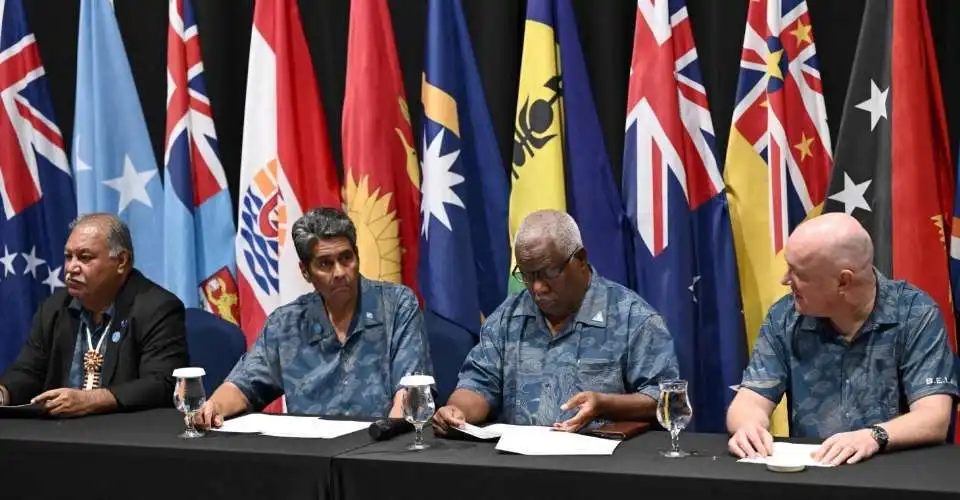
The 2026 Pacific Islands Forum leaders' meeting ended in Palau on Friday with something the region's diplomats had spent nearly two months trying and failing to produce: a collective statement, in the leaders' own communiqué, criticising China over a ballistic missile it fired across the Pacific in July. It was a modest paragraph in a long document, and it stopped well short of the formal condemnation Australia and Palau had sought. But in a regional bloc that operates by consensus and has spent a decade trying to avoid being turned into a theatre of great-power rivalry, even a modest paragraph was a significant act — and the way it was assembled revealed how much leverage Beijing now holds over parts of the Pacific.
Background: A Missile in the Nuclear-Free Pacific
In early July, a submarine belonging to the People's Liberation Army Navy fired a nuclear-capable ballistic missile carrying a dummy warhead from the South China Sea into the Pacific Ocean. Accounts of the launch vary in their technical detail: the Pacific Islands Forum communiqué and most regional leaders have described it as an intercontinental ballistic missile test, while several defence analyses characterised it as a submarine-launched ballistic missile of the JL series. The reported flight path was roughly 7,000 to 7,300 kilometres, with the missile splashing down in the South Pacific just outside Tuvalu's exclusive economic zone and not far from Naoero, the nation formerly known as Nauru. Beijing described the launch as part of routine annual training, said the weapon was unarmed, and insisted it was not directed at any country.
What made the test politically explosive was not only its destination but the absence of warning. Only a handful of governments received any notice, and those that did received it with very little time to spare. The missile came down inside the South Pacific Nuclear Free Zone, established by the 1985 Treaty of Rarotonga — an instrument that carries enormous moral weight in a region whose people lived through decades of American, British and French nuclear testing, and whose communities in the Marshall Islands and French Polynesia are still dealing with the medical and environmental consequences. For Pacific leaders, a nuclear-capable missile arriving unannounced in those waters was not an abstraction.
The reaction in July was unusually blunt by Pacific standards. The Solomon Islands' prime minister said the test was “not the act of a friend,” a formulation echoed by several counterparts. Australian Prime Minister Anthony Albanese was sharply critical. But when Pacific foreign ministers met last month to translate that anger into a joint statement, the effort stalled. Kiribati and Naoero — both of which switched diplomatic recognition from Taipei to Beijing in 2019 — refused to endorse a standalone statement, and the ministers' communiqué ended up with only a brief, unattributed call for “transparency and reassurance” on nuclear testing. That failure set up this week's confrontation in Palau.

Key Developments: A Retreat, a Paragraph, and a Dissent
Palau's President Surangel Whipps Jr, who chaired the Forum and is among the region's most outspoken critics of Beijing, pressed leaders to endorse a joint position during their traditional closed-door retreat, held at his family's residence in the north of the country. Returning to the commercial hub of Koror for the closing ceremony, Whipps read the agreed language to reporters: leaders had “registered concern on the recent intercontinental ballistic missile (ICBM) test, which overflew a number of members without adequate notice,” and had “called on all states undertaking ICBM testing to ensure transparency and reassurance, including through the provision of advance notification of a test at least 24 hours in accordance with international practice.”
The construction is worth reading closely. It is stronger than what the foreign ministers managed last month, because it comes from heads of government and refers directly to the test that overflew member states. But it never names China. It frames the demand as a universal standard applying to “all states undertaking ICBM testing” — language that allowed governments wary of antagonising Beijing to sign on, while giving Australia, New Zealand and Palau the substantive point they wanted: 24 hours' notice, as a regional expectation.
Even that compromise did not hold unanimously. Whipps told reporters that Naoero had dissented from the section criticising the test and that its objection would be recorded in the document, leaving the statement carrying 17 of 18 members. Kiribati's position was murkier still. President Taneti Maamau did not travel to Palau at all, sending instead David Teaabo, a senior official and the country's recently returned envoy to China — a substitution widely read across the region as a snub directed at both the host and at Taiwan. New Zealand Prime Minister Christopher Luxon told journalists that Kiribati “wasn't with the leaders” during the retreat and said he had not been aware of any Kiribati representative in the room. In an awkward moment at the closing ceremony, organisers initially omitted Teaabo from the public acknowledgment of senior country representatives before correcting themselves minutes later.
The absences went well beyond Kiribati. Leaders from five of the eighteen member nations — Fiji, Vanuatu, Samoa, Kiribati and New Caledonia — sent deputies or officials in their place. A sixth, Solomon Islands Prime Minister Matthew Wale, arrived in Palau and then flew home to Honiara to deal with a no-confidence motion against his government. Alan Tidwell of Georgetown University's Center for Australian, New Zealand and Pacific Studies told Radio Free Asia the meeting would inevitably be “less productive” as a result. “Being productive means having leaders in the room,” he said, predicting the summit would be remembered as the one where nearly a third of the leadership stayed away.
Running underneath the missile dispute was a second and arguably hotter argument, over Taiwan. Palau is one of three Pacific states — with the Marshall Islands and Tuvalu — that maintain diplomatic relations with Taipei, and as host it exercised its customary right to issue invitations to non-members. Taiwan attended as a “development partner,” a status it has held since the early 1990s that permits sideline events but not participation in the dialogue partners' session where China, the United States, France and others sit. Taiwan's Foreign Minister Lin Chia-lung attended Monday's opening ceremony. China's Pacific envoy, Qian Bo, warned there would be “consequences,” while insisting this was not a threat; Chinese officials were also reported to have told delegations not to attend Taiwan-linked side events. Beijing had already issued a travel advisory on 19 August warning its citizens against visiting Palau — a step the U.S. embassy in Koror described as the weaponisation of tourism, and one with real precedent: a similar advisory in 2017 gutted an industry from which China then supplied roughly 40 per cent of Palau's tourism income.
Reactions
Luxon defended the outcome as a workable compromise, calling the leaders' discussion “unifying” and “high quality.” “I'd sooner have a statement that summarises the vast consensus for everyone except for one country,” he said, adding that it mattered to push back on Beijing's conduct: “I don't want to see this normalised — when you fire a nuclear missile into the nuclear free Pacific, that's not something we want to see.”
Beijing's response was scathing. Foreign ministry spokesperson Guo Jiakun accused Palau of trying to “sensationalise” the test and of holding other Forum members “hostage” to its position. “Its intentions are sinister, and its scheme will not succeed,” he said, adding that “China never engages in military expansion” and that Beijing wanted to work with South Pacific countries on peace, stability and prosperity. On Taiwan, Guo said Taipei “is not qualified to participate in the forum's activities in any capacity.”
The most substantive counter-argument came from within the region. Maamau told Kiribati's parliament last month that his government had registered concerns with Beijing privately, but questioned the fairness of singling China out when the United States has long tested missiles into Marshall Islands waters. “We are trying to be fair,” he said. Albanese rejected the equivalence directly: “The US gives proper notice, has an agreement with the Marshall Islands. What we saw with the Chinese test was a firing of a missile with very little notice … with no respect for those nations.” Whipps made the same point in plainer language, asking why the missile had been sent into the crowded southern Pacific rather than the open water between Japan and Guam: “We don't want our backyard, our homes, to be threatened and really disrespected.”

What's Next
The 24-hour notification demand is not binding on anyone, and there is no mechanism to enforce it. Its value is as a regional norm that can now be cited — by Pacific states individually and collectively — the next time any nuclear power fires a missile into these waters. Whether Beijing observes it will be the first real test of whether this week's exercise achieved anything.
The nearer-term question is retaliation. Analysts expect Palau to bear the cost of hosting Taiwan and driving the missile statement, most plausibly through tourism restrictions, stalled loans and delayed infrastructure projects. Gregory Brown of the Alliance Futures Initiative told Radio Free Asia that Qian's warning was “a precisely calibrated threat in Pacific diplomacy,” and that the August travel advisory suggested the first consequence was already in motion.
Washington's engagement will also be scrutinised. Deputy Secretary of State Christopher Landau attended the Forum — a higher-ranking delegation than the United States has typically sent — and travels on to Kiribati for a development partners' meeting. How Landau is received in Tarawa, given the government's demonstrative absence from Palau, will say more about the balance of influence in the northern Pacific than the communiqué does.
For the Forum itself, the deeper problem is structural. Consensus is the organisation's founding principle and, increasingly, its vulnerability: any single member aligned with an outside power can dilute or block a collective position. This week the bloc found a form of words that let it speak with seventeen voices instead of none. Whether that model survives the next crisis — and whether it can survive an era in which the Pacific has become contested ground between Washington and Beijing — remains the open question the Palau meeting could not answer.
Published By | News Editor