LOS ANGELES
For more than a decade, the Lucas Museum of Narrative Art has existed mostly as a rumor with a construction budget — rejected by San Francisco, courted and lost by Chicago, finally landing in Los Angeles, then delayed, redesigned and delayed again. It became the sort of project people described in the conditional tense.
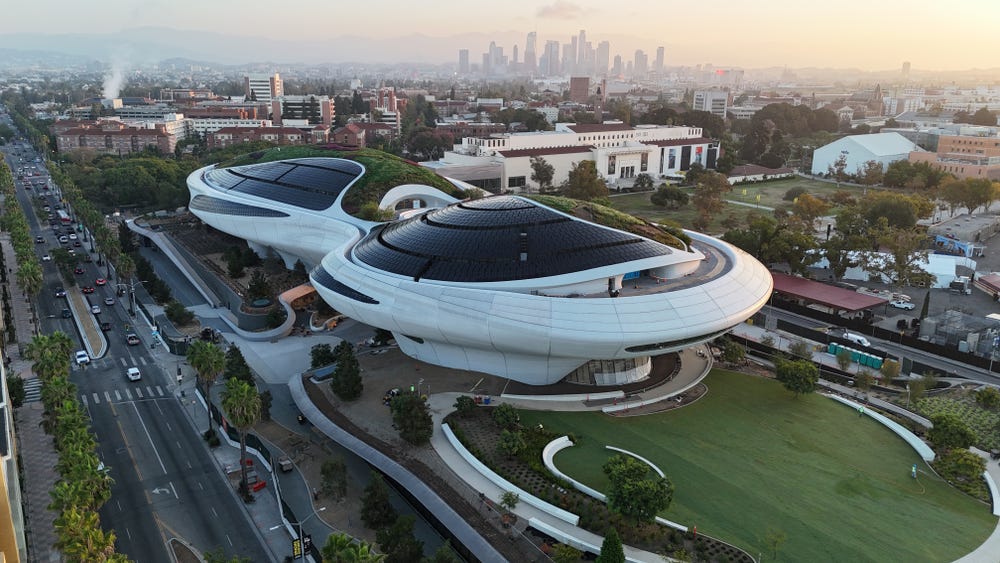
That ends on September 22. Tickets are already on sale. The museum that George Lucas and Mellody Hobson have spent something in the region of a billion dollars building will open to the public in Exposition Park, and Los Angeles will acquire one of the strangest and most ambitious buildings in the country.
The Building
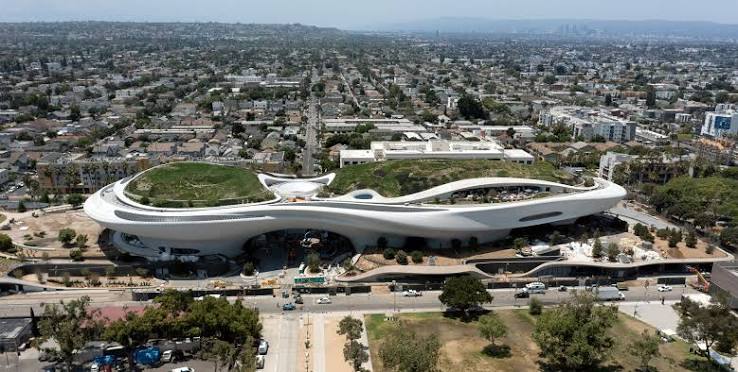
Ma Yansong, founder of the Beijing practice MAD Architects, has designed something that refuses every convention of the American civic museum. There is no colonnade, no grand stair, no rectilinear box wearing stone. Instead there is a vast, curving, pale mass — variously described as a cloud, a wave, and a spaceship on a lunch break — lifted clear of the ground on sculpted supports.
The structure runs to roughly 300,000 square feet on an eleven-acre site that was, until recently, a surface parking lot. Its skin is composed of more than 1,500 individually molded fiberglass-reinforced polymer panels, each one distinct, which is how you get a continuous curve at that scale without visible seams or repetition.
The most consequential design decision is the one most visitors will feel before they notice it. By lifting the bulk of the building into the air, Ma freed the ground plane entirely. What sits underneath is not a plinth but shade — a covered public space, open to the park, that requires no ticket. Landscape architect Mia Lehrer of Studio-MLA has surrounded it with new gardens, converting asphalt into something closer to a public commons.
Ma has described the collaboration with Lucas in terms that sound almost mystical, noting that sometimes he doesn't need words to explain — that Lucas can just feel it. From a lesser building that would be an evasion. From this one it reads as an accurate description of the design method.
The Collection, and the Argument Inside It
Thirty-five galleries occupy roughly 100,000 square feet, and they are not named after donors or centuries. They are named after human experiences: love, family, community, play, work, sports, childhood, adventure. It is a curatorial structure that quietly rejects the entire art-historical apparatus of period, movement and national school.
The permanent collection runs to more than 40,000 works, and the range is the point. Norman Rockwell hangs in the same institution as Frida Kahlo. N.C. Wyeth, Maxfield Parrish and Jessie Willcox Smith — illustrators long exiled from serious museums — share the building with Judy Baca's muralism and Kadir Nelson's paintings. And then there is the comics holding: Winsor McCay, Jack Kirby, Frank Frazetta, Alison Bechdel, Chris Ware, R. Crumb. Beatrix Potter is in there too.
That list is a thesis. The Lucas Museum's founding argument is that the twentieth century's dominant visual art forms — illustration, comics, animation, cinema, advertising — were dismissed as commercial precisely because they were popular, and that the distinction between fine art and narrative art was always more about class than about quality. You can disagree with the argument. You cannot accuse the building of being coy about it.
The Neighborhood Question
Big cultural buildings have a habit of landing in working-class neighborhoods and functioning as sealed objects — beautiful, guarded, and irrelevant to the people who live nearest. Exposition Park sits in South Los Angeles, and the museum has been asked, repeatedly and fairly, what it intends to be for its immediate neighbors.
Its answer so far is concrete: residents of the 90037 ZIP code surrounding the park are eligible for a pass allowing free admission for themselves and a guest. Combined with the open, unticketed ground plane beneath the building, it amounts to a genuine attempt to make the institution porous rather than merely adjacent.
Whether that holds is a longer story. Free-admission programs are easy to announce in an opening year and easy to erode in a difficult one. Commentators have already raised questions about how faithfully the finished institution matches Lucas's original stated vision of a museum for ordinary people. Those questions are worth keeping alive past the ribbon-cutting.
Why It Matters Beyond Los Angeles
Museum construction in the United States has spent two decades in a defensive crouch — expansions rather than new institutions, renovations rather than statements. A billion-dollar, ground-up museum with a genuinely radical curatorial premise is close to unprecedented in this generation, and it is being built with private money on a scale that public institutions can no longer contemplate.
It also matters architecturally. MAD is the first Chinese practice to design and complete a major cultural building of this scale in the United States, and the design's rejection of the neutral white-box gallery in favor of curved, light-shaped interior space will be argued about by architects long after the opening-week coverage fades.
What This Means for You
If you are anywhere near Los Angeles this fall, book early — opening-month capacity at institutions like this evaporates fast, and Exposition Park already draws serious crowds. If you live in 90037, check your eligibility for the neighborhood pass before opening day.
And if you have ever been told that the comics you read as a child or the illustrated books on your shelf weren't real art, you now have a 300,000-square-foot rebuttal with a parking structure.
The Bottom Line
On September 22, after twelve years of false starts, lawsuits and redesigns, a cloud will finally open in South Los Angeles. Whether it becomes a genuine civic institution or an expensive monument to one man's taste is a question the next decade will answer. But the ambition — architectural, curatorial, and civic — is not in doubt, and ambition on this scale has become rare enough to be worth showing up for.
Published By | Features Editor