Written By | Business Experts

Rwanda's export performance in 2025 was dominated by minerals
Economic and Social Transformation
For most of the past decade Rwanda has been the East African economy that macroeconomists cite when they want an example of policy discipline compounding over time. Growth has been fast and remarkably steady, inflation has spent most of the period inside the central bank's target band, and the fiscal accounts have been managed tightly enough that the country has repeatedly qualified for non-financing IMF programmes rather than rescue packages. In 2026 that reputation is being tested in a way it has not been tested before — not by a growth collapse, but by the opposite problem. The economy is expanding at close to double digits while consumer prices are rising at more than fourteen percent, and the National Bank of Rwanda has been forced into the most aggressive tightening cycle in the country's modern history.
A growth record that keeps beating its own forecasts
Real GDP grew 9.4 percent in 2025, following an average of 8.5 percent across 2022–2024, according to the World Bank's April 2026 Macro Poverty Outlook. The composition matters as much as the headline: services — mainly trade and transport — carried the expansion and generated roughly 40 percent of new jobs, industry grew 11.2 percent on the back of a construction boom, and agriculture rebounded to 7.4 percent after a weather-suppressed 2024. On the expenditure side, gross fixed capital investment rose 9.3 percent as investment recovered.
Momentum has not faded in 2026. The National Bank of Rwanda reported that economic activity expanded 10 percent year-on-year in the first quarter of 2026, with growth broad-based across sectors. The IMF and the World Bank both project around 7.2 percent for the full year, with the World Bank pencilling in 7.6 percent for 2027 and 7.3 percent for 2028. For an economy of roughly 14.6 million people and about US$16.7 billion in output — GDP per capita of about US$1,143 in 2025 — that is a sustained expansion of the kind very few countries manage for two consecutive decades.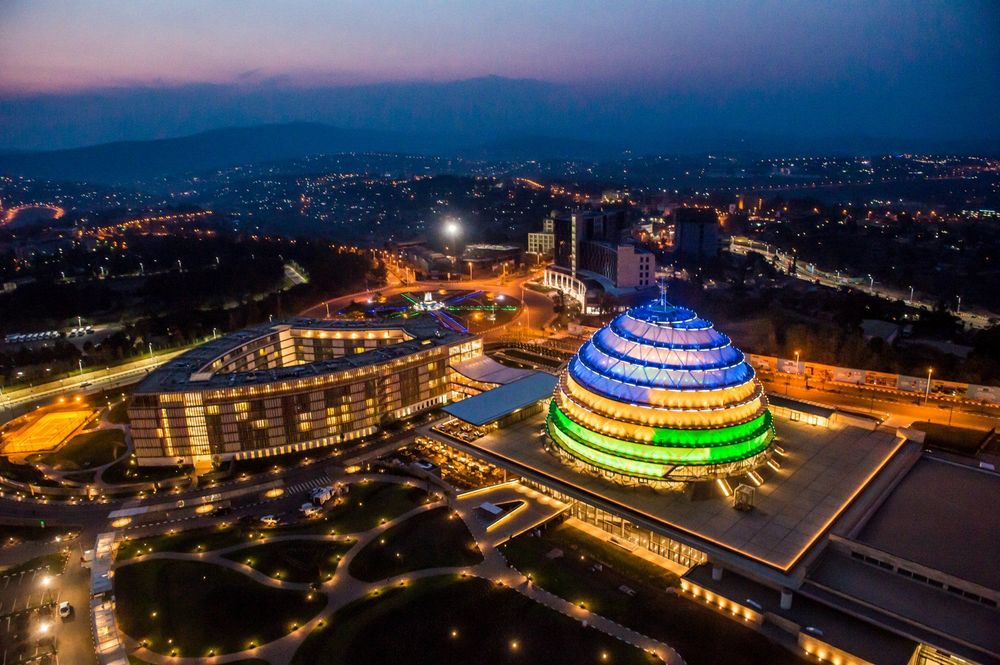
The inflation shock the forecasts missed
What almost nobody projected was the price surge that arrived alongside it. As recently as April 2026, the World Bank's Macro Poverty Outlook expected inflation to average 6.7 percent for the year and described the pressure as temporary, driven by pass-through from regulated price adjustments and new tax measures. Instead, headline inflation rose from an average of 9.1 percent in the first quarter of 2026 to 13.2 percent in the second, and reached 14.5 percent in July — nearly double the top of the National Bank of Rwanda's 2–8 percent target band.
The drivers are a combination of administered prices, taxes and imported costs. Electricity tariffs and health service charges were adjusted upward; a package of indirect taxes took effect from July 2025, including new fuel levies, VAT on mobile phones, gaming taxes and excise increases. By May 2026, transport prices were up roughly 28 percent year-on-year and housing and utilities about 21.8 percent. Energy inflation reached 45.7 percent in the second quarter, and — more worryingly for the central bank — core inflation hit 12.3 percent, indicating that the shock has spread well beyond volatile items into the broader price structure.
The policy response has been unusually forceful by Rwandan standards. Having lifted the central bank rate by a cumulative 75 basis points to 7.25 percent by February 2026, the Monetary Policy Committee continued through the year, raising the rate to 8.75 percent at its 26 August meeting — a third consecutive increase, 175 basis points of tightening since November 2025, and the highest policy rate since 2009. The central bank now forecasts inflation averaging 13.1 percent in 2026 and 7.9 percent in 2027, expecting a return to the target band only in the second half of next year. The exchange rate has been comparatively steady by regional standards, with the franc depreciating 5.3 percent year-on-year in 2025 against 9.4 percent in the prior period, but a two-year overshoot of the inflation target is a materially different environment from the one Rwandan borrowers and budget planners have grown used to.
Debt arithmetic and a Rwf7.8 trillion budget
The fiscal picture is genuinely two-sided, and the two principal international assessments do not fully agree. The World Bank estimates public and publicly guaranteed debt at about 72.4 percent of GDP at end-2025, narrowing the fiscal deficit to 3.9 percent of GDP that year and projecting debt to peak near 78 percent in 2027 before easing. The IMF, concluding its 2025 Article IV consultation and the sixth and final review of Rwanda's Policy Coordination Instrument on 4 December 2025, took a broader perimeter and projected overall public debt reaching 86.3 percent of GDP by 2026. On the Fund's assessment, Rwanda remains at moderate risk of debt distress, but debt burden indicators have deteriorated, and the programme's 65-percent-of-GDP debt anchor is now expected to be reached in 2033 — two years later than originally envisaged.
Against that backdrop, the government proposed a Rwf7.8 trillion budget for fiscal 2026/27, an increase of Rwf844.2 billion on the revised Rwf6.9 trillion budget for 2025/26. The economic transformation pillar takes Rwf4,999 billion, social transformation Rwf1,669 billion and transformational governance Rwf1,135 billion. Sectoral allocations include Rwf352.5 billion for agriculture — covering agro-inputs, local seed multiplication for maize, wheat, soya, Irish potatoes, rice, cassava and beans, and the Gabiro Agribusiness Hub — Rwf350.1 billion for energy, including the Nyabarongo II hydropower plant, Arc Power Rwanda and KivuWatt, Rwf305.3 billion for transport, and Rwf147.4 billion for environment and ecosystem restoration.
The single largest claim on the medium-term investment envelope, however, is the new Kigali airport at Bugesera, developed with Qatar Airways holding a 60 percent stake alongside the Rwandan state. Qatar Airways committed US$1.3 billion, and the overall scope has since expanded to roughly US$2 billion. Runway, access roads, drainage and utilities were completed by end-2024 and construction has moved into the terminal phase, but the first phase — designed for seven to 8.2 million passengers a year — is now scheduled to open in 2028 rather than the originally advertised date. The World Bank expects the associated import bill to widen the current account deficit from about 10.5 percent of GDP in 2025 to 11.5 percent in 2026, offset by foreign direct investment rising from 3.6 to 6.2 percent of GDP.
Minerals, the Washington Accords and export geopolitics
Rwanda's export performance in 2025 was dominated by minerals. Shipments of tin, tungsten and tantalum rose 46.2 percent year-on-year, and total mineral export value climbed from roughly US$1.75 billion in 2024 to about US$2.56 billion in 2025, helping narrow the merchandise trade deficit from US$3 billion to US$2.7 billion. Officials attribute the gains to higher global prices, new investment and a gradual shift from artisanal to mechanised operations; coffee exports also benefited from both higher prices and larger volumes.
That export mix sits at the centre of a contested regional politics. On 4 December 2025, Presidents Félix Tshisekedi and Paul Kagame signed the full Washington Accords package in Washington — five instruments comprising a peace agreement, a Regional Economic Integration Framework between the Democratic Republic of the Congo and Rwanda, a declaration of principles, a US–DRC strategic minerals partnership and a US–Rwanda framework for shared economic prosperity. The REIF establishes joint coordination mechanisms across energy, mineral supply chains, infrastructure, national park management and tourism, and public health and safety, and commits both governments to supporting formal mining activity and regional value chains.
Implementation has been difficult. M23 announced the capture of a major settlement in South Kivu on 10 December 2025, days after the signing; the group withdrew from Uvira on 17 January 2026 following US pressure, but fighting resumed and intensified in parts of the east through early 2026. On 2 March 2026 the US Treasury sanctioned the Rwanda Defence Force and four senior officials over what the State Department described as violations of the accords, and further designations followed in July 2026 targeting individuals and companies — including a gold refinery — accused of financing armed groups through illicit mineral trade. Kigali publicly described the measures as one-sided. Notably, the sanctions did not extend to US foreign assistance to Rwanda or to critical-minerals arrangements involving Rwandan-linked entities. Separately, the United Kingdom suspended direct financial assistance to Rwanda in February 2025, exempting support targeted at the poorest. For an economy whose external accounts now lean heavily on minerals and on concessional financing, that combination is a live risk to both sides of the balance of payments.
Poverty, human capital and the distribution question
The social ledger contains Rwanda's most striking recent claim and its most contested one. The seventh Integrated Household Living Conditions Survey (EICV7), conducted between October 2023 and October 2024 across 15,054 households visited five times each, found the national poverty rate falling from 39.8 percent to 27.4 percent — a 12.4 percentage-point decline that the National Institute of Statistics of Rwanda equates to roughly 1.5 million people moving out of poverty — with extreme poverty down from 11.3 percent to 5.4 percent. Because EICV7 revised the underlying methodology, the earlier figure is an imputed comparator rather than a like-for-like historical number, and the World Bank presents it accordingly.
International poverty lines tell a slower story. On the US$3.00-a-day line in 2021 purchasing power parity, the World Bank puts poverty at 38.6 percent in 2023, an estimated 36.0 percent in 2025, and projects 32.7 percent by 2028. At US$4.20 a day, 60.0 percent of Rwandans were poor in 2025; at US$8.30, 89.2 percent. The Bank's own diagnosis is blunt: private sector job creation remains limited, activity is concentrated in low-value-added sectors dominated by microenterprises, few firms scale, and the benefits of structural transformation have accrued disproportionately to more educated workers. The employment rate has been essentially flat at 55.9 percent of the working-age population. Rwanda ranks 160th of 174 countries on the Human Capital Index.
There is real progress on the delivery side. Rwanda trained and certified 24,000 teachers in under a year; a World Bank-supported basic education programme has built 22,000 classrooms, upgraded 16 teacher training colleges, trained over 78,000 in-service teachers and enabled the hiring of more than 50,000 new ones. A US$270 million skills programme reports a 90 percent employment rate for its short-course graduates. But financing for the social sectors is tightening from outside. In fiscal 2023–24, PEPFAR funded 37.7 percent and the Global Fund 50.8 percent of Rwanda's total HIV expenditure; Global Fund allocations to countries are falling from US$6.6 billion in the 2024–2026 cycle to US$5.6 billion in 2027–2029, a 15 percent reduction. Rwanda has signed bilateral health arrangements with the United States that route assistance through government channels, and is running a rapid assessment of the funding shift with UNAIDS technical support.
What to watch
Three questions will define the next twelve months. First, whether the National Bank of Rwanda's tightening cycle brings inflation back toward the band without materially denting the investment-led growth that has been the country's defining feature — the central bank's own forecast implies the target is not met until late 2027. Second, whether the fiscal consolidation path holds as the Bugesera airport bill peaks, concessional financing tightens, and debt approaches the high seventies or, on the IMF's measure, the mid-eighties as a share of GDP. Third, whether the Regional Economic Integration Framework converts from a signed document into functioning cross-border mineral, energy and infrastructure arrangements — or whether sanctions and renewed fighting keep Rwanda's fastest-growing export category tied to a security dispute it cannot resolve unilaterally.
Rwanda's macroeconomic management has earned the benefit of the doubt over twenty years. What is new in 2026 is that the country is being asked to demonstrate that discipline under genuine pressure — an inflation overshoot, a rising debt path, an external financing environment turning less generous, and a regional conflict entangled with its export base — all at once, and all while growing at close to ten percent.



