Written By | Business Experts

According to World Bank figures, the oil sector contributed 14.3 percent of GDP in 2024, 51.8 percent of fiscal revenues and 65.3 percent of exports
Central Africa
Few African economies are currently described in more contradictory terms by their own multilateral partners than Chad. In its April 2026 Macro Poverty Outlook, the World Bank recorded real GDP growth of 5.6 percent for 2025 and projected 5.2 percent for 2026. Two months later, in the country note accompanying the African Economic Outlook 2026, the African Development Bank put 2025 growth at 3.4 percent and forecast 3.6 percent for 2026. That is a gap of more than two percentage points on the same economy in the same year — larger than the entire annual growth rate of several of Chad's neighbours.
The divergence is not a rounding error. It reflects a genuine analytical disagreement about what is actually driving activity in a landlocked country of roughly 21 million people where oil supplies the fiscal revenue, rain-fed agriculture supplies the employment, and a refugee influx of historic scale supplies an unplanned and largely unmeasured demand shock. Reading the two forecasts against each other is the most useful available guide to Chad's economic transformation, because each institution is effectively weighting a different Chad.
The Oil Chad and the Agricultural Chad
Chad's headline structure has been stable for two decades. According to World Bank figures, the oil sector contributed 14.3 percent of GDP in 2024, 51.8 percent of fiscal revenues and 65.3 percent of exports. Production is modest and flat: the country pumped an estimated 126,490 barrels per day in 2025, down 0.6 percent from 127,254 barrels per day the year before. The non-oil economy, meanwhile, is dominated by rain-fed agriculture, which accounts for around 40 percent of GDP and the overwhelming majority of jobs.
This is where the two forecasts split. The World Bank's 5.6 percent estimate for 2025 attributes growth to oil-sector expansion of 6.6 percent from increased extraction, alongside 5.5 percent non-oil growth led by mining and agriculture; on the supply side it credits agriculture with 1.9 percentage points, industry with 1.8 and services with 1.6. The African Development Bank tells a narrower story: growth decelerating from 5.0 percent in 2024 to 3.4 percent in 2025, supported principally by a recovery in agricultural production after the devastating 2024 floods.
Both institutions agree on the direction of the fiscal story, if not the magnitude. The World Bank records total revenues reaching 17.8 percent of GDP in 2025 on the back of a 16.1 percent increase in non-oil revenues, spending at 19.4 percent of GDP driven by a 10.6 percent rise in infrastructure outlays, and a fiscal deficit of 1.7 percent of GDP. The AfDB puts the 2025 budget deficit at 2.3 percent of GDP, down from 2.7 percent in 2024, and notes that the increase in current spending on defence, security and refugee-related costs was largely offset by higher non-oil tax revenue. On either measure, Chad stayed comfortably inside the 3 percent deficit ceiling set by the Central African Economic and Monetary Community (CEMAC).
Public debt is likewise unusually contained by regional standards: 30.2 percent of GDP at end-2025 per the World Bank, projected to fall to 28.7 percent in 2026 before edging up to 30.9 percent in 2027. The latest Debt Sustainability Analysis still classifies Chad as at high risk of debt distress — a reminder that in a commodity-dependent, aid-dependent economy the ratio matters less than the volatility around it. The four-year Extended Credit Facility arrangement the IMF Executive Board approved on 25 July 2025, worth SDR 455.65 million (about US$625 million, or 325 percent of quota), sets a net debt target of 28 percent of GDP with a maximum threshold of 42 percent, to be met by 2029.
The Inflation Whiplash
The most striking single number in Chad's 2025 accounts is the price level. The World Bank records average inflation of minus 2.6 percent — outright deflation — driven by improved food supplies and better market connectivity. The AfDB, using a different basket and methodology, reports inflation falling to 3.9 percent from 5.1 percent in 2024. Whichever figure one prefers, the direction is the same, and the social consequence is real: the World Bank credits improved food availability with a 1.9 percentage point fall in the poverty rate, to 40.7 percent at the US$3.00 (2021 PPP) line, leaving roughly 8.5 million people in extreme poverty.
That relief is expected to be brief. The World Bank projects inflation rising to 2.2 percent in 2026 and averaging 2.7 percent over the medium term as higher global energy prices pass through into transport and import costs; the AfDB expects 4.0 percent in 2026. The mechanism is the same one that supports the growth upgrade — higher oil prices linked to Middle East conflict — which is precisely why Chad's 2026 is best read as a single price shock working through the economy in two opposite directions at once: more fiscal room, more expensive imports.
Foreign reserves are the pressure valve, and they are tightening. Reserves fell 2.7 percent year-on-year by end-2025, reducing import cover to 4.2 months and the external coverage ratio to 67 percent. The Bank of Central African States responded on 16 December 2025 by raising its tender rate from 4.50 percent to 4.75 percent and the marginal lending facility rate from 6.00 percent to 6.25 percent — a regional decision, but one whose credit-tightening effects land hardest in the CEMAC member with the thinnest financial sector.
A Banking System That Cannot Finance the Plan
That financial sector is the quiet constraint on everything else. Chad has 10 banks, 50 microfinance institutions and three insurance companies. Only five banks meet prudential requirements, and non-performing loans stand at 33.3 percent, concentrated in commerce, real estate and construction. Regional market saturation and tight liquidity constrain the government's access to domestic financing, which means that a country attempting a historic investment push must import essentially all of the capital for it.
The push in question is Chad Connexion 2030, the National Development Plan for 2025–2030, structured around 17 programmes and 268 projects and reforms, of which 124 are designated flagship projects. The total financing requirement is US$30 billion, with the private sector expected to supply 46 percent. At the investment roundtable that closed in the United Arab Emirates on 11 November 2025, President Mahamat Idriss Déby Itno announced US$16.4 billion in pledges from private and international investors; adding 40 signed agreements and memoranda of understanding worth US$4.1 billion brings the AfDB's tally of secured commitments to US$20.5 billion. The Islamic Development Bank committed US$650 million in project financing plus US$200 million in investment and trade guarantees, and the World Bank announced a US$2.5 billion package.
Two features of that financing map are worth noting. First, the pledge total is a commitment ledger, not a disbursement schedule; the gap between US$20.5 billion promised and US$30 billion needed is roughly the size of Chad's entire annual GDP, which the World Bank put at US$21.4 billion in 2025 (US$1,017.70 per capita). Second, the geography of the money has shifted decisively. Chad is diversifying toward South–South and Gulf partnerships — the UAE, the Islamic Development Bank, Green Climate Fund co-financing — in a way that would have been unusual for a francophone Sahelian state a decade ago.
The Refugee Economy
The variable that most complicates any forecast of Chad is demographic. As of February 2026 Chad hosted more than 1.5 million refugees, over 226,000 internally displaced persons and nearly 96,000 returnees, according to UNHCR figures cited by the World Bank. Roughly 1.3 million of those refugees are Sudanese, with more than 900,000 having arrived since the war began in 2023. In a country of 21 million, that is an increase in population of around 7 percent absorbed in under three years, concentrated in the eastern provinces that were already the poorest and least serviced.
The economics of this are genuinely two-sided, and the forecasters split on which side dominates. The World Bank explicitly notes that private consumption contributed 2.4 percentage points to 2025 growth, "partly reflecting increased demand from the refugee population" — humanitarian transfers spent in local markets function, in the short run, as a fiscal stimulus. The AfDB emphasises the cost side: refugee-related current spending pushing up the deficit, pressure on public services, and disruption to market operations and agricultural production.
What makes the stimulus reading fragile is that it depends entirely on funding that is not arriving. UNHCR and 123 partners are seeking US$1.6 billion for 5.9 million people across the seven countries neighbouring Sudan in 2026. For Chad specifically, UNHCR and the World Food Programme have warned that assistance will be drastically scaled back unless a US$428 million shortfall is closed — US$289 million for UNHCR and US$139 million for WFP. Donors had pledged US$1.161 billion to UNHCR globally in December 2025, covering under a fifth of projected 2026 needs. A refugee economy financed by an underfunded appeal is a demand shock with an expiry date.
The food-security data already show the strain. The latest Cadre Harmonisé analysis projects nearly 3.2 million people — almost 15 percent of Chad's population — facing acute food insecurity during the June–August 2026 lean season, within a regional total that could reach 52.8 million across West Africa and the Sahel. FEWS NET's February 2026 outlook attributes the deterioration in Chad directly to the effects of the refugee influx and conflict. 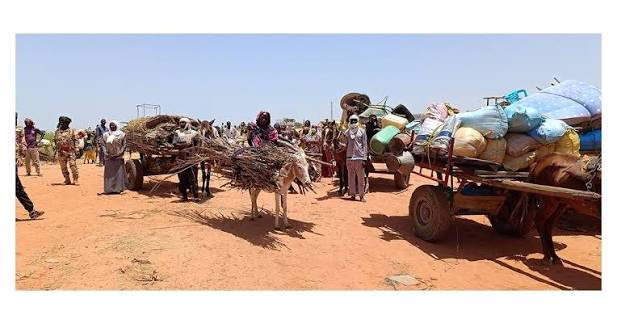
The Human Development Floor
Beneath the macro argument sits a set of social indicators that neither growth scenario changes quickly. Chad ranked 190th of 193 countries on the 2025 Human Development Index, well below both the sub-Saharan African average of 0.568 and the least-developed-country average of 0.560. Maternal mortality stands at 860 deaths per 100,000 live births and infant mortality at 78 per 1,000. Life expectancy at birth is 55.1 years. Gross primary enrolment is 88.5 percent — respectable on paper, but the labour market that graduates enter is dominated by informal, low-productivity agricultural work, with almost 90 percent of the poor living in rural areas.
The poverty projections are correspondingly slow-moving. The World Bank expects the US$3.00-a-day rate to fall only from 40.7 percent in 2025 to 39.5 percent by 2028 — about four-tenths of a percentage point a year, against population growth that will add far more people than that in absolute terms. At the US$4.20 lower-middle-income line, 62.8 percent of Chadians were poor in 2025; at the US$8.30 upper-middle-income line, 89.5 percent. Perhaps the most under-discussed figure in the World Bank's table is employment: the employment rate is projected to fall from 58.3 percent of the working-age population in 2025 to 53.1 percent by 2028, meaning the growth being forecast is not, on current assumptions, job-rich growth.
What to Watch
Three things will determine which forecast turns out to be closer. The first is the IMF programme. A delegation led by Julien Reynaud visited N'Djamena from 4 to 15 May 2026 for discussions on the combined first and second reviews of the Extended Credit Facility, reporting significant progress toward a staff-level agreement. Completion unlocks not only Fund money but the concessional budget support from multilateral and bilateral donors on which the whole four-year financing plan depends.
The second is execution of Chad Connexion 2030. The plan targets 10 percent annual real growth by 2030 — roughly triple the AfDB's current forecast — and its investment map is weighted toward transport, water and sanitation, electricity and the digital economy. Whether pledges convert into disbursed capital in a country with a 33.3 percent non-performing loan ratio and only five prudentially compliant banks is the practical test.
The third is Sudan. Chad's fiscal position, its food-security outlook, its eastern-province service delivery and a meaningful share of its consumption growth are now all downstream of a war it is not fighting. Should the humanitarian appeal remain a fifth funded, the demand impulse the World Bank counted in 2025 becomes a fiscal liability in 2027 — and the optimistic forecast quietly converges on the pessimistic one.




