Written By |

On the floor of the Albertine Rift, a 220-square-kilometre fragment of Central African rainforest hides geysers, hornbills and a border you can hear before you see.
Bundibugyo District, Western Uganda
The steam finds you before the path does. You are walking through lowland forest west of Fort Portal, listening to the metallic clatter of a piping hornbill somewhere above the canopy, and then the air changes — thickens, sweetens faintly with sulphur — and through a screen of raffia palms a white column rises two metres into the morning and drifts sideways into the trees. This is Nyasimbi, the female spring at Sempaya, and she has been boiling for as long as anyone in Bundibugyo can remember. Guides carry eggs in their pockets for the demonstration. Ten minutes in a woven basket lowered into the water, and breakfast is ready. The water runs at around 100 degrees Celsius. Nobody puts a hand in twice.
Semuliki National Park is the least visited of Uganda's national parks and, by a good margin, the strangest. It covers just 220 square kilometres along the floor of the Albertine Rift in Bundibugyo District, hemmed by the Democratic Republic of Congo to the west and the glacier-topped Rwenzori Mountains rising to the south-east. Geographically it belongs less to East Africa than to Central Africa: this is the far eastern tongue of the Ituri Forest, the great Congo Basin rainforest that reaches across the border and stops here, at the Semliki River. Everything that makes the park remarkable follows from that single accident of geography.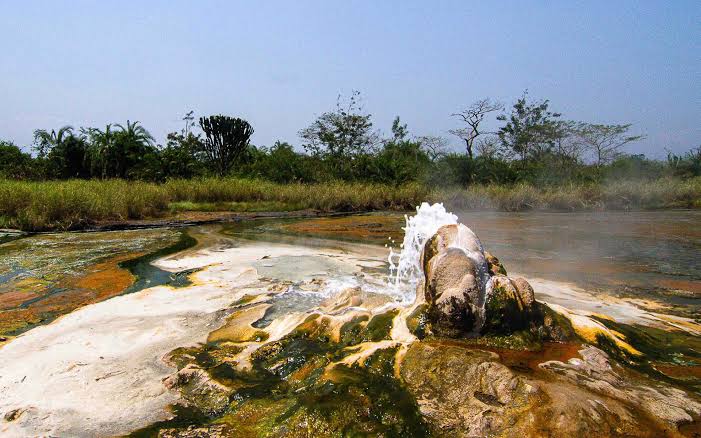
A piece of the Congo, misplaced
Botanists have called Semuliki one of the oldest and most biologically rich forests in Africa, a refuge that stayed wet and wooded through the dry glacial periods when much of the continent's forest cover retreated. What survived here survived nowhere else nearby. The result is a bird list that reads like a Congolese field guide dropped into Uganda by mistake: some 441 species recorded, of which 46 are Guinea-Congo biome specialists found in no other part of East Africa. Birders come for the white-crested hornbill, the red-billed dwarf hornbill, the African piculet, the Congo serpent eagle, the spot-breasted ibis, the swamp palm bulbul, the lyre-tailed honeyguide. Great blue and Ross's turacos flash indecently through the mid-storey. Out on the Lake Albert flats at Ntoroko, in the papyrus at the river mouth, the shoebill stands like a badly assembled statue and lets boats drift close.
The mammals are harder work. Around sixty species are present — forest buffalo, sitatunga, water chevrotain, bush pig, several kinds of duiker — but this is dense lowland forest and sightings are a matter of patience and luck rather than schedule. Eight primate species live here, including chimpanzees, red-tailed monkeys, grey-cheeked mangabeys, black-and-white colobus and the nocturnal potto. Visitors arriving expecting a game drive misunderstand the place. Semuliki rewards walkers, listeners and people willing to stand still in humidity.
Sempaya, Ntandi and the long green trail
Most visits begin and end at Sempaya, where the two hot springs sit about half an hour apart on an easy, well-made boardwalk-and-forest circuit that takes roughly an hour with a ranger. Nyasimbi, the female spring, is the geyser — the one that erupts and steams and boils eggs. Bintente, the male spring known locally as Mumbugu, is calmer and stranger: a twelve-metre pool of hot water lying in a swampy clearing, steam sliding across the surface. For the Bamaga people these are not scenery. The springs are a shrine; men have long come to the male spring to ask for wealth and blessing, and sacrifices are still made. Good guides tell that story properly, and it is worth asking for.
Beyond Sempaya, the park opens up for anyone with time. The Kirumia Trail is the serious one — roughly thirteen kilometres through primary forest to the Semliki River, a full day out and the best birding walk in the park, starting early and finishing muddy. The Red Monkey Track follows the eastern edge along the Semliki towards the DRC frontier, named for the de Brazza's monkeys that haunt it. Shorter circuits run from Ntandi, where you can also meet Batwa communities whose ancestors lived in this forest long before it was gazetted, and whose displacement remains part of the park's unfinished story. At the northern end, Lake Albert and the Semliki flats offer boat trips, fishing villages and the best shoebill odds in western Uganda.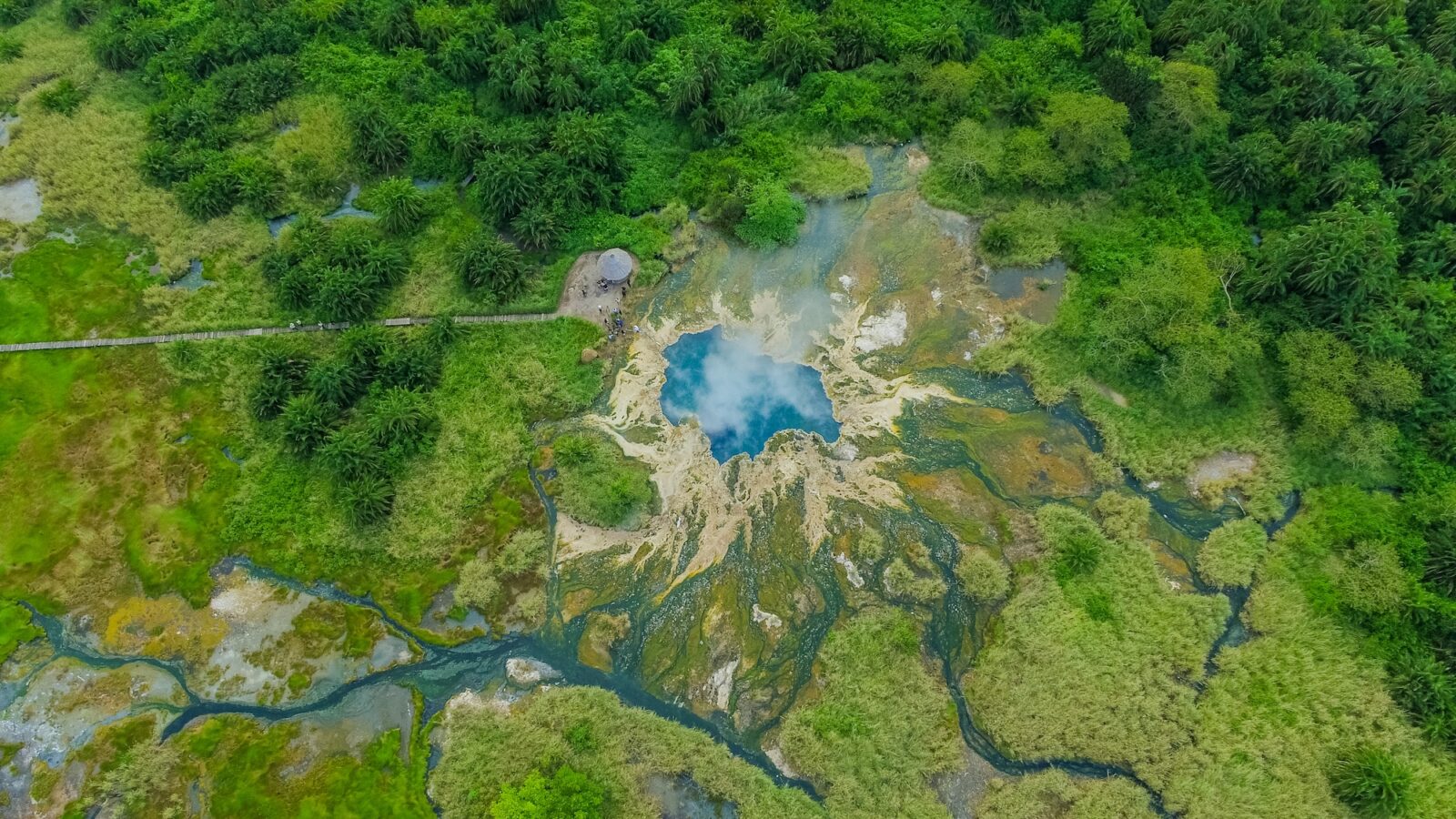
Practical matters
Getting there: Sempaya Gate is about 52 kilometres from Fort Portal on the tarmac road to Bundibugyo — two to three hours, spectacular where it drops off the Rwenzori escarpment, and full of humps and blind corners. Fort Portal is roughly five to six hours from Kampala. The park pairs naturally with Kibale, the Tooro crater lakes or a Rwenzori trek.
Fees: Semuliki is a Category B park. Entrance is USD 35 for foreign non-residents, USD 25 for foreign residents and UGX 15,000 for East African citizens, with most guided activities charged separately at around USD 10 (UGX 10,000 for EAC). Current Uganda Wildlife Authority tariffs run to 30 June 2026; confirm rates at booking, as the next cycle is due.
When to go: The drier windows of December to February and June to August make the trails manageable; this is one of the hottest and most humid corners of Uganda, and the long-rains months turn the Kirumia Trail into a wade. Birding is good year-round, with migrants adding weight from November to April.
Where to stay: Options are modest and few — Semliki Safari Lodge in the Toro-Semliki Wildlife Reserve at the upper end, Ntoroko Game Lodge on Lake Albert, Nyati Game Lodge and a handful of guesthouses and campsites around Bundibugyo and Sempaya. Many visitors simply base themselves in Fort Portal and drive in.
What to bring: Binoculars, a Congo-inclusive bird guide, waterproof boots, insect repellent, and more drinking water than you think you need.
This Week in Ugandan Tourism
Open Park Days return, 25–27 September. The Uganda Wildlife Authority has confirmed three days of free park entry from 25 to 27 September, open to Ugandans and foreign visitors alike, across selected protected areas including Murchison Falls and Queen Elizabeth. The initiative leads into national World Tourism Day celebrations and is the clearest signal yet of the domestic-tourism push that has defined the sector's year. Expect crowds at the marquee parks — and, for those who plan well, an unusually quiet Semuliki.
World Tourism Day heads east to Mbale. National celebrations move to Mbale and the wider eastern region this year, deliberately putting Mount Elgon, Sipi Falls, Bagisu culture and Bugisu coffee at the centre of the national story. Uganda Tourism Board chief executive Juliana Kagwa has framed it as part of a decentralisation strategy — spreading visitors beyond the familiar western circuit and widening what counts as a Ugandan tourism product.
Permit economics keep shifting. Following the tariff changes announced on 26 February 2026, standard gorilla permits sit at USD 800 with a discounted USD 600 low-season rate for April, May and November, and the seven-day reservation hold was scrapped on 1 March — full payment is now due at booking. The gorilla habituation experience has risen from USD 1,500 to USD 1,800 for foreign non-residents, with UWA attributing the increase to conservation financing and community obligations. Operators are still adjusting 2027 quotations accordingly.
New routes and new beds. Uganda Airlines announced in August that it will add Accra from 27 October and Kigali from 18 November, extending the network at both ends of the continent, while Air Serv's scheduled Entebbe–Arua service is beginning to make West Nile itineraries practical for the first time in years. On the lodge side, Asilia's Erebero Hills near Bwindi — built largely from bamboo, on former farmland now replanted with more than 25,000 indigenous trees — is the highest-profile example of a conservation-first building trend the sector has been promising for a decade.
The numbers behind the noise. Ministry figures put 2025 tourism earnings at a record USD 1.7 billion, up from USD 1.28 billion in 2024, with international arrivals climbing from about 1.3 million to roughly 1.65 million. The sector now supports something in the order of 800,000 jobs. Whether Uganda reaches the USD 2 billion mark this year will depend heavily on the second half — and on whether initiatives like Open Park Days and the eastern-region pivot convert attention into nights booked. The tenth Pearl of Africa Tourism Expo, held at Speke Resort Munyonyo in May under the theme “Wanderlust — It’s Your Time to Thrive,” was built around exactly that question.
The border you can hear
Late in the afternoon on the Red Monkey Track, the forest thins towards the Semliki River. On the far bank the trees begin again and do not stop for a thousand kilometres. There is no fence, no post, no line — only water the colour of milky tea, and the sound of voices carrying across from a Congolese fishing camp, and hornbills moving between two countries without noticing either. It is a good place to remember that Uganda's borders were drawn across an ecosystem that never agreed to them, and that Semuliki exists because a small piece of the Congo happened to fall on this side of the line. Fewer people come here in a year than pass through Bwindi in a month. That, for now, is precisely the appeal.



