Written By | Torch Media Africa
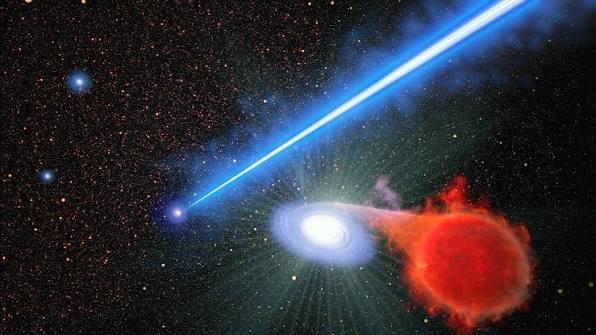
A supermassive black hole 5.5 billion light-years away has been blasting a jet of matter moving at nearly the speed of light directly toward our planet for almost three decades
PASADENA, Calif.
Somewhere in the depths of the constellation Hercules, a black hole with a mass millions of times that of our sun has spent the last 27 years methodically firing a beam of white-hot plasma in our general direction — and nobody on Earth needed to worry, because by the time that light reaches us, it has already traveled for 5.5 billion years.
That black hole, known to astronomers as the blazar 3C 345, has just become the subject of the most detailed long-term reconstruction ever made of a supermassive black hole's jet, published in the journal Nature this past August by a team led by Caltech researcher Marianna Foschi. The findings, unveiled to wider public attention this month, are already upending assumptions that have guided black hole physics for decades.
"This is the most extreme regime in which we can test general relativity," Foschi said of the work — a nod to the fact that matter near a supermassive black hole behaves in ways so violent and strange that it offers scientists one of the only natural laboratories in the universe capable of stress-testing Albert Einstein's century-old theory of gravity.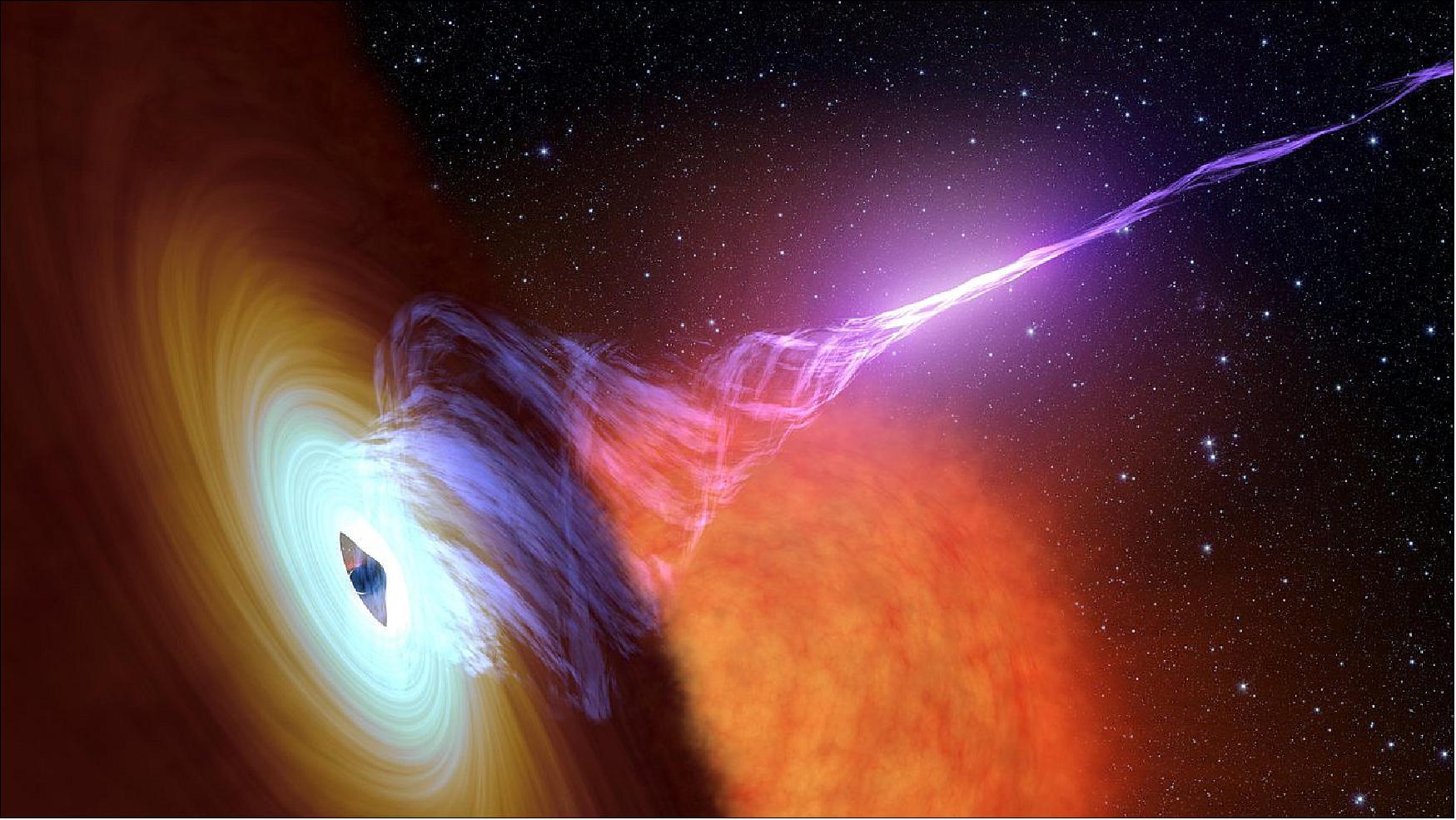
WHAT EXACTLY IS FIRING AT US?
First, the reassurance: 3C 345 is not aiming a weapon at Earth in any meaningful sense, and nothing about this jet poses any danger to anyone. A "blazar" is simply the name given to a supermassive black hole whose jet happens to be pointed almost directly at our line of sight from Earth, making it appear especially bright and dramatic to our telescopes compared to jets angled off in other directions. Think of it less like a death ray and more like a lighthouse beam that happens to be sweeping past your boat — spectacular to observe, harmless to experience, and only visible at all because of the angle.
What makes 3C 345 so scientifically valuable is exactly that alignment. Because its jet points so close to directly at us, astronomers get an almost head-on view of some of the most extreme physics in the known universe: matter being flung outward from the churning, superheated disk of gas and dust that spirals into a black hole's event horizon, accelerated to nearly the speed of light by forces scientists still don't fully understand.
HOW YOU TURN 27 YEARS OF BLURRY DOTS INTO A MOVIE
Capturing a black hole jet on camera has always been a challenge of both distance and time. Even the best radio telescopes on Earth can only catch fragmentary, noisy snapshots of something this far away, and a black hole jet's true motion only becomes visible across years or decades — far too slow, and far too faint, for any single observation to capture.
So Foschi's team turned to a technique called very long baseline interferometry, or VLBI — the same fundamental method used by the Event Horizon Telescope collaboration to capture humanity's first-ever direct image of a black hole back in 2019. VLBI links radio dishes scattered across the globe together so they function, in effect, as a single telescope roughly the size of the planet, dramatically sharpening the resolution of what can be seen.
But VLBI alone wasn't enough to stitch together nearly three decades of scattered, gap-filled observations into something coherent. For that, the team turned to a deep learning algorithm called Kine, which was used to reconstruct the 27 years of fragmented data into a single continuous, flowing video of the jet's evolution. The results were a dramatic leap over anything achieved previously: two orders of magnitude — literally 100 times — better dynamic range, and four times sharper resolution than earlier imaging attempts of the same object.
"This is the most extreme regime in which we can test general relativity." — Marianna Foschi, Caltech, lead researcher
THE TWIST THAT'S UPENDING BLACK HOLE PHYSICS
Here's where the story gets genuinely surprising, even to the scientists who ran the study. For years, the leading theoretical model of black hole jets assumed that the bright knots of light astronomers see traveling down a jet — called shock fronts — move considerably faster than the bulk plasma flow surrounding them, similar to how a sonic boom's shockwave can outrun the aircraft that created it in certain reference frames.
The new 27-year reconstruction found something different: the bright jet components are traveling at nearly the same speed as the surrounding plasma itself, not dramatically faster as the old models predicted. That single finding forces a rethink of the underlying mechanics of how supermassive black holes manage to accelerate matter to relativistic speeds in the first place — a process that remains one of the most stubborn open questions in modern astrophysics, even though scientists have been observing these jets since the earliest days of radio astronomy.
It's a reminder of just how much remains unknown about objects that, despite decades of study, still govern the shape and evolution of entire galaxies. Supermassive black holes like the one at the heart of 3C 345 are now understood to act as a kind of cosmic architect — their jets and radiation capable of either triggering or suppressing star formation across vast stretches of their host galaxies, making them central characters in the story of how galaxies like our own Milky Way came to look the way they do.
A BUSY MONTH FOR BLACK HOLE WATCHERS
The 3C 345 reconstruction lands amid a broader wave of black hole discoveries that have kept astronomers unusually busy this year. Separate research has tracked a different supermassive black hole flinging matter outward at roughly 134 million miles per hour, while other teams have documented a dormant black hole abruptly "reawakening" after 100 million years of silence, erupting in a burst one astronomer described as being "like watching a cosmic volcano erupt." Together, the studies paint a picture of black holes as far more dynamic and unpredictable over long timescales than the static, sleeping-giant image many people carry in their heads.
EXPERT PERSPECTIVE
Researchers not directly involved in the study have pointed to the Kine algorithm itself as almost as significant as the astrophysical result it produced. Reconstructing continuous, high-fidelity video from decades of sparse, irregular VLBI snapshots has long been considered a major technical bottleneck in the field — many older observations of jets like this one have simply sat in archives, too noisy and incomplete to yield reliable scientific conclusions on their own. A machine-learning approach capable of squeezing a coherent, physically consistent movie out of that kind of messy historical data opens the door to revisiting decades of archived observations of other blazars and jets that scientists had previously written off as unusable, potentially unlocking a wave of similar discoveries hiding in old data nobody thought to look at twice.
WHAT THIS MEANS FOR YOU
No one needs to lose sleep over a beam from a black hole 5.5 billion light-years away — by the time this jet's light reaches Earth, both the light and the story it tells are almost as old as the universe itself, and the notion of it representing any real threat to our planet is pure science fiction. But the science behind the discovery matters closer to home than it might seem.
Black holes like 3C 345 are natural laboratories for testing Einstein's general theory of relativity under conditions no human-built experiment could ever replicate — extreme gravity, extreme speed, extreme energy. Every time one of these tests confirms or challenges Einstein's century-old equations, it refines the physics that underpins technology many people rely on daily, from the GPS satellites in your phone (which must correct for relativistic time effects to function accurately) to the broader scientific understanding of gravity, time and space that modern physics and engineering are built on.
There's also a more human takeaway: this discovery exists because scientists refused to throw away 27 years of imperfect, incomplete data, and because a new generation of AI tools is now capable of finding patterns and structure in scientific archives that were previously considered a lost cause. That same approach — applying modern machine learning to old, messy datasets — is quietly transforming fields well beyond astronomy, from medical imaging to climate science, wherever valuable data has been sitting underused simply because nobody had the tools to make sense of it.
THE BOTTOM LINE
Nearly three decades after astronomers first pointed their instruments at 3C 345, a black hole spitting matter across the cosmos at nearly the speed of light has yielded one of the sharpest, longest-running views ever assembled of the universe's most extreme objects in action — and in the process, upended a piece of black hole physics that had gone largely unchallenged for years. Foschi and her colleagues say this is just the beginning: with the technique now proven on 3C 345, astronomers are eyeing a growing list of other blazars whose jets, once dismissed as too faint or too messy to study properly, may be about to tell their own 27-year stories.



