Written By | Staff Writer
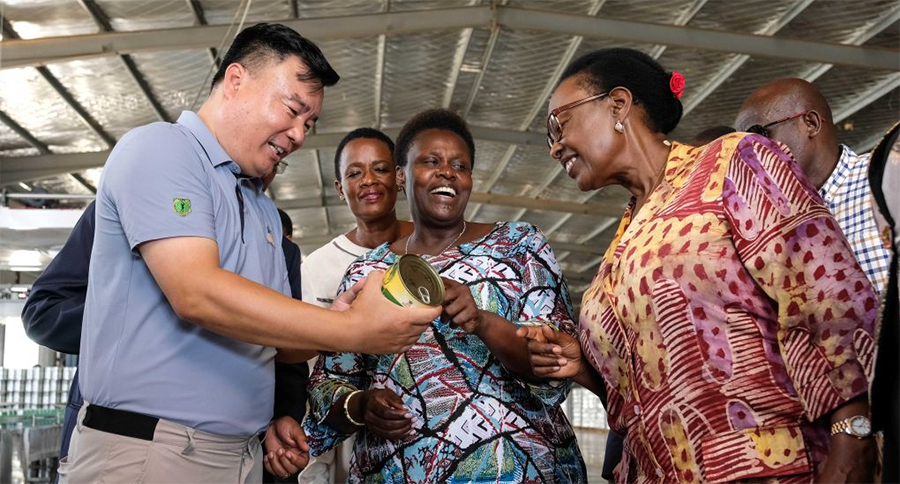
Uganda VP hails China-backed agro-industrial park for boosting agricultural transformation (Photo: Xinhua)
Agriculture
Ten years after President Yoweri Museveni cut the ribbon on a Chinese-backed farming estate in Luwero District, Uganda's Vice President Jessica Alupo stood on the same ground this week and called it proof that the country's agro-industrialisation strategy is working. Her July 23 tour of the China-Uganda Agricultural Cooperation Industrial Park came with a headline number that will matter far more to farmers than any speech: a further 500 million US dollars in Chinese private investment over the next five years, on top of the roughly 220 million dollars already sunk into the estate since 2016.
For a government that has spent the better part of a decade promising to move Uganda “from garden to factory,” the Luwero park has become something of a proof-of-concept — one that is now entering a second, much bigger phase just as Kampala rolls out its largest-ever agro-industrialisation budget.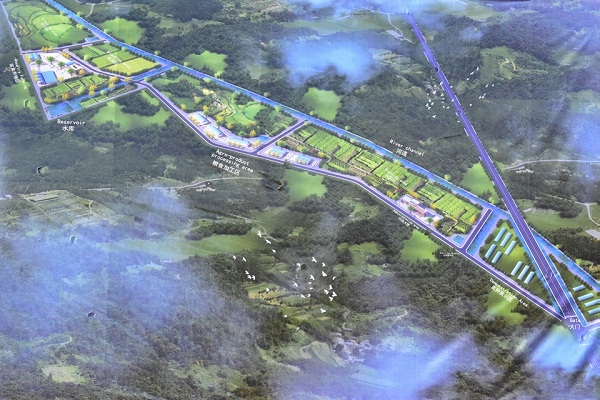
A decade in the making
The China-Uganda Agricultural Cooperation Industrial Park (CUACIP) sits across Luwero and neighbouring Kalungu districts and is run by Kehong Uganda Industrial Development Limited, a private Chinese firm operating under the FAO-China-Uganda South-South Cooperation framework — a triangular arrangement in which the UN's Food and Agriculture Organisation brokers Chinese technical and financial support for African agriculture. Museveni launched the first phase in April 2016, and it has not always been smooth sailing: at one point, a related Shs700 billion agriculture park project in the same district stalled amid delays, underscoring how difficult it has been for Uganda to translate big-ticket agro-industrial pledges into functioning factories on schedule.
A decade on, however, the park that did get built is running at meaningful scale. Its first phase, which Kehong chairman Luo Heng says is now complete, comprises a commercial layer farm producing eggs for domestic and regional markets, contract chili cultivation feeding a drying and processing plant that exports to China, a pineapple canning factory, and a seed multiplication programme promoting improved rice varieties among out-grower farmers. Alupo's delegation inspected canned pineapple products during the visit — a fitting stop, given that the plant achieved a milestone in May this year when it shipped Uganda's first commercial consignment of canned pineapple to China: four containers carrying 104 metric tonnes of finished product. It was a small shipment in global trade terms, but symbolically significant as one of the clearest examples yet of a Ugandan factory turning a smallholder crop into a branded, exported, value-added good.
The park currently employs more than 1,500 Ugandans directly, according to earlier government figures, with several thousand more smallholder farmers feeding into it through out-grower schemes for chili and pineapple.
Why Beijing is doubling down now
Luo's announcement of a 500-million-dollar second phase is a significant bet, roughly double the size of the park's first ten years of investment, and it comes at a moment when China is actively courting African exporters. Alupo pointed to China's “100 percent zero-tariff policy” for eligible exports from the least-developed and other qualifying African countries — a preferential trade arrangement Beijing has been expanding as part of its broader push to rebalance trade with the continent — as the incentive that could turn the Luwero park's output from a curiosity into a serious export earner. “We look forward to having more related exports by taking advantage of the 100 percent zero-tariff policy,” she said during the visit, according to Xinhua's account of the tour.
For Uganda, the timing lines up with a domestic push that has been building for months. The Ministry of Finance's 2026/27 budget, presented in June by Finance Minister Henry Musasizi, allocated Shs2.26 trillion to the agro-industrialisation programme — the largest allocation the sector has ever received in a single budget year. That money is earmarked for irrigation and water for production, expanded extension services, better-quality inputs, post-harvest storage, agro-processing and value addition, quality certification, and market access — almost a checklist of the gaps that have historically kept Ugandan farm produce leaving the country raw and cheap rather than processed and valuable. Government officials, including President Museveni himself, have cited the recent commissioning of the NEC Meat and Beans Processing Factory in Gomba and the ongoing expansion of the Soroti Fruit Factory as evidence that this agro-processing drive is gathering pace across multiple regions and partners, not just in Luwero.
What it means for farmers
The immediate, practical effect for Ugandan farmers near the park is a market for crops that have traditionally had thin or unreliable local demand. Chili and pineapple are not staple food crops; farmers grow them almost entirely for a buyer, and the presence of a processing plant willing to take contracted volumes changes the calculus for a smallholder deciding what to plant. Out-grower schemes tied to CUACIP have, in principle, given farmers in Luwero and Kalungu a guaranteed off-taker and a price floor that spot markets rarely offer, along with access to agronomic support tied to the contract.
But the model has real limits and real risks that farmers and policymakers alike will need to watch as the second phase rolls out. Contract farming arrangements anchored to a single foreign-owned processor concentrate bargaining power with the buyer; if Kehong sets prices or quality standards that squeeze margins, farmers locked into chili or pineapple have fewer alternative markets than they would for maize or beans. The park's own history — a decade to complete “phase one,” and a separate, larger project in the same district that stalled entirely — is a caution against assuming the next 500 million dollars will be deployed smoothly or on the announced timeline. And a processing model built around exports to a single country carries currency, shipping and geopolitical exposure that a domestically-focused value chain would not.
The bigger picture
Set against Uganda's wider ambitions, the Luwero park is a small piece of a much larger puzzle. Agriculture still employs roughly 70 percent of Ugandans and contributes about a quarter of GDP, yet the sector has for decades been characterised by exporting raw commodities — green coffee, raw cotton, unprocessed fish — while importing processed foods and losing much of the value addition to factories abroad. The government's 10-fold growth strategy, which aims for a $500 billion economy by 2040, explicitly names agro-industrialisation as one of its core engines, alongside tourism, minerals and science and technology.
Whether Luwero's model — a foreign-financed, foreign-managed industrial park anchored to smallholder out-grower schemes — becomes the template for that strategy, or remains one experiment among several competing approaches (state-linked ventures like the UPDF's meat and beans plant, or locally-driven ones like Soroti's fruit factory), will say a great deal about how Uganda's agro-industrial future actually takes shape. For now, the pineapple cans rolling off Luwero's line, and the chili drying in its sheds, are being watched closely in Kampala as evidence that the strategy can work — and as a test of whether it can scale five times over in the next five years without repeating the delays of the last ten.



