Written By | Fashion and Design Desk

A Detroit exhibition opening today — the first devoted entirely to her architectural paintings — argues that the artist of flowers and bleached skulls spent four decades studying walls.
DETROIT
Ask most people to picture a Georgia O'Keeffe and you will get one of two images: an enormous flower, opened to the point of abstraction, or a sun-bleached animal skull floating over a desert horizon. Both are real. Both have been reproduced onto enough tote bags to constitute a second career.
Neither is what the Detroit Institute of Arts wants you to look at.
"Georgia O'Keeffe: Architecture" opens today and runs through January 3, 2027. It gathers almost forty paintings made between the 1920s and 1960, and it is the first exhibition anywhere to focus solely on O'Keeffe's engagement with the built environment. Not as a footnote to the flowers. As the subject.
The painting at the centre
The show is built outward from a work the museum already owned: "Stables," painted in 1932, one of the DIA's most treasured holdings.
"The DIA has long been proud to count Georgia O'Keeffe's Stables among our most treasured holdings, and it is a particular joy to see it take on new meaning at the heart of this exhibition," said museum director Salvador Salort-Pons. He called the show a landmark moment, "not just for this institution, but for how the world understands one of America's greatest modern artists."
That is a large claim for a barn painting. The exhibition's argument is that it is not, in fact, a barn painting — it is a study of geometry, edge and light that happens to have a stable in it, and that O'Keeffe was making that kind of picture, with remarkable consistency, for something close to forty years.
Three places, one question
Curator Ben Colman, the DIA's Curator of American Art, has organised the paintings into three environments, which turn out to map onto three phases of O'Keeffe's life.
There is New York. She lived and worked in the city from 1918 until 1949, much of that time in the skyscraper apartments she shared with the photographer and gallerist Alfred Stieglitz at the Shelton Hotel. From those windows she painted the Manhattan skyline as boldly abstracted verticals — a subject then considered the exclusive property of male modernists, and one she took up partly because she had been told not to.
There are the rural buildings. Barns, stables and farmhouses in upstate New York, in her home state of Wisconsin, and along the coast of Quebec, rendered with exactly the formal precision she is celebrated for applying to petals. A wooden barn wall, in her hands, becomes the same kind of object as a calla lily: flattened, cropped, pushed to the front of the picture plane until it stops being a thing and becomes a shape.
And there is New Mexico. First as a visitor, then as a full-time resident, O'Keeffe documented the adobe architecture of Taos, Abiquiú and Ghost Ranch across nearly four decades. The exhibition includes a meditative sequence of paintings of the patio at her Abiquiú house — the same wall, the same door, the same square of sky, returned to again and again over years.
"When you step back and consider all her architectural paintings together — the New York cityscapes, the rural barns, the adobe walls of New Mexico — you realise she was asking remarkably consistent questions about place and identity across decades," Colman said. "I think visitors will come away seeing both O'Keeffe and the built world around them a little differently."
What the letters revealed
The exhibition's research, drawn from O'Keeffe's personal letters and writings, turned up something the wall labels alone would not convey: her interest in architecture was not confined to painting it.
She was, as Colman puts it, a thoughtful observer of the field, and she maintained long-term friendships and correspondence with Frank Lloyd Wright and with Alexander Girard — the latter one of the great American designers of the twentieth century, whose textiles and interiors for Herman Miller helped define what mid-century modernism looked like in ordinary homes.
This changes the reading. An artist who paints buildings might simply like the shapes. An artist who paints buildings and writes to Wright and Girard for decades is participating in an architectural conversation, not just observing one from a car window.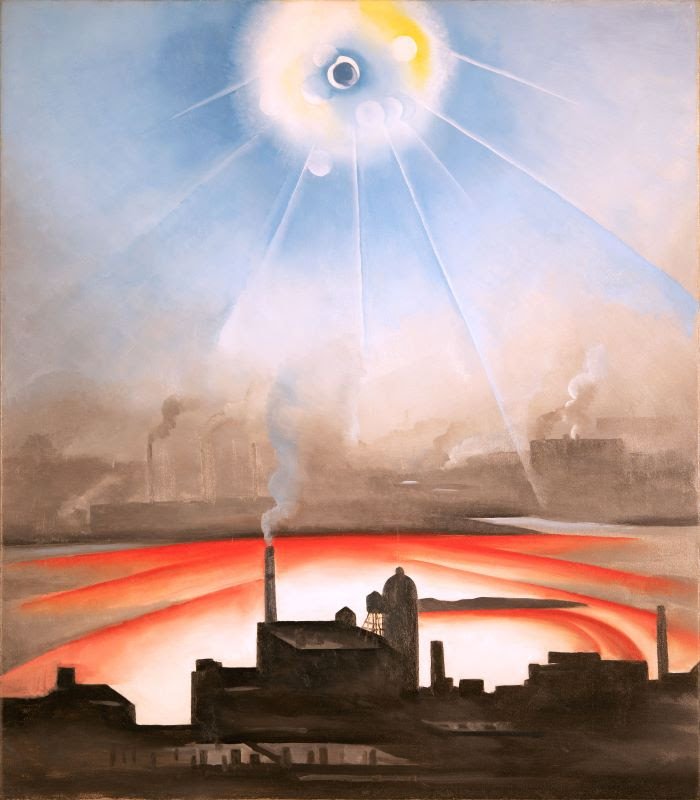
Two rooms you cannot paint
The DIA has commissioned two immersive digital video works specifically for the exhibition, both of which attempt something conventional hanging cannot.
The first reconstructs the view of the East River from O'Keeffe's apartment windows, showing visitors what she would have been looking at — and what that same sightline looks like today. The second captures the Abiquiú patio as it appears now, across different times of day, so that the light moves the way it moves in the painting sequence rather than sitting frozen at one hour.
It is a risky move. Digital supplements in painting exhibitions often feel like a concession to short attention spans. Here the justification is specific: both bodies of work are about light changing on a surface over time, which is precisely the thing a static canvas cannot show and a room full of static canvases can only imply.
What this means for you
The broader argument here extends past one artist. Architecture has a persistent problem being taken seriously as a subject of feeling rather than of function — we discuss buildings in terms of cost, efficiency, heritage and planning permission, and rarely in terms of what it is like to look at a wall for forty years.
O'Keeffe's answer, as this exhibition presents it, is that a barn and a skyscraper and an adobe doorway are all doing the same thing: organising space, catching light, telling you where you are. That is a useful lens to carry out of a museum and onto your own street.
If you go
"Georgia O'Keeffe: Architecture" is at the Detroit Institute of Arts, 5200 Woodward Avenue, through January 3, 2027. Adult tickets are $30, or $20 for residents of Wayne, Oakland and Macomb counties, who can also visit free on three designated dates, beginning September 30. A fully illustrated catalogue accompanies the show, with essays by Colman and other O'Keeffe scholars.
Programming includes a lecture by Dr Cody Hartley, director of the Georgia O'Keeffe Museum in Santa Fe, on September 30, and an adobe talk and demonstration by the artist Joanna Keane Lopez on October 24.
Go for the flowers if you must. Stay for the walls.