Written By | Staff Writer
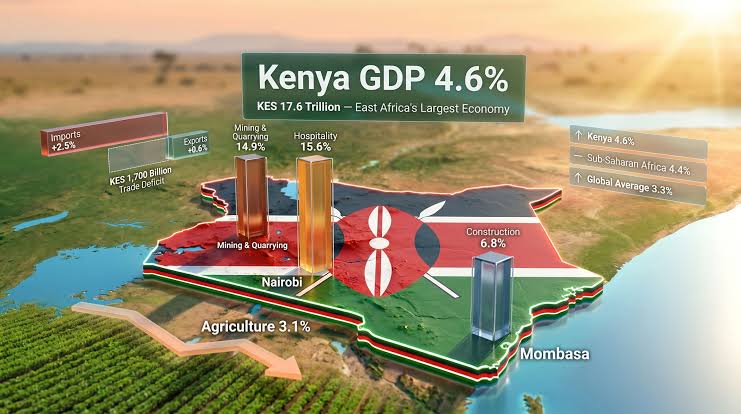
Kenya's real GDP grew 4.6 percent in 2025, essentially flat against 4.7 percent in 2024, according to the Kenya National Bureau of Statistics' 2026 Economic Survey
NAIROBI
Kenya enters the second half of 2026 with an economy that is stable but no longer sprinting. After years of being cast as East Africa's most reliable growth story, the country is now confronting a slower expansion, a debt-servicing burden that is eating into export earnings, and a manufacturing sector still short of the scale its own industrial strategy demands. At the same time, agricultural exports are proving more resilient than headline growth numbers suggest, and Nairobi is positioning itself as a continental hub for the African Continental Free Trade Area (AfCFTA) just as the country hosts a major pan-African trade summit. The result is a picture of an economy rebalancing rather than collapsing — one where the gap between macroeconomic stability and inclusive prosperity remains the central story.
A Growth Rate That Has Lost Its Shine
Kenya's real GDP grew 4.6 percent in 2025, essentially flat against 4.7 percent in 2024, according to the Kenya National Bureau of Statistics' 2026 Economic Survey. The World Bank's more cautious 2026 forecast puts growth at 4.3 percent — what the Bank has described as a four-year low — citing elevated global oil and fertiliser prices linked to the US-Israeli conflict with Iran, which have raised input costs for both manufacturers and farmers. The African Development Bank is somewhat more optimistic, projecting 4.6 percent growth in 2026 rising to 4.7 percent in 2027.
The composition of that growth tells its own story. Services now account for roughly 55 percent of GDP and are projected to expand about 5.4 percent on average across 2026 and 2027, remaining the primary engine of the economy. Agriculture contributes 23.2 percent of GDP, with the World Bank projecting agricultural growth of 4.2 percent in 2026, rising to 4.9 percent in 2027, contingent on rainfall patterns and climate-adaptation investment. Industry, meanwhile, sits at just 16.3 percent of GDP — and it is here that Kenya's structural challenge is most visible.
Manufacturing: Big Ambitions, Modest Delivery
Kenya's manufacturing sector contributed KSh 1.25 trillion to the economy in 2025, equivalent to 7.1 percent of GDP — well short of the 15 percent target the government has held as an aspiration for over a decade under successive industrialisation plans. Growth in the sector has been described by local analysts as too low for an economy of Kenya's size and stage of development, with 2025 manufacturing growth print at around 2.0 percent.
The Kenya Association of Manufacturers (KAM) used the early-2026 launch of its Manufacturing Priority Agenda (MPA) 2026 to press government for coordinated support — cheaper power and credit, faster port clearance, and stronger enforcement against counterfeit imports — arguing these are prerequisites for manufacturers to expand into regional markets under AfCFTA. That framing dovetails with the government's own Bottom-Up Economic Transformation Agenda (BETA), which prioritises industrialisation, job creation and export-led growth, explicitly targeting micro, small and medium enterprises (MSMEs), women and youth as the intended beneficiaries of expanded intra-African trade.
Kenya shipped its first goods under AfCFTA preferences in October 2022 — locally made car batteries and tea sent to Ghana — and the government has since built out a National AfCFTA Implementation Strategy and a "Route to Market" programme intended to help exporters navigate the trade bloc's rules of origin and non-tariff barriers. The stakes were on full display in early August 2026, when Nairobi hosted the three-day Africa Commerce & Industry Summit (ACIS) 2026, explicitly designed to move past policy discussion and connect Kenyan and regional businesses directly with investors.
Kenya's positioning as East Africa's logistics and financial hub — anchored by the Port of Mombasa and an expanding digital economy — gives it a structural advantage in this push. But KAM's own diagnosis suggests that advantage will not convert into manufacturing jobs and export volumes without addressing the cost-of-doing-business issues that have kept industrial growth below 3 percent even as services roar ahead.
Agriculture: Tea Wobbles, Horticulture Surges
Agricultural export performance in 2026 has been a story of divergence. Tea — Kenya's leading single export commodity at roughly 16.3 percent of total exports and historically the country's second-largest source of foreign exchange — earned Sh186.91 billion on export volumes of 652.8 million kilograms, even as tea output and pricing came under pressure, with production reportedly falling 7.8 percent amid unfavourable weather and a softer global market. That volatility underscores the exposure smallholder tea farmers carry to both climate variability and international commodity cycles.
Horticulture has been the brighter spot, growing 13.8 percent within the agriculture sector in 2026 — a reminder that Kenya's cut-flower, fruit and vegetable exports to European and Middle Eastern markets remain a comparatively fast-growing segment of the rural economy, even as tea's fortunes fluctuate. Kenya's Economic Survey 2026 frames agriculture as remaining a key growth and export anchor overall, but one whose outcomes will continue to hinge on rainfall, climate-adaptation investment, and progress on logistics and regional market access — the same bottlenecks that constrain manufacturing.
Debt Servicing Is Squeezing Fiscal Space
Behind the growth and trade headlines sits a tightening fiscal constraint. External debt service consumed 31.1 percent of Kenya's exports of goods and services in the latest reporting period, up sharply from 21.2 percent the year before — comfortably above the roughly 25 percent threshold the IMF generally treats as elevated risk. High public debt and persistent fiscal pressures continue to constrain the government's room to manoeuvre, with rigid expenditure commitments and large debt-servicing obligations limiting its ability to absorb external shocks or expand priority social and development spending, according to the World Bank's 2026 assessment.
That squeeze matters directly for the inclusive-growth ambitions embedded in BETA. Every shilling directed to servicing external debt is a shilling not available for the industrial incentives, credit guarantees, or agricultural extension services that manufacturers and farmers say they need.
Poverty and Jobs: The Inclusion Gap
The human development picture remains the most sobering element of Kenya's 2026 economic story. National poverty stands at 39.8 percent, according to the latest available data cited in the Economic Survey, while unemployment sits at 13.9 percent nationally. Youth unemployment is estimated at around 30 percent on some measures, though ILO-modelled estimates for the narrower 15–24 age cohort put the figure closer to 12 percent — a discrepancy that reflects how differently "unemployment" can be defined in an economy where informal and underemployed work is pervasive.
This is precisely the gap BETA was designed to close: macroeconomic stability and steady, if unspectacular, GDP growth have not yet translated into broad-based improvements in household welfare. The informal economy — hawking, boda-boda transport, small-scale trade — continues to absorb the majority of new entrants to Kenya's labour force, workers who sit largely outside the formal credit, tax and social-protection systems that BETA's MSME-focused interventions are meant to reach.
What to Watch
Three threads will determine whether 2026 becomes a turning point or another year of stable-but-shallow growth. First, whether the Manufacturing Priority Agenda translates KAM's demands into concrete policy — tariff protection, energy cost relief, port efficiency — that moves industry's GDP share meaningfully above 16.3 percent. Second, whether the AfCFTA push culminating in the ACIS 2026 summit produces bankable cross-border deals for Kenyan MSMEs rather than another round of trade-facilitation rhetoric. Third, whether debt servicing costs stabilise enough to free up fiscal space for the social spending — health, education, agricultural extension — that would let poverty and youth unemployment rates start moving in the right direction.
For now, Kenya's economy is a study in contrasts: a services sector and horticulture export base performing well, a manufacturing base still punching below its weight, and a debt burden narrowing the government's options just as the political pressure to deliver inclusive growth intensifies.



