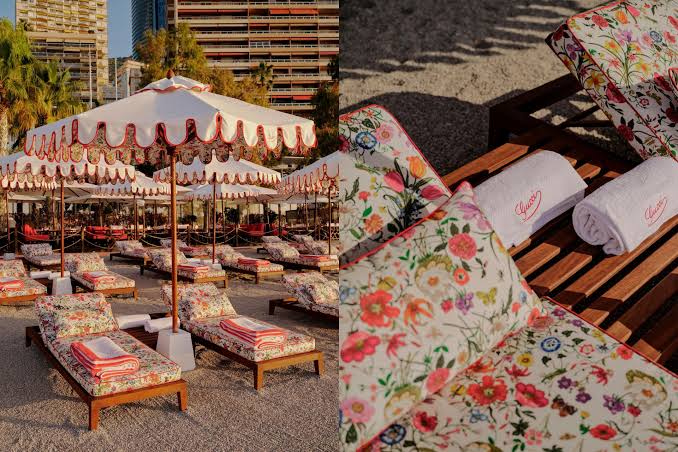
Gucci took over a stretch of Monaco sand. Jacquemus painted a beach club mint and milk. Burberry flew its checks to Athens. Welcome to the ninth summer of fashion's most lucrative real estate play: the designer beach club.
MONACO / ATHENS
There was a time when a fashion house's summer strategy meant a print ad in a glossy magazine and, if the brand was feeling ambitious, a billboard near a major airport. That era is over. This summer, the most coveted square footage in European fashion isn't a Madison Avenue storefront or a Parisian flagship — it's a stretch of sand with a cabana, a cocktail menu, and a brand's logo stitched into every towel in sight.
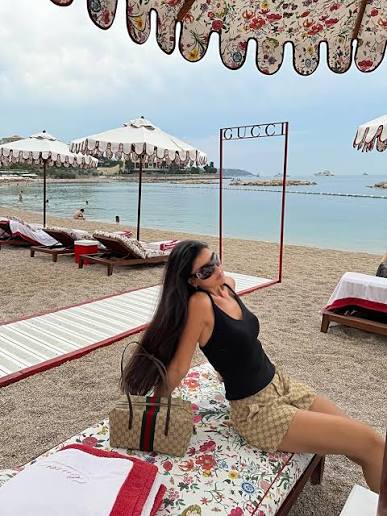
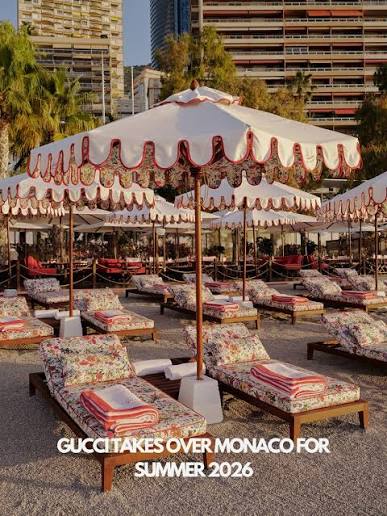
Right now, on Monaco's Larvotto Beach, guests at La Rose des Vents are lounging on parasols dressed head to toe in Gucci's archival Flora print — the same pattern Vittorio Accornero designed in 1966 as a silk scarf commissioned by Rodolfo Gucci for Princess Grace of Monaco himself. A few hundred meters down the coast, the Monte-Carlo Beach club has been repainted in Jacquemus's 1950s-inspired mint blue, milky white, and black, with co-branded towels, T-shirts, and beach bags stocked across two Jacquemus boutiques nearby. Across the Mediterranean in Greece, Burberry has swapped its usual British countryside imagery for the Athenian Riviera, taking over the One&Only Aesthesis resort and reimagining its signature check in a sun-bleached turquoise to match a High Summer collection built around check swimwear and coastal pieces. Mytheresa, the German luxury e-commerce platform, has joined the Monaco contingent as well, cementing the principality as this year's most contested piece of fashion-marketing turf.
A Strategy Now Old Enough to Have a History
According to Business of Fashion's ongoing coverage of the phenomenon, this is the beach club takeover's ninth consecutive summer as a fixture of the luxury calendar — which makes it less a trend than an established institution, on par with fashion week itself in terms of calendar predictability, if not scale. What began as a relatively novel marketing experiment roughly a decade ago has matured into something closer to a strategic pillar: an entire wing of seasonal brand activity built around hospitality rather than retail.
Dolce & Gabbana has reportedly racked up more beach club takeovers than any other house, but the field has grown crowded enough that nearly every major name in luxury now treats a coastal residency as a non-negotiable part of its summer calendar. The appeal for brands is straightforward — a beach club gives them weeks of sustained, immersive contact with exactly the kind of high-net-worth clientele that a single runway show or a magazine spread can only reach for a moment. Guests aren't just looking at the brand. They're sleeping under its umbrellas, drinking out of its branded glassware, and posting all of it to followings that, in aggregate, dwarf most advertising buys.
Selling the Memory, Not Just the Merchandise
What separates 2026's iteration of the trend from its earlier years is how deliberately each takeover has been built around a narrative rather than just a color palette. Gucci's Monaco activation isn't simply slapping a logo on loungers — it leans directly into the brand's own archive and a real historical figure, Princess Grace, giving sunbathers in 2026 a tactile connection to a 60-year-old design story. Jacquemus's mint-and-milk scheme deliberately evokes a specific mid-century beach aesthetic rather than the brand's usual playful, body-conscious silhouettes, signaling that even at a beach club, creative direction still matters. And Burberry's choice of Athens over its usual Cotswolds-and-Norfolk Britishness suggests brands are increasingly willing to relocate their entire visual identity to wherever the right audience happens to be vacationing.
Travel and lifestyle outlets have started treating these activations as destinations unto themselves rather than incidental marketing — Forbes Travel Guide recently described Jacquemus and Burberry's summer programs as part of a broader redefinition of luxury travel, alongside wellness-focused operators like Goop. The fact that a fashion house's beach towel selection is now considered relevant travel journalism is itself a measure of how far this strategy has traveled from its advertising roots.
The Business Logic Behind the Sand
There is a harder commercial calculus underneath the aesthetics. Branded capsule collections tied to these residencies — exclusive swimwear, beach totes, resort-only accessories — sell at a premium specifically because they are nearly impossible to get anywhere else, a built-in scarcity mechanic that retail analysts have long understood drives desire more effectively than broad availability. A piece bought at the Gucci-branded beach club in Monaco carries social currency that the identical item sold at a flagship boutique simply does not: it proves you were there, at that place, in that moment — which, in an era when luxury consumers increasingly say they want experience and provenance over generic opulence, is precisely the point.
Industry analysts tracking the broader luxury sector have noted that after a prolonged slowdown, the category is gradually returning to growth, led by demand out of the US and China, with customers showing a renewed appetite for what's been described as "curated, story-driven ownership" rather than one-size-fits-all status symbols. A beach club residency is, in that light, almost the purest possible expression of story-driven luxury: it is an experience first, a product second, and a photograph — inevitably — third.
What It Means If You're Not Flying to Monaco
Most readers will never set foot on Larvotto Beach this summer, and that is, in a sense, exactly the brands' intention — exclusivity is the product. But the ripple effects reach further than the cabanas themselves. Expect the visual language of these takeovers — archival prints repurposed as resortwear, nostalgic mid-century color stories, country-house patterns transplanted onto swim trunks — to filter down into mainstream resortwear and fast-fashion collections within a season or two, just as runway silhouettes eventually do. The Flora print on a Monaco lounger today has a reasonable chance of showing up on a department-store sarong by next summer.
It's also worth watching as a barometer of where luxury believes its money actually is. Brands don't spend months and considerable budgets repainting an entire beach club on a whim. The fact that Gucci, Jacquemus, Burberry, and Mytheresa all converged on the same two stretches of European coastline this June says something concrete about where the industry believes its most valuable customers are spending their summer — and increasingly, the answer isn't in a store at all. It's on a lounger, with a cocktail, wearing the brand rather than just buying it.
Published By | Features Editor