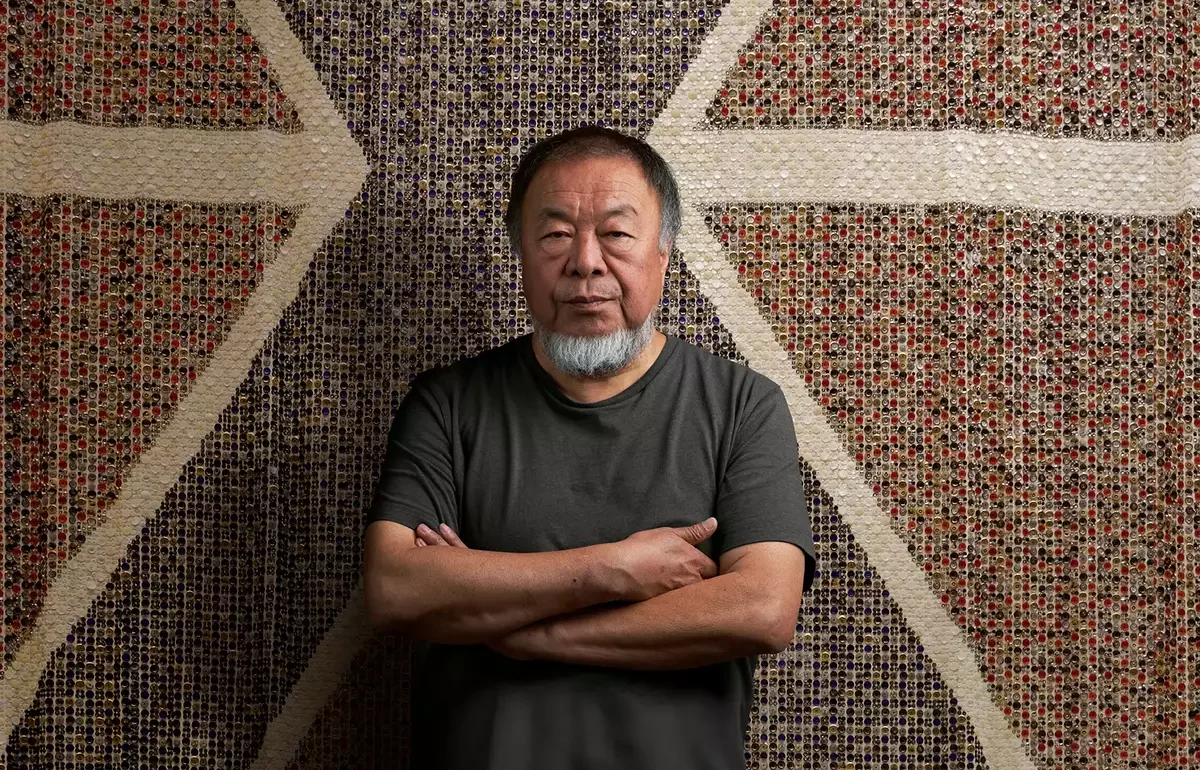
Button Up! brings 3.5 million toy bricks, half a million buttons, and a reconstructed Ming dynasty hall to Factory International's cavernous Aviva Studios, in the artist's largest site-specific exhibition to date.
MANCHESTER
A Warehouse Built for Monuments
Ai Weiwei has never been an artist who thinks small, but even by his standards, Button Up!, which opened this month at Manchester's Aviva Studios, represents something new: the largest site-specific exhibition of his career, built specifically for the airplane-hangar-scale Warehouse space at Factory International's flagship venue. Running from July 2 to September 6, the show transforms raw architectural volume into the exhibition's actual subject matter, using scale itself to make its argument about power, empire, and censorship.
“I'm not interested in making very big things just for the sake of it,” Ai Weiwei said of the project. “But in Manchester, that wonderful Warehouse space calls for monumental work.” The result is less a traditional retrospective than an immersive confrontation with two centuries of Sino-British history, staged inside one of Europe's most architecturally ambitious new cultural buildings.
Flags, Bricks, and a Reconstructed Temple
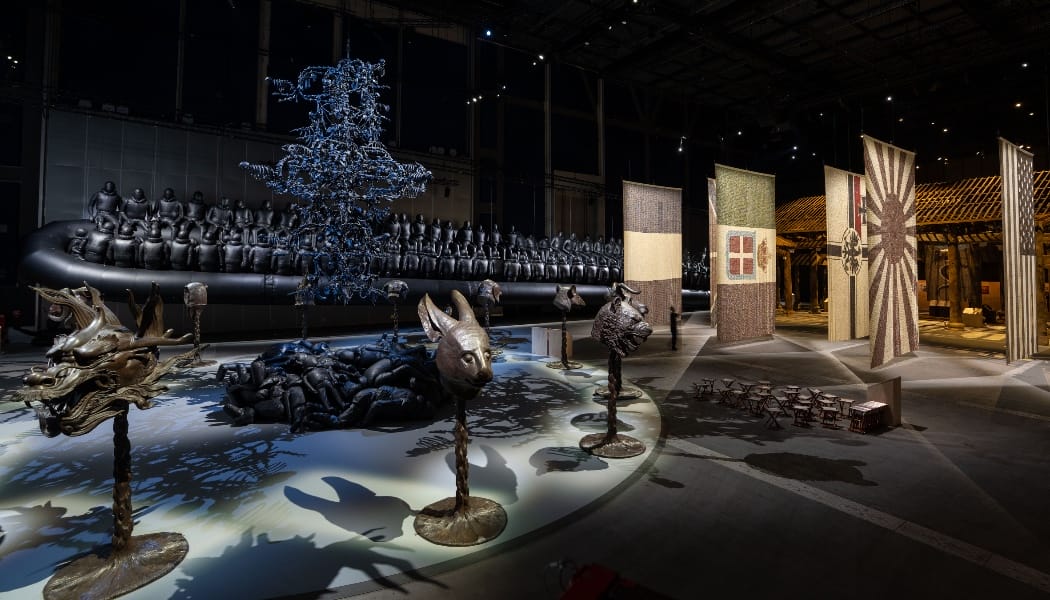
The exhibition's two major new commissions anchor its argument. Eight-Nation Alliance Flags reproduces eight historical flags, each stitched from nearly half a million buttons, referencing the early twentieth-century invasion of China by an international coalition of imperial powers — a piece that turns a mundane object of everyday clothing into a monument of geopolitical violence. Nearby, History of Bombs spans 25 metres wide and 10 metres high, built from 3.5 million toy bricks into life-size renderings of conventional weapons and weapons of mass destruction, described by Factory International as the largest toy-brick artwork Ai Weiwei has ever produced.
Elsewhere in the Warehouse, Law of the Journey — a 47-metre inflatable boat crowded with hundreds of refugee figures — makes its UK debut, while Wang Family Ancestral Hall paints an entirely different picture of scale: a meticulous reconstruction of a Ming dynasty temple, painstakingly rebuilt from 1,500 salvaged timber components. Together, the works span from digital-age mass production to centuries-old craftsmanship, unified by Ai Weiwei's recurring interest in how objects carry history.
Sewing a Button, Live
The exhibition's title, Button Up!, doubles as a wry reference to the artist's long-running battles with state censorship. That theme took physical form in Sewing a Button, a 24-hour live performance staged July 3 to 4, marking fifteen years since Ai Weiwei's 81-day secret detention by Chinese authorities in 2011 — the first time he has publicly reenacted that experience. “Even sewing a button can be subversive,” as one reviewer put it, capturing how the artist repeatedly finds political weight in the most domestic, unremarkable gestures.
Why Manchester, Why Now
Ai Weiwei has been explicit that the exhibition's location shaped its content as much as its scale. “Visiting the city for this exhibition — the birthplace of the Industrial Revolution — and reflecting on Britain's global territorial expansion made me realise I had to explore that history and understand how it connects to the forces driving today's wars and global crises,” he said. Manchester's industrial legacy, and its role in the trade networks that connected Britain to China, become an implicit backdrop to nearly every work on display.
John McGrath, artistic director and chief executive of Factory International, framed the show as validation of the young venue's architectural ambitions: “Having the largest works of Ai Weiwei's career shown alongside each other would only be possible in the vast, flexible space of Aviva Studios, and we are delighted that this extraordinary artist has responded so brilliantly to our venue.”
Design as Argument
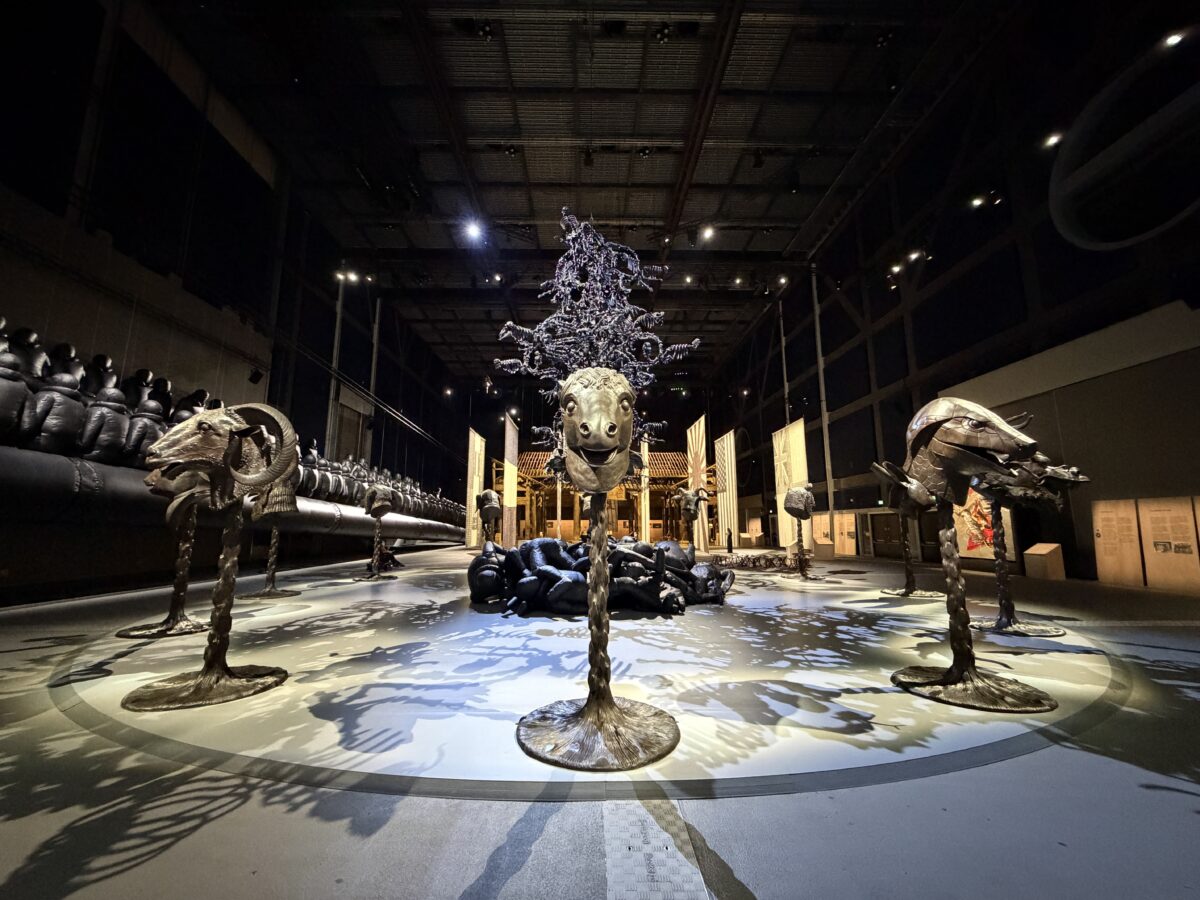
What makes Button Up! particularly notable from a design and architecture standpoint is how thoroughly the exhibition's meaning depends on its spatial engineering. The Warehouse's soaring, reconfigurable volume — one of the defining features of Aviva Studios' £241 million construction — doesn't simply house the artworks; it's essential to their impact, giving a 47-metre inflatable boat and a 25-metre brick mural room to overwhelm rather than merely occupy space. For a building still establishing its identity within Manchester's cultural landscape, hosting a show of this scale is itself a statement about what the venue's architecture was built to achieve.
Aviva Studios has positioned itself since opening as one of Britain's most flexible cultural spaces, capable of reconfiguring for anything from immersive theatre to large-scale visual art, and Button Up! is arguably the clearest test yet of that ambition. Few venues in Europe could accommodate a 10-metre-high toy-brick mural and a full-scale reconstructed timber temple within the same room without one work diminishing the other — a curatorial and architectural balancing act that reviewers have singled out as central to the show's success.
What This Means for Visitors
For design and art audiences, Button Up! offers a rare chance to see how architectural scale and artistic intent can amplify one another rather than compete. The exhibition runs through September 6, with accompanying programming that transforms Aviva Studios' Social space into a Chinese Tea Room for talks, workshops, and events. Anyone visiting Manchester this summer will find a show that treats its building not as a backdrop, but as a collaborator — proof that the biggest ideas sometimes need the biggest rooms to be properly understood. It's a reminder, too, that ambitious cultural architecture only fully proves its worth once artists are given the freedom to push it to its limits, which is precisely what Button Up! sets out to do.
Published By | Features Editor