Written By | Sports Desk
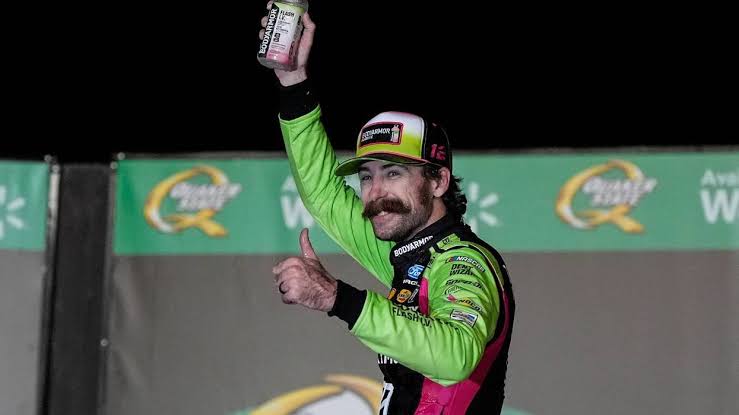
A three-hour rain delay pushed the Quaker State 400 past 1 a.m. — and set up a photo-finish scramble that ended with a penalty flag nearly as dramatic as the checkered one.
Hampton, Georgia
By the time the green-white-checkered flag finally waved over EchoPark Speedway, most of Atlanta was asleep. It was 1:45 a.m. Monday, more than three hours later than scheduled, and the fans who stuck it out were on their feet for one of the wildest final laps NASCAR has produced all season: three cars, side by side by side, fighting for the win at nearly 190 miles an hour. When the smoke cleared, it was Ryan Blaney's No. 12 Team Penske Ford out front — and Bubba Wallace's night in ruins.
It capped a Quaker State 400 that had already tested everyone's patience. A band of thunderstorms rolled through mid-afternoon and parked over the speedway, triggering a red-flag delay of three hours and nine minutes while lightning strikes kept crews and fans alike off the property. When the race resumed, it did so under lights, and it did not let up until well past midnight.
A Dominant Day, Until It Wasn't Simple
For most of the afternoon and evening, this looked like a runaway. Blaney started from the pole, swept all three stages, and led a race-high 171 of the scheduled 263 laps — the kind of number that usually means an easy trip to Victory Lane. Atlanta's reconfigured 1.5-mile surface, with its higher banking and narrower racing groove, has turned the track into something closer to a drafting circuit like Talladega or Daytona than a traditional intermediate oval. Cars run in tight packs, momentum matters more than horsepower, and a single push from a drafting partner can decide the winner. That is exactly what happened at the end.
As the laps wound down, NASCAR's overtime rules kicked in after a caution bunched the field for a final restart. Blaney lined up alongside Carson Hocevar, who had spent much of the night as his closest challenger, and the two ran door to door through the final circuit. Then Wallace, running third, made his move.
Three-Wide for the Win
Coming off the last corner, Wallace threw his No. 23 Toyota to the bottom of the racetrack, squeezing between Blaney and the wall to make it a three-wide sprint to the stripe. For an instant, all three cars ran nose to tail to nose, close enough that fenders nearly touched. But Blaney had the stronger push — a shove from teammate-turned-rival Christopher Bell, running just behind — and it was enough. Exiting turn four, Blaney's Ford surged half a car length ahead of both Hocevar and Wallace and held on to the line.
It was Blaney's second win of the 2026 season, the 19th of his Cup Series career, and his first at Atlanta — a track that, in its current high-banked form, had eluded him. The 2023 Cup Series champion has now put together one of his most consistent seasons in years, and Monday's overtime scramble was the loudest possible exclamation point.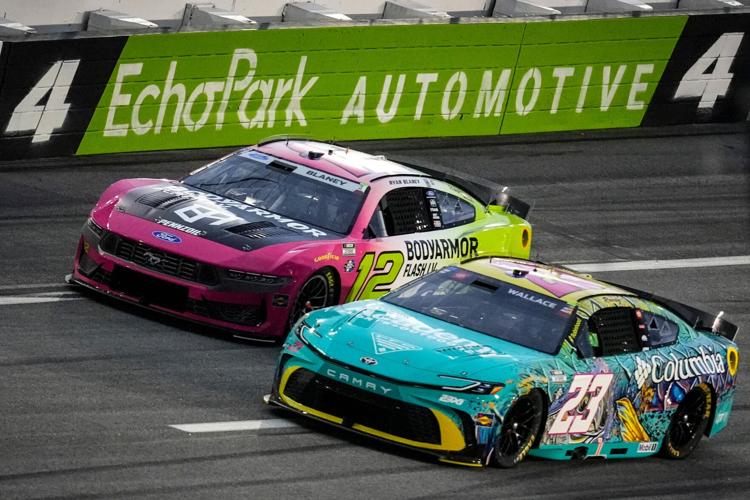
The Penalty That Reordered the Finish
The story didn't end at the checkered flag. NASCAR officials reviewed the closing sequence and ruled that Wallace had advanced his position by dipping below the yellow out-of-bounds line at the bottom of the racetrack during the three-wide battle — a rule NASCAR enforces strictly at its drafting-style tracks to prevent cars from using the apron as a passing lane. The penalty dropped Wallace from an apparent second-place finish all the way to 29th, erasing what would have been one of the best results of his season and reshuffling the entire finishing order behind Blaney and Hocevar.
The ruling reignited a long-running argument among drivers and fans about the yellow-line rule, which has decided finishes at Daytona and Talladega for two decades but feels newer — and rawer — at Atlanta since its reconfiguration. Supporters say it is the only way to keep cars from turning the apron into a fourth lane at 190 mph; critics say it punishes hard racing in a track design that all but invites it. Either way, it turned a thrilling finish into a controversial one, and it will not be the last time the debate surfaces this season.
"Past My Bedtime"
Blaney, for his part, treated the marathon night with the dry humor drivers tend to reach for after a long one. Asked about the race stretching toward 2 a.m., he simply said it was "past my bedtime," adding that he'd passed part of the three-hour delay the way most people would: he "took a nap and ate a little food." It was a fittingly low-key response to a night that had, by its final ten minutes, turned into one of the most replayed finishes of the NASCAR season.
What It Means for the Championship Picture
With the regular season now well past its midpoint, the win matters beyond bragging rights. Denny Hamlin continues to lead the regular-season standings, but his cushion is shrinking: he's up by 24 points over Tyler Reddick, 65 over Blaney, 126 over Ty Gibbs, and 181 over Chase Elliott, with six races remaining before the playoff field is set. Blaney's Atlanta win all but locks him into the postseason on points alone and hands him a playoff seeding boost that could matter enormously once the format resets for the Round of 16 — in NASCAR's playoff system, wins during the regular season translate directly into bonus championship points once the postseason begins.
For a driver who has spent recent seasons as a championship threat without always getting the credit, Monday's win is exactly the kind of statement victory — dominant most of the day, gritty at the very end — that playoff contenders lean on when the pressure ratchets up in the fall.
What This Means for Fans
Atlanta's transformation into a drafting track has been polarizing since NASCAR reconfigured it in 2022, but nights like this one are the argument in its favor: tight, unpredictable packs that turn ordinary late-race restarts into three-wide, white-knuckle finishes. If you tuned out when the rain delay hit mid-afternoon, you missed the best of it — a reminder that in modern NASCAR, especially at Atlanta, the smart move is to stay put no matter how long the delay runs, because the finish is where the race actually happens.
The Cup Series doesn't get much of a breather. With the regular season clock ticking down to six races and the playoff bubble tightening, every finish from here on carries a little more weight — and after Monday night, Ryan Blaney has made himself very hard to ignore.



