Design
Britain's most prestigious architecture prize turns 30 this year, and the six buildings competing for it read like a survey of everything the profession is currently wrestling with: how to build densely without building coldly, how to honor centuries-old institutions without freezing them in amber, and — again and again across this year's list — how to save a building rather than replace it. The Royal Institute of British Architects revealed its 2026 Stirling Prize shortlist earlier this month, drawn from the 32 winners of this year's RIBA National Awards, with the winner to be crowned at a ceremony at London's Old Billingsgate on October 15.
The Contenders
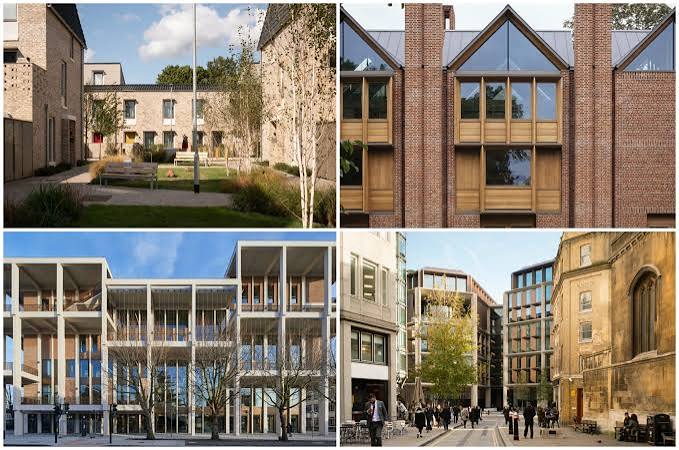
Two of the six finalists come from Cambridge, both wrestling with how to insert contemporary architecture into centuries-old academic institutions. Witherford Watson Mann Architects' River Wing at the Grade I-listed Clare College transforms a set of underused riverside spaces into what juries have praised as a warm, informal addition to one of the university's most historic sites — and, according to early betting from architecture-watchers, the current favorite to win. A short distance away, Haworth Tompkins' Pembroke, Mill Lane reworks a previously closed-off site within Cambridge's Historic Core Conservation Area, blending adaptive reuse of existing structures with new academic, residential and public space.
In London, Renzo Piano Building Workshop returns to the Stirling shortlist for the first time since The Shard narrowly missed out on the award in 2014, this time with Paddington Square — a striking 55-by-55-meter cube built above one of the city's busiest transport interchanges, wrapped in an exposed steel frame and glass curtain walls. It's the kind of civic-scale statement piece the prize has rewarded before, though this year it shares the shortlist with far smaller, quieter projects.

Renzo's Paino Cube
Croydon's Lion Green Road, by Mary Duggan Architects with RUFF Architects, takes on the housing question directly: five brick buildings arranged in a pinwheel layout, an attempt to bring density and material warmth to a typology too often reduced to one or the other. And on the edge of Epping Forest, Sergison Bates' Fairmead is the shortlist's lone single-family home — a brick house whose inclusion alongside a transit-hub megastructure and a university wing underscores just how broad "best building in Britain" can be interpreted.
The Retrofit Argument
The project generating the most conversation among architecture critics, however, is neither the largest nor the most photogenic. BEAM, led by Bennetts Associates, retains the structural bones of Hertford's 1970s theatre and wraps them in a striking new hexagonal brick form housing a cinema and events space. The project leans heavily on cross-laminated timber, runs on an all-electric energy supply, and — critically — keeps the original building standing rather than demolishing it for a clean-slate replacement.
That decision has turned BEAM into something of a stand-in for the industry's broader retrofit-versus-rebuild debate. As embodied-carbon concerns increasingly shape how juries evaluate "sustainable" architecture, a project's willingness to work with what already exists — rather than clear it and start over — has become its own kind of design statement, and BEAM's shortlisting is widely read as recognition of that shift.
A Prize Turning 30
This year's milestone anniversary adds extra weight to the selection. Since its 1996 launch, the Stirling Prize has served as the UK's most closely watched barometer of architectural taste, and past winners — from Zaha Hadid's Evelyn Grace Academy to more recent retrofit-forward victors — have tended to signal where the profession is heading next, not just what it has already accomplished. A jury statement accompanying the announcement framed this year's list as representative of architecture's shift "from monument to context," a nod to how many of this year's finalists prioritize fitting into an existing setting over dominating it.
The Piano project carries its own subplot in that history. When The Shard, his soaring glass pyramid over London Bridge station, was shortlisted in 2014, it lost out to Burntwood School — a result some critics read at the time as the jury signaling that scale and spectacle weren't, on their own, enough to win. Paddington Square's presence on this year's list, more contextual and horizontally scaled than the Shard's skyline-dominating verticality, suggests Piano's practice may have absorbed that lesson: this cube sits above a transit hub rather than looming over one.
What This Means for Design-Watchers
For anyone who follows architecture as a spectator sport, the 2026 shortlist doubles as a fairly reliable preview of where the field's energy is concentrated: adaptive reuse over demolition, dense housing that doesn't sacrifice material quality, and institutional buildings that treat their historic context as a design constraint worth honoring rather than working around. Early odds favor Clare College's River Wing, but juries have a habit of surprising bettors — BEAM, in particular, has the kind of underdog retrofit story that Stirling juries have rewarded before.
For now, the wider industry conversation is less about picking a favorite than about what the shortlist collectively argues: that the most interesting architecture being built in Britain right now is often the architecture willing to negotiate with what was already there, whether that's a 1970s theatre, a Grade I-listed college quad, or a patch of ancient forest. Judges will spend the coming months visiting each site before deliberating, with the winner revealed live on October 15 at Old Billingsgate, capping the prize's 30th anniversary year and, whichever project takes it, setting the tone for what British architecture chases next.
Published By | Features Editor