Written By | International News Desk
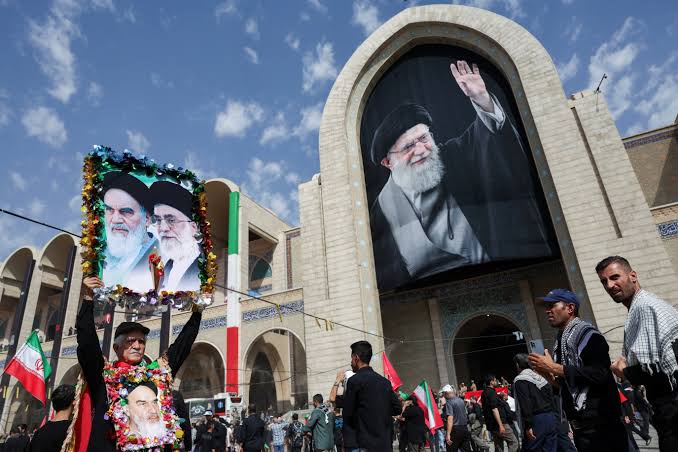
Khamenei, who succeeded Ayatollah Ruhollah Khomeini in 1989, was the longest-serving head of state in the Middle East and the central pillar of Iran’s clerical system
World Politics
Tehran is in the grip of one of the largest public mourning events in the Islamic Republic’s history. On July 4, Iran opened a six-day state funeral for Ayatollah Ali Khamenei, the supreme leader who ruled the country for more than three and a half decades before he was killed on February 28 in the strikes that opened the U.S.-Israeli war with Iran. The ceremonies, which run through July 9, have drawn hundreds of thousands of mourners to the Imam Khomeini Grand Mosalla and processions across the capital, with millions expected before the late leader is laid to rest. The spectacle is at once an act of grief, a demonstration of the system’s endurance, and a carefully choreographed political message — delivered while denuclearization talks between Washington and Tehran sit on a one-week pause agreed for the duration of the funeral.
Background
Khamenei, who succeeded Ayatollah Ruhollah Khomeini in 1989, was the longest-serving head of state in the Middle East and the central pillar of Iran’s clerical system. His death came on the first day of the war, when a U.S.-Israeli airstrike hit him directly — an attack that, according to reporting cited by international outlets, also killed the wife and mother of his son Mojtaba and left Mojtaba himself seriously wounded. The killing of a sitting supreme leader by foreign strikes was an unprecedented shock to the Islamic Republic, and the months of war that followed reshaped the region’s security landscape, closing and then reopening the Strait of Hormuz and drawing in proxies across the Middle East.
The system moved quickly to demonstrate continuity. On March 8, the Assembly of Experts elected Mojtaba Khamenei, 56, as the new supreme leader — a succession long speculated about but never confirmed while his father lived. Yet the new leader has not been seen in public since the war began. State media said he would not attend his own father’s funeral ceremonies, citing security concerns, and The New York Times reported that he was effectively barred from appearing over fears that Israel would attempt to assassinate him. His absence has become one of the defining images of the funeral: a succession proclaimed but not yet publicly embodied.
Key Developments
The funeral itself is an enormous logistical undertaking. The government has facilitated attendance by providing transportation, food, and lodging for mourners, and organizers have mapped processions across different districts of Tehran for each day of the ceremony, which runs from July 3–4 through July 9. Crowds dressed in black have beaten their chests and wept openly, and the ceremonies have been broadcast continuously on state television. Three of Khamenei’s sons joined the mass mourning in Tehran, underscoring the family’s central place in the ritual even as the son who now holds supreme power stayed away.
Alongside grief, the dominant theme has been revenge. Crowds have chanted “Our word is one! Revenge! Revenge!” and “We will kill, we will kill he who killed our Imam,” according to the Associated Press and other outlets reporting from Tehran. Al Jazeera described the commemoration as promoting a deliberate message of “continuity and revenge.” The Islamic Revolutionary Guard Corps has used the occasion to reassert its visibility: its commander-in-chief, Brigadier General Ahmad Vahidi, made his first public appearances in months at funeral events, telling state television that Iranians should grieve Khamenei so that “enemies will take their wish for our surrender to the grave.”
The path to the present negotiating table was anything but smooth. During the months of fighting, Tehran at one point threatened a “complete halt” to talks after trading strikes with the United States, even as a Washington official insisted negotiations would continue — an episode, reported by CBS News, that captured the pattern of the entire war: escalation and diplomacy running on parallel tracks, each used to pressure the other. The conflict closed the Strait of Hormuz to commercial traffic, drew Hezbollah into the confrontation, and prompted a U.S. naval blockade of Iranian ports before the sides edged toward a framework for ending the war. The UK House of Commons Library, in a research briefing on the ceasefire and nuclear talks, has traced how each pause in the fighting was converted, haltingly, into negotiating room.
The funeral also intersects directly with diplomacy. On June 17, President Donald Trump and Iranian President Masoud Pezeshkian remotely signed a fourteen-point memorandum of understanding to end the war — a framework agreement providing for an end to military strikes, the reopening of the Strait of Hormuz to commercial shipping toll-free for sixty days, an end to the U.S. naval blockade of Iranian ports, and a sixty-day extension of the ceasefire. Follow-on denuclearization talks were underway when Tehran requested, and Washington accepted, a one-week pause in negotiations so the funeral could proceed. Fox News and CBS News both reported that the talks are expected to resume after the ceremonies conclude.
Reactions
Inside Iran, the state has treated the funeral as a referendum on the system’s survival. The scale of mobilization — and the government’s heavy investment in enabling it — is intended to project popular legitimacy after a war that battered the country’s military command and exposed the depth of Israeli and American intelligence penetration. The revenge chants, amplified rather than discouraged by officials, signal to domestic hardliners that the leadership has not capitulated, even as it negotiates with the very governments it blames for Khamenei’s death.
The new supreme leader’s own position on diplomacy remains deliberately ambiguous. Mojtaba Khamenei has said publicly that he holds a “different view” from President Pezeshkian on the June memorandum, but that he endorsed Iran’s signing after receiving assurances that “the rights of the Iranian nation and the Resistance Front” would be protected in talks. That formulation allows him to keep distance from any concessions while permitting negotiations to continue — a hedge that mirrors his father’s decades-long balancing act between pragmatists and hardliners. In Washington, the administration has framed the pause as a gesture of respect that costs little, with officials indicating that the broader framework remains on track.
What’s Next
The immediate question is what happens on July 9, when the ceremonies end and the pause expires. Negotiators must convert the June framework into durable arrangements on Iran’s nuclear program, sanctions relief, and regional de-escalation — issues on which the memorandum is only a scaffold. The funeral’s rhetoric raises the political cost of visible compromise for Tehran’s negotiators, while the leadership’s decision to keep talking suggests the economic and military pressures that produced the ceasefire have not eased.
The memorandum’s own architecture builds in deadlines. Its sixty-day clocks — on toll-free passage through the Strait of Hormuz and on the ceasefire extension — mean that the weeks immediately after the funeral will be consumed by talks over what replaces those temporary arrangements. Mojtaba Khamenei’s reference to protecting “the Resistance Front” in negotiations suggests Tehran will fight to shield its regional allies from the deal’s terms, a point of predictable friction with Washington and Jerusalem. And the funeral’s vows of vengeance leave open the question of whether Iran’s security establishment intends retribution on its own timetable, regardless of what its diplomats sign.
The deeper uncertainty is the succession itself. A supreme leader who cannot appear in public — not even at his father’s funeral — poses a novel problem for a system whose authority has always rested partly on the leader’s visible presence. Whether Mojtaba Khamenei consolidates real control over the IRGC, the clerical establishment, and the negotiating file, or whether power diffuses toward the military and the presidency, will shape Iran’s trajectory long after the mourning tents come down. For now, Iran is staging unity in grief; the contest over what follows has barely begun.



