Written By | Peter Luzinda
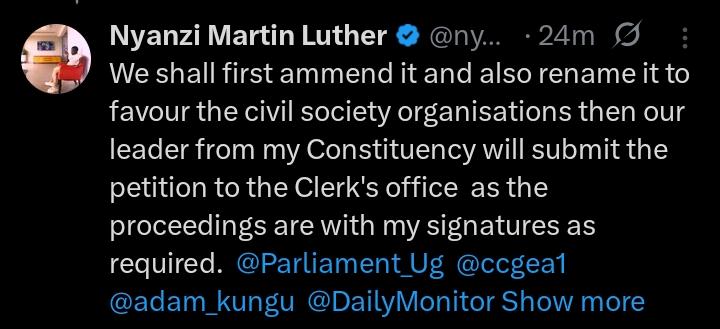
Nyanzi's tweet
KAMPALA
A controversial proposal seeking government financing for Uganda's non-governmental organisations is set for revision after its promoter, youth activist Nyanzi Martin Luther, acknowledged concerns raised by civil society actors and pledged to amend the draft before it reaches Parliament.
The announcement marks a significant shift for the young petitioner, whose proposal for a National NGO Fund has triggered debate over the relationship between government and civil society organisations.
Speaking through a social media statement, Nyanzi revealed that the draft bill would not proceed in its current form. Instead, he said changes would be made to address concerns raised by stakeholders, including a possible change of name for the proposed legislation.
"We shall first amend it and also rename it to favour civil society organisations," he said, adding that the petition would only be forwarded to Parliament after the review process is completed.
The proposal was conceived as a mechanism to provide financial support to community-based organisations and NGOs, many of which face recurring funding shortages as international donor priorities continue to evolve. According to supporters, a dedicated national fund could reduce dependence on foreign aid and provide a more predictable source of financing for grassroots initiatives.
However, the idea has been met with resistance from some civil society leaders who fear that state-backed funding could create unintended consequences for the sector. Critics have warned that financial dependence on government could weaken the ability of organisations to independently monitor public institutions, advocate for reforms, or hold leaders accountable.
The criticism intensified in recent weeks as details of the proposal circulated online, prompting discussions among activists, development practitioners, and governance experts.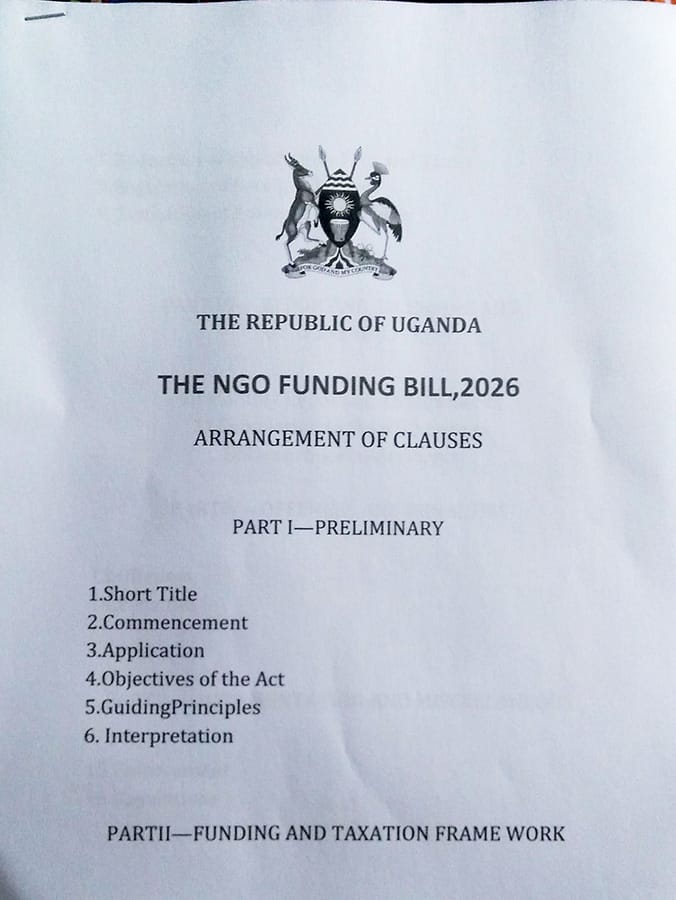
Nyanzi's decision to revisit the draft appears aimed at preventing those concerns from overshadowing the broader objective of improving financial sustainability for local organisations. However, he has not publicly disclosed which sections of the proposal are likely to be amended or whether consultations with civil society groups have formally begun.
The debate comes against the backdrop of longstanding concerns about NGO financing in Uganda. While many organisations provide essential services in health, education, humanitarian response, and civic engagement, a large percentage of their funding originates from foreign development partners.
Funding reductions by some international donors in recent years have reignited discussions about whether Uganda should develop alternative domestic financing mechanisms to support civil society work.
Governance analysts say the challenge lies in finding a balance between financial sustainability and institutional independence. While local funding could help organisations plan long-term programmes, any framework involving government resources would require safeguards to ensure that beneficiaries remain free from political influence.
For now, the proposal remains outside Parliament, with Nyanzi indicating that revisions will be completed before the petition is formally lodged with the Clerk to Parliament.
The next steps are likely to determine whether the initiative evolves into a broadly supported reform proposal or remains a subject of contention within the country's civil society landscape.
Either way, the debate has already placed questions of NGO financing, donor dependence, and civic independence firmly back on Uganda’s public agenda.
Torch Media Africa



