Background
On February 28, 2026, a joint American-Israeli air campaign opened what has become known as the 2026 Iran war, striking targets across the country in an operation aimed at Iran's nuclear and missile infrastructure. Among the strikes was one that killed Iran's longtime Supreme Leader, Ayatollah Ali Khamenei, along with his wife and other family members, at a location where he had reportedly been sheltering. The killing of the man who had ruled Iran since 1989 marked one of the most consequential single events of the conflict, instantly reordering the leadership of the Islamic Republic and setting off a scramble over succession that has still not fully resolved four months later.
Within roughly a week of his father's death, Iranian state media announced that Mojtaba Khamenei, the second of Ali Khamenei's sons, had been named the new Supreme Leader. Mojtaba, 56, is a hardline cleric long seen as close to the Islamic Revolutionary Guard Corps (IRGC) and to the security establishment that effectively runs much of Iran's domestic and foreign policy apparatus. His elevation broke with Iran's formal succession process, in which the Assembly of Experts is constitutionally supposed to select a new Supreme Leader, underscoring how much of the transition has been managed informally by security elites amid wartime conditions.
What has made Mojtaba's succession unusual is that he has not been seen or heard in public since the strike that killed his father. People close to his inner circle told Reuters that he suffered a significant facial disfigurement and a serious injury to one or both legs in the same attack. He has communicated only through written statements attributed to him and released via Iranian media, including at least one fiery message vowing vengeance against the United States and Israel. Israeli Defense Minister Israel Katz has said publicly that Mojtaba is "marked for death," and his personal security is now treated as one of the Iranian state's highest priorities.
Key Developments
A conditional ceasefire between Iran, the United States, and Israel has been in place since a 14-point memorandum of understanding was signed on June 17, setting out a 60-day framework for talks covering the Strait of Hormuz, Iran's nuclear and missile programs, and the lifting of sanctions. Negotiators, including U.S. envoys Steve Witkoff and Jared Kushner, met Iranian counterparts for two days of indirect talks in Doha in late June and early July, mediated by Qatar and Pakistan. Officials described "positive progress" but no resolution on Iran's central demands: the release of roughly $6 billion in frozen Iranian assets and a new legal and financial regime governing transit through the Strait of Hormuz, through which Iran wants to impose tolls on shipping. The U.S. has refused to release the frozen funds absent full Iranian compliance with the memorandum, and Oman has separately objected to any toll scheme. Talks paused entirely this week to allow for Khamenei's funeral, scheduled to run from July 4 through July 9.
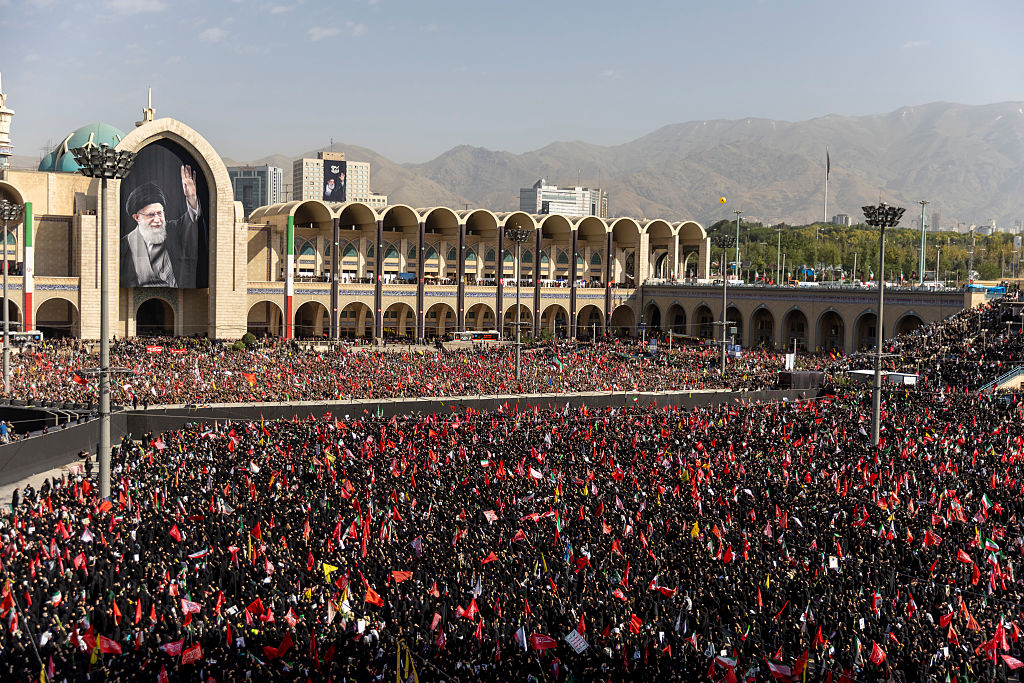
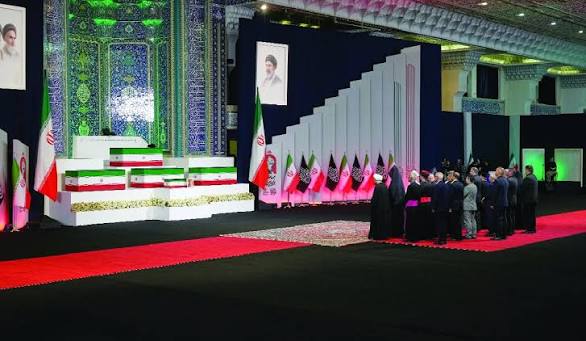
The funeral itself became a major public spectacle on July 6, when a procession carried Khamenei's coffin, along with the coffins of four family members killed alongside him, through central Tehran. State media showed enormous crowds turning out at dawn. Three of Khamenei's surviving sons appeared beside the coffins during prayers, but Mojtaba — the son who now formally holds his father's title — was again absent, a fact that has become a running storyline across Iranian and international coverage of the mourning period. Iranian television and officials have offered no public explanation for his absence beyond generalized security concerns.
Even as the funeral proceeded, the fragile ceasefire came under renewed strain. On July 7, Britain's maritime security agency reported that two commercial vessels were struck in the Strait of Hormuz: a liquefied natural gas tanker traveling near Limah, Oman, was hit on its port side by an unidentified projectile and caught fire while attempting to head south out of the strait, and a second vessel sustained structural damage without casualties. Iranian state television said the tanker had ignored warnings before being struck but stopped short of an official claim of responsibility. The Wall Street Journal, citing an unnamed U.S. official, reported that Iran's Revolutionary Guard Corps had fired on the two ships. Qatar's foreign ministry identified one of the vessels as the Qatari-flagged tanker Al Rekayyat and called the strike an "unacceptable attack" and a "serious and explicit violation" of international law, holding Iran "fully legally responsible."

Reactions
The scenes from Khamenei's funeral drew sharp reactions in Washington and beyond because of their explicitly anti-American character. Mourners in Tehran carried banners reading "kill Trump" and "kill Bibi" — a reference to Israeli Prime Minister Benjamin Netanyahu — and chanted vows of revenge. Crowds took part in a symbolic "stoning the devil" ritual, throwing pebbles at an image of President Trump, while a speaker addressing mourners before funeral prayers, identified as Mohammad Rasouli, asked the crowd, "Why shouldn't we kill the one who killed my Imam and my Leader?" to audible cheers from parts of the crowd.
President Trump, for his part, struck a defiant and mocking tone. He said the United States is "going to win one way or the other," and told reporters, "We gave him a week off for a funeral because we're nice," a reference to the pause in strikes and negotiations during the mourning period. He also revived earlier threats to strike Iranian power plants and bridges if Tehran does not fall in line with the terms of a peace agreement, signaling that Washington views the ceasefire as conditional and reversible rather than settled.
Assessments of Mojtaba Khamenei's actual authority diverge across outlets. Some Israeli sources cited by Fox News described him as effectively weak or not fully in control of the regime, suggesting his formal title masks a more collective, security-establishment-driven decision-making process. Other analysis, including from CNN, has floated the theory that Mojtaba's prolonged invisibility may actually be helping the regime project continuity and avoid a leadership vacuum that adversaries could exploit, since his absence has not yet triggered visible fracturing among competing power centers in Tehran. What is consistent across reporting is that ordinary Iranians, particularly in Tehran, say the new Supreme Leader's absence is unsettling and is feeding broader anxiety about the durability of the post-war order.
What's Next
The most immediate question is whether the July 7 Hormuz tanker attacks will derail the broader U.S.-Iran diplomatic track once the funeral period ends. The 60-day roadmap agreed in late June envisions technical talks continuing toward a final settlement on the frozen assets, the nuclear and missile files, and a durable arrangement for the strait, but repeated incidents at sea — this is not the first attack on shipping since the June 17 memorandum — illustrate how easily the ceasefire could unravel even as formal negotiations continue on parallel tracks.
Equally significant will be whether and how Mojtaba Khamenei eventually reappears in public. His continued absence functions as a kind of open question mark over Iran's chain of command: until he is seen or heard directly, outside observers and, reportedly, many Iranians themselves will continue to wonder how much authority he truly wields, and how stable the arrangement among IRGC commanders, clerical figures, and the Khamenei family really is. Israeli officials' explicit targeting rhetoric toward him adds a further layer of uncertainty, since any future strike targeting him could reopen the war outright.
In the coming days, attention will also turn to how the U.S. responds to the Hormuz attacks — whether Washington treats them as an isolated incident attributable to rogue IRGC elements, or as a deliberate signal from Tehran that will trigger the kind of retaliatory strikes on Iranian infrastructure that Trump has repeatedly threatened. With the frozen funds, the shape of a post-war security regime for the strait, and Iran's missile and nuclear programs all still unresolved, the interlocking crises of succession, negotiation, and maritime security are likely to remain the central storylines out of Iran for weeks to come.
Published By | News Editor