The Democratic Republic of the Congo has long been treated as an afterthought in conversations about Africa's technology boom, overshadowed by Nigeria's fintech scene, Kenya's mobile-money pioneering, and Rwanda's tidy digital-government showcases. That is starting to change. In 2026, the DRC is running one of the continent's more ambitious digital build-outs relative to its starting point: an €8 billion national digital and infrastructure plan, a blockchain-based national identity system, a newly licensed Starlink service, and a fast-growing cluster of fintech startups trying to serve a population where roughly 85% of people remain unbanked. The scale of the ambition is real. So is the scale of the gap it is trying to close in a country of more than 100 million people spread across a landmass the size of Western Europe.
A Mobile-Money Economy That Is Still Mostly Cash
Financial inclusion in the DRC remains thin by regional standards: around 85% of Congolese are unbanked, and most day-to-day transactions are still conducted in physical cash. But mobile money platforms and a growing roster of fintech startups — between 40 and 50 are currently operating in the country, spanning payments, remittances, digital banking, and financial infrastructure — are gradually chipping away at that reality. A significant marker of how fast the sector is evolving came in February 2026 at the Africa Fintech Summit, where Onafriq, the pan-African payments network whose APIs connect M-Pesa, Airtel Money, and Orange Money wallets across the DRC, announced it would plug into Conduit, a US cross-border payments platform, to on-ramp payments in USDC and manage its global treasury in stablecoins. Visa and M-Pesa have separately begun piloting stablecoin-settled cross-border mobile-money payments in the country, making the DRC one of the more advanced live tests anywhere in Africa for dollar-settled, blockchain-rail mobile money.
Mastercard, Flash, and the Push Toward Cards
Alongside mobile wallets, card-based payments are gaining ground through a strategic partnership between Mastercard and Flash, a DRC-based fintech that will begin issuing physical and virtual prepaid cards linked to its platform. Flash already serves more than three million customers through a network of roughly 4,000 agents and 160 agencies spanning both the Democratic Republic of Congo and the neighboring Republic of Congo, giving it one of the widest last-mile distribution networks of any Congolese fintech and making it a natural rail for card issuance in a market where formal banking penetration remains low.
The €8 Billion Digital DRC Plan
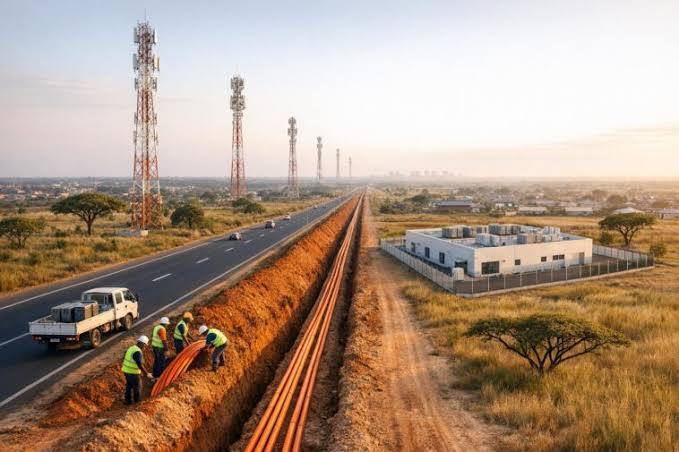
The centerpiece of the country's technology ambitions is a national digital and infrastructure plan worth roughly €8 billion (about $8.8 billion) running from 2026 to 2030, built around four pillars: broadband infrastructure and connectivity, digital public platforms, human capital development including AI skills, and cybersecurity. Concrete near-term milestones include a National Interbank Payments Platform that the government has targeted for launch by March 2026, intended to enable seamless transactions between banks and mobile money providers for the first time, and continued build-out of a planned 55,000-kilometer national fiber backbone, of which roughly 12,000 kilometers has been laid to date. A new submarine cable with 192 terabits per second of capacity is also planned to expand international bandwidth and underpin the government's push toward advanced data centers and digital public services — a considerable capacity upgrade for a country that has historically relied on comparatively thin, expensive international links routed through neighboring states.
DRC Pass: A Blockchain Bet on Digital Identity
In June 2025, the Congolese government finalized a partnership with Singapore-based Trident Digital Tech Holdings to roll out "DRC Pass," a blockchain-based national digital identity system. The design combines blockchain, biometrics, artificial intelligence, and zero-knowledge proofs to create identity records that are intended to be tamper-resistant, decentralized in storage, and unalterable once issued — an approach officials frame explicitly around strengthening data sovereignty as much as improving service delivery. If it scales as planned, DRC Pass would give the government a foundational layer for digital public services, from banking access to social programs, in a country where a large share of the population currently lacks any verifiable formal identity document.

Starlink Arrives, Chasing a Large Connectivity Gap
Satellite internet has also entered the picture. SpaceX's Starlink officially launched commercial service in the DRC after the Congolese Postal and Telecommunications Regulatory Authority (ARPTC) granted an operating license, reversing an earlier restriction. Congolese consumers can now buy a standard Starlink kit for roughly 1,130,000 Congolese francs (about $389) plus a monthly subscription of CDF144,000 (around $50) — a meaningful cost for most households, but a potentially transformative option for rural areas, mining towns, and businesses beyond the reach of terrestrial fiber. Starlink's entry is widely framed in the local tech press as targeting a roughly 70% connectivity gap nationally. That framing underscores how much work remains on terrestrial infrastructure too: the first phase of the National Backbone linking the port city of Matadi to Kinshasa, a roughly 650-kilometer stretch, has been built but is still not fully operational, illustrating the gap between announced infrastructure and infrastructure actually in service.
A Young, Still-Underfunded Startup Ecosystem
The DRC's homegrown tech ecosystem centers on Kinshasa, where Ingenious City — an incubation platform launched through a partnership between local investor Sycomore Ventures and the UK-backed ELAN RDC program — brings together roughly forty startups and about fifty mentors under one roof in the city's Procoki concession area, alongside several individual incubators. Government policy has moved to support the sector on paper: a national Startup Act, promulgated in 2022 with support from the Netherlands, established FOGEC, a guarantee fund designed to help Congolese entrepreneurs access loans that would otherwise be out of reach given thin local credit markets. Continent-wide, African venture capital funding stabilized and grew in 2025 compared with the two prior years, with fintech — stablecoins in particular — moving from experimental status to mainstream infrastructure across African markets. The DRC has captured only a small share of that recovery so far, but the combination of a large, underbanked population, new payment rails, and an active identity and infrastructure buildout gives local founders a broader platform to build on than existed even two years ago.
Risks and Outlook
None of this erases the DRC's underlying constraints: chronic underinvestment in terrestrial infrastructure, an economy that remains overwhelmingly cash-based, financing execution risk on an €8 billion plan in a country with a track record of slow project delivery, and ongoing conflict in the mineral-rich east that continues to disrupt connectivity, commerce, and investment sentiment in affected provinces. But the direction of travel in 2026 is unusually concrete for the DRC: a funded national plan with named pillars and deadlines, a blockchain-based identity system already under contract, a licensed satellite-internet entrant, and international payment networks piloting stablecoin rails inside the country rather than merely discussing them. Whether the National Interbank Payments Platform actually launches on schedule in March 2026, and whether the promised 55,000 kilometers of fiber gets built rather than merely announced, will be the clearest tests of whether this digital leap becomes durable infrastructure or another partially realized plan in a country that has seen several.
Published By | Features Editor