Written By | Our Reporter
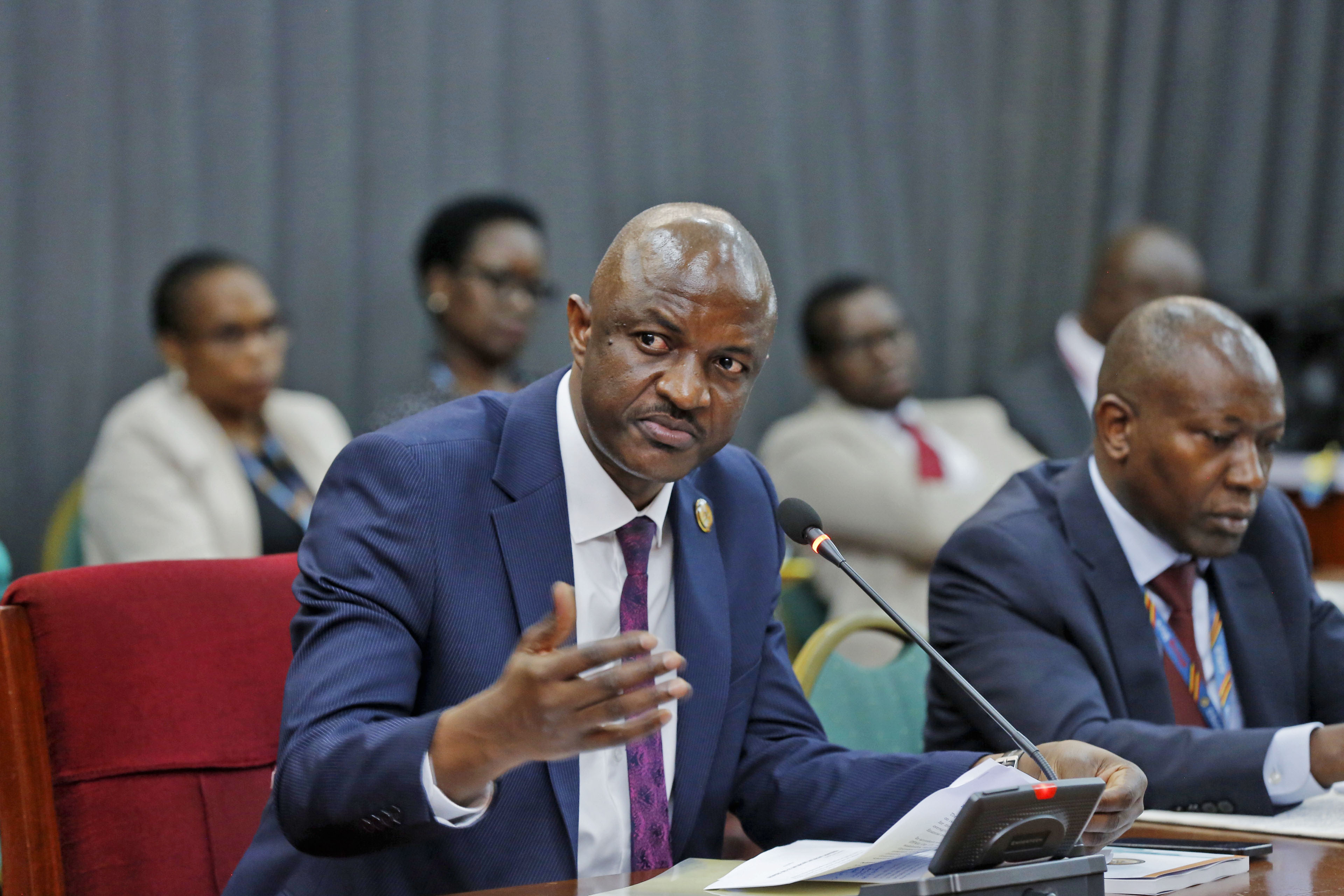
Ramathan Ggoobi
Parliament
The Secretary to the Treasury, Ramathan Ggoobi, has directed all Accounting Officers in Ministries, Departments and Agencies (MDAs) not to sign contracts or Memoranda of Understanding (MOUs) with development partners on governance-related projects without prior authorisation from Cabinet.
The directive is contained in the Second Budget Call Circular on the finalisation of Ministerial Policy Statements and detailed estimates of revenue and expenditure for FY2026/27, dated February 13, 2026. Ggoobi noted that the instruction is in line with Cabinet Minute 164 (CT 2025).
“As you finalise your budgets for FY2026/27, you are directed not to enter into agreements or Memoranda of Understanding with Development Partners on governance issues without prior clearance from Cabinet. Any financing proposals from Development Partners on governance issues shall be subjected to a consultative process with stakeholders, including this Ministry, the Ministry of Justice and Constitutional Affairs, the Ministry of Foreign Affairs, and the Ministry of Internal Affairs. Strict adherence is required, and any deviations will be considered a breach of Cabinet directive,” Ggoobi wrote.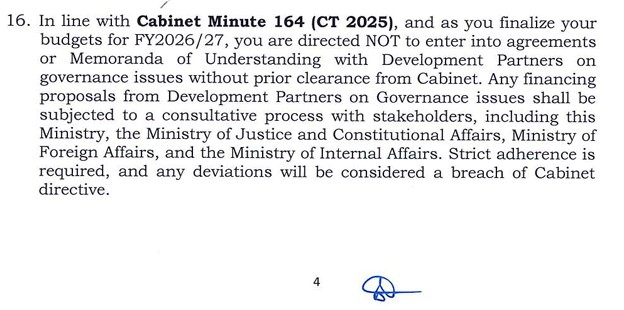
Ggoobi noted that the instruction is in line with Cabinet Minute 164 (CT 2025)
Budget Increased to UGX78.249 Trillion
The Ministry of Finance also revised the FY2026/27 national budget, with the resource envelope now projected at UGX78.249 trillion—an increase of UGX8.85 trillion from the UGX69.399 trillion initially communicated in the First Budget Call Circular.
“In line with the above adjustments, all Accounting Officers are requested to revise their budget estimates as per the current Indicative Planning Figures (IPFs). These are hard ceilings with no post-submission negotiations. You are required to exercise allocation efficiency to achieve maximum impact through efficient and strategic allocation of resources,” Ggoobi stated.
UGX3.788 Trillion Injected into PDM
Ggoobi further revealed that since July 1, 2021, government has invested UGX3.788 trillion in the Parish Development Model (PDM), capitalising 10,589 eligible PDM SACCOs. He said the programme has now entered the Sustainability and Acceleration Phase, to be implemented on a village-by-village basis.
Accordingly, all Local Government Accounting Officers have been instructed to fully budget for activities under this phase through the Extension, Production and Marketing Grants.
“Since 1st July 2021, Government has capitalised 10,589 eligible PDM SACCOs to a tune of UGX3.788 trillion and is now in the Sustainability and Acceleration Phase, to be undertaken on a village-by-village basis. Accordingly, all Local Government Accounting Officers should fully budget for all activities under this phase of the PDM,” Ggoobi said.
He added that activities related to the compilation of the SPEAR report and development of Parish Action Plans should be funded through the Discretionary Development Equalisation Grant (DDEG).
ICT Purchases Now Subject to Clearance
In a further directive, Ggoobi instructed all Accounting Officers to seek authorisation from the Ministry of ICT and National Guidance before procuring any ICT-related goods and services.
He said the move is aimed at ensuring efficient digital governance and eliminating duplication in public digital infrastructure, following the establishment of the Governmental Digital Registry (GDR), which profiles and maintains an inventory of government digital assets.
“This registry enables real-time visibility of existing digital systems across Government and identifies areas of potential duplication or inefficiency. Accordingly, all MDAs and LGs are required to seek and obtain clearance and approval from the Ministry of ICT and National Guidance prior to including any budget provisions for new digital systems, ICT infrastructure upgrades, software applications, or digital transformation initiatives in their annual budget submissions,” he said.
New Budget Discipline Measures
The Ministry of Finance also signalled that the FY2026/27 budget will prioritise enforcement of execution discipline, with plans to reward or sanction Accounting Officers based on fiscal performance and compliance.
Among the reforms is the introduction of an Accounting Officers’ Budget Discipline Charter for managing public funds.
The charter will require fiscal discipline, strict adherence to approved work plans, timely budget submissions, and robust internal controls. It also emphasises personal accountability of Accounting Officers to Parliament for proper utilisation of public funds, with penalties for non-compliance, including failure to implement recommendations of the Auditor General or mismanagement of funds.
The measures signal a tightening of fiscal controls as government seeks to enhance efficiency, accountability and productivity in public expenditure.



