Los Angeles
For nearly a decade, the Lucas Museum of Narrative Art has existed mostly as a rendering — a hovering, curvilinear structure that critics variously described as a spaceship, a wave, or a cloud, depending on the light and their mood. This week, that rendering finally acquired a firm date. Museum officials announced that the $1 billion institution, co-founded by Star Wars creator George Lucas and his wife, the financier Mellody Hobson, will open to the public on September 22, 2026, in Los Angeles's Exposition Park, ending one of the more protracted sagas in recent American museum-building.
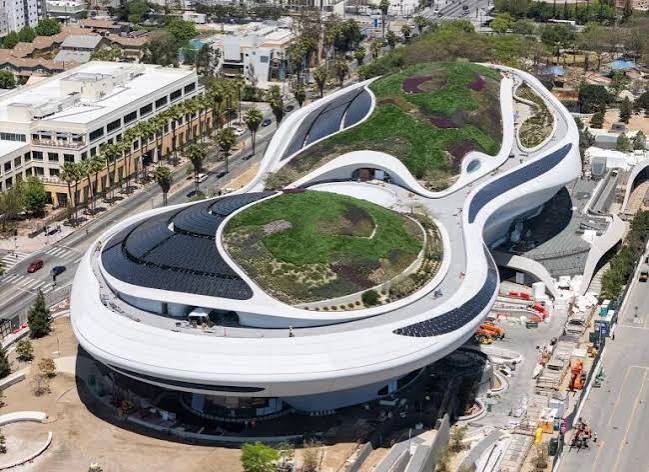
The announcement lands with the particular satisfaction of a long-delayed sequel finally hitting theaters. Construction broke ground in 2018 with an original target opening of 2021; five years of delays later, the museum's undulating, elevated form is complete, its 300,000 square feet of gallery, theater, and public space ready to be filled.
A Building That Doesn't Look Like a Museum
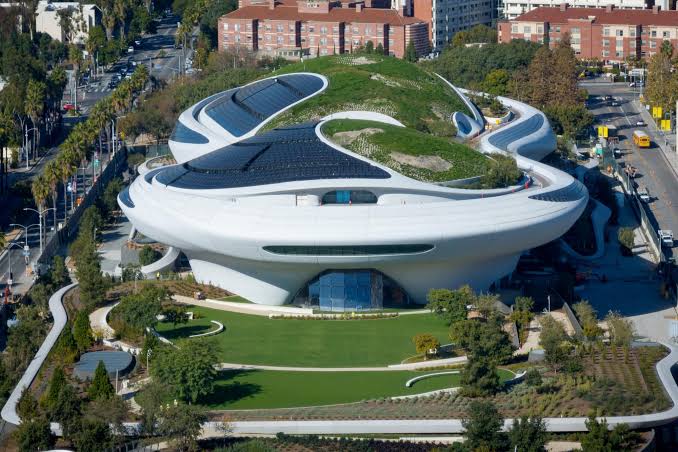
The design, led by Ma Yansong, founder of the Beijing-based firm MAD Architects, alongside landscape architect Mia Lehrer of Studio-MLA, continues MAD's long-running fascination with sculptural, organic forms that resist the boxy rationalism of most institutional architecture. The Lucas Museum's defining gesture is an elevated volume that spans much of its eleven-acre site, floating above ground level and creating broad, shaded public space beneath it — a design move that doubles as climate strategy in a city where shade is increasingly treated as civic infrastructure rather than an afterthought. Seen from a distance, the building rises out of its surrounding parkland like something that landed rather than something that was built, a resemblance to MAD's other spaceship-esque projects that has followed the firm throughout its career and that the practice has never seemed particularly eager to discourage.
Inside, the museum will house 35 galleries spread across 100,000 square feet, along with two theaters, a research library, community program space, a restaurant, a café, and a retail store — the full apparatus of a major cultural institution built, notably, around a curatorial premise that barely existed as a formal museum category before this project: narrative art.
What, Exactly, Is Narrative Art?
The museum's founding thesis, per its organizers, is that visual storytelling deserves the same institutional weight traditionally reserved for painting and sculpture — meaning its collection spans illustration, comic art, animation, photography, and film alongside more conventional fine art, unified not by medium but by an interest in how images are used to tell stories and connect people across cultures and eras. It's a curatorial bet that reflects Lucas's own career as much as any personal collecting habit: a filmmaker whose entire body of work sits at the intersection of populist storytelling and technical craft, building an institution designed to argue that the images popular culture produces are as worthy of serious study as anything hanging in a traditional fine-art museum.
That framing has made the museum something of a bellwether for a broader argument playing out across the museum world about what belongs in a permanent collection — and Los Angeles, a city whose primary export is narrative media, is arguably the only place in the country where that argument could be staged this literally.
Architecturally, the wager is just as pointed. Ma Yansong has spoken previously about wanting MAD's buildings to feel less like static containers for art and more like landscapes people move through, and the Lucas Museum pushes that idea to an institutional scale rarely attempted in American museum-building, where cautious, boxy expansions remain the norm. Pairing that ambition with Lehrer's landscape design, which threads new green space through the eleven-acre site, effectively turns the museum's grounds into an extension of the exhibits themselves — parkland doing curatorial work.

The Long Road to Exposition Park
It's easy to forget, watching the finished renderings, just how contested this project's path to Los Angeles actually was. Lucas originally pursued sites in Chicago and San Francisco before settling on Los Angeles's Exposition Park — already home to the California Science Center, the Natural History Museum of Los Angeles County, and the Coliseum — as the museum's permanent location. Construction delays through the early 2020s pushed the opening back repeatedly, turning what was meant to be a mid-2020s cultural landmark into a running punchline about optimistic museum timelines. This week's confirmed date effectively closes that chapter, replacing years of construction photographs with an actual calendar entry.
What This Means for You
For Los Angeles, the opening adds a genuine architectural landmark to a stretch of Exposition Park that was already one of the city's densest cultural corridors, and gives the city another reason for out-of-town visitors to build a museum weekend around, alongside the Getty and LACMA. For design and pop-culture enthusiasts further afield, the September 22 opening is worth calendaring regardless of geography — early reporting suggests the museum's opening exhibitions will draw from Lucas's own extensive personal collection of illustration and film art, material that has never been shown publicly at this scale.
Eight years, one pandemic, and several revised opening dates after it broke ground, the Lucas Museum of Narrative Art is, at last, a building rather than a promise — and a fairly audacious one at that, betting that a city built on telling stories deserves a museum shaped like it's still telling one.
The Lucas Museum of Narrative Art explores how stories connect people and capture the human experience. — Lucas Museum of Narrative Art, mission statement
Published By | Features Editor